



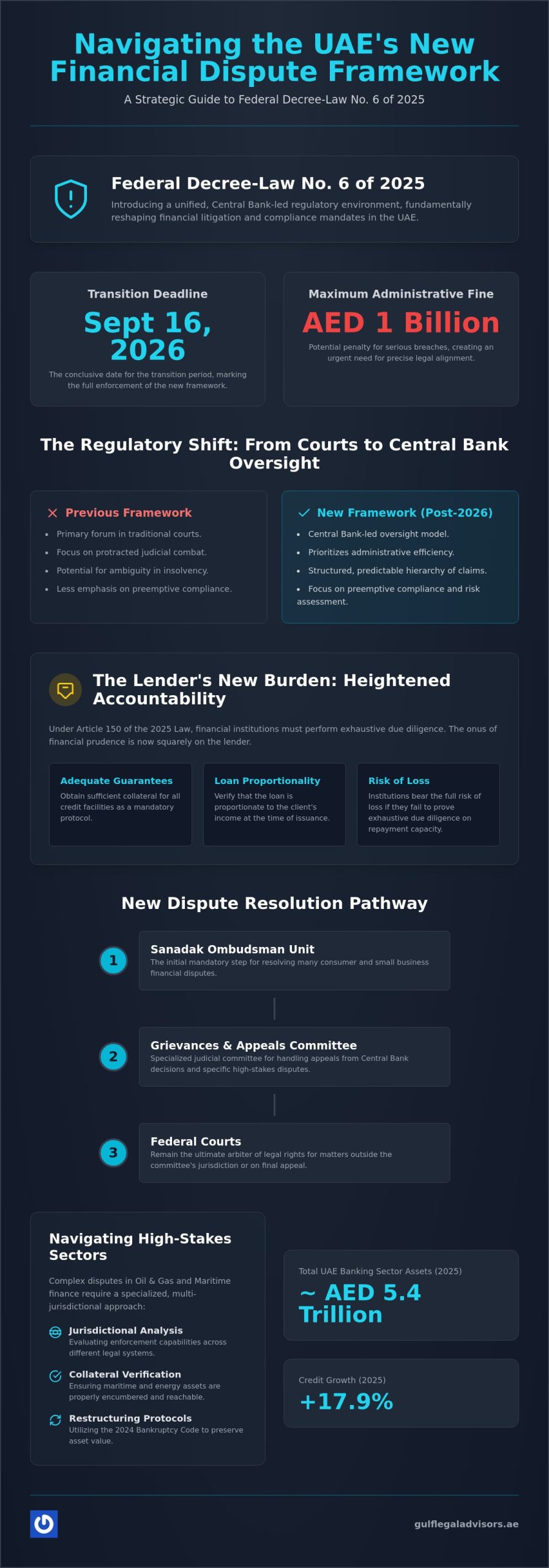
The transition period for Federal Decree-Law No. 6 of 2025 concludes on September 16, 2026, marking a definitive shift toward a unified, Central Bank-led regulatory environment. For high-stakes decision-makers, the prospect of administrative fines reaching AED 1 billion for serious breaches creates an urgent need for precise legal alignment. You’ve likely felt the weight of this new legislative framework as it replaces long-standing precedents and introduces specialized judicial committees. Mastering banking and finance dispute resolution UAE now requires a sophisticated understanding of both the Sanadak Ombudsman Unit and the modernized Civil Transactions Law effective June 1, 2026.
This overview offers a comprehensive analysis of the evolving landscape to help you secure your institutional interests and maintain regulatory adherence. We’ll detail the specific functions of the Grievances and Appeals Committee, provide a strategic framework for loan recovery under the 2024 Financial Restructuring and Bankruptcy Code, and explain how to protect assets during complex liquidations. By the end of this guide, you’ll possess the specialized knowledge necessary to manage multi-jurisdictional enforcement with confidence.
Key Takeaways
- Analysis of the unified regulatory framework established by Federal Decree-Law No. 6 of 2025 and its immediate impact on institutional compliance mandates.
- Clarity on the procedural hierarchy of banking and finance dispute resolution UAE, specifically regarding the strategic function of the Grievances and Appeals Committee.
- Identification of critical legal risks and administrative penalties associated with unlicensed financial activities under the 2026 regulatory regime.
- Strategic methodologies for navigating complex disputes within capital markets and structured finance arrangements to mitigate litigation exposure.
- Understanding the integration of technical legal expertise and sector-specific insight for the management of multi-jurisdictional financial advocacy.
The Evolving Landscape of Banking and Finance Dispute Resolution
Modern banking and finance dispute resolution UAE is no longer defined solely by courtroom advocacy. It’s now a multifaceted regulatory discipline. The enactment of Federal Decree-Law No. 6 of 2025 has transitioned the primary forum for conflict from traditional litigation to a sophisticated, Central Bank-led oversight model. This shift prioritizes administrative efficiency and systemic stability over protracted judicial combat. While the Judicial system of the United Arab Emirates remains the ultimate arbiter of legal rights, the preliminary regulatory layers now dictate the strategic trajectory of most financial claims.
Licensed financial institutions face a heightened burden of proof under the 2026 regime. They must demonstrate rigorous adherence to transparency and risk assessment protocols before pursuing recovery actions. This increased accountability serves a dual purpose. It protects the consumer base while reinforcing the UAE’s reputation as a secure global financial hub. With total banking sector assets reaching approximately AED 5.4 trillion in 2025, maintaining institutional integrity is a matter of national economic priority. The focus has moved toward preemptive compliance to avoid the administrative fines that now characterize the regulatory landscape.
The Interplay of Regulatory Duty and Consumer Protection
Article 150 of the 2025 Law mandates that banks obtain adequate guarantees or collateral for all credit facilities. Recovery success now hinges on whether the institution verified that the loan was proportionate to the client’s income at the time of issuance. The new standard for natural person credit safeguards dictates that institutions bear the risk of loss if they fail to perform exhaustive due diligence on a borrower’s repayment capacity. This shift places the onus of financial prudence squarely on the lender. It ensures that credit growth, which saw a 17.9% increase in 2025, remains sustainable and grounded in verifiable data. Institutions seeking to align their credit facilities with these heightened standards should consider a thorough loan agreement legal review UAE to identify vulnerabilities in existing documentation before disputes arise.
Addressing High-Stakes Sector Volatility
Volatility in the Oil & Gas and Maritime finance sectors has introduced complex multi-jurisdictional challenges. Large-scale defaults in these capital-intensive industries require a specialized approach to commercial dispute resolution to manage the interests of diverse stakeholders. Institutions financing energy projects should also consider engaging upstream oil and gas legal advisory UAE counsel to address the sector-specific regulatory complexities that directly affect collateral valuation and recovery strategies. Effectively mitigating risks in cross-border financial transactions requires:
- Jurisdictional Analysis: Evaluating the enforcement capabilities across different legal systems.
- Collateral Verification: Ensuring that maritime and energy assets are properly encumbered and reachable.
- Restructuring Protocols: Utilizing the 2024 Financial Restructuring and Bankruptcy Code to preserve asset value.
Strategic banking and finance dispute resolution UAE in these sectors demands a deep integration of technical legal knowledge and practical industry insight. It’s about securing outcomes that respect the gravity of the investment while navigating the intricacies of the new federal framework.
The Impact of Federal Decree-Law No. 6 of 2025 on Financial Litigation
Federal Decree-Law No. 6 of 2025 establishes a rigorous framework for institutional resolution and liquidation that moves beyond mere supervision. It defines the statutory order of debt payments with absolute clarity, ensuring that during an institutional failure, the hierarchy of claims is predictable. This structured approach fundamentally alters the strategy for banking and finance dispute resolution UAE. Secured creditors must now navigate a system that prioritizes Central Bank administrative costs and priority depositor claims before other obligations. Such transparency provides a level of security for international investors, as it removes the ambiguity that historically plagued insolvency proceedings in emerging markets.
The jurisdictional complexity is further defined by the interaction between federal law and the DIFC Courts. While the 2025 Law provides the onshore foundation, the common-law framework of the DIFC remains essential for resolving high-value international financial disputes. Understanding how these two systems complement each other is vital for any entity involved in multi-jurisdictional litigation. It’s this dual-system approach that solidifies the UAE’s position as a global commercial hub, offering diverse avenues for legal recourse depending on the nature of the financial instrument involved.
Administrative Penalties and Corporate Liability
The criminalization of unlicensed financial activities represents a significant escalation in regulatory enforcement. For entities engaging in the promotion of unauthorized services, the law mandates a minimum fine of AED 1 million. Those identified as perpetrators of unlicensed finance face staggering penalties of up to AED 500 million. These aren’t merely administrative hurdles; they’re existential risks for any corporate entity. For leaders, the strategic risk is clear: any lapse in licensing can lead to immediate asset freezes and severe reputational damage. Developing a robust internal compliance framework is the primary defense against triggers that could lead to severe criminal and civil liability.
Digital Tender and Modern Financial Disputes
Article 54 of the 2025 Law introduces a transformative element by recognizing the Central Bank-issued digital currency as legal tender. This recognition shifts the paradigm for debt settlement and contract fulfillment. In court-ordered liquidations, the valuation of digital assets presents unique challenges. Traditional appraisal methods often fail to account for the specific liquidity profiles and volatility of digital tender. Future-proofing financial contracts now requires precise language regarding the acceptance and valuation of the Digital Dirham to prevent future litigation. As the UAE moves toward a more digitized economy, the ability to resolve disputes involving these assets will define the next era of banking and finance dispute resolution UAE.
If you’re managing complex institutional portfolios, reviewing your commercial dispute resolution strategies can help mitigate these emerging regulatory and digital risks.
Procedural Pathways: Grievances, Committees, and Federal Courts
The hierarchy of banking and finance dispute resolution UAE follows a methodical progression designed to filter claims before they reach the federal judiciary. The process initiates with an internal bank complaint, which must be exhausted before escalating to Sanadak, the independent ombudsman unit. Following the official UAE financial complaint process ensures that administrative remedies are properly pursued, a prerequisite for any subsequent litigation. If a resolution isn’t reached at the ombudsman level, the matter may proceed to specialized judicial committees or the federal courts, depending on the claim’s value and nature. For claims under AED 100,000, specialized judicial committees now provide final and enforceable decisions, significantly reducing the burden on the broader court system.
Strategic litigation under the 2025 Law requires strict adherence to procedural timelines. Decisions issued by the Central Bank or lower judicial bodies are subject to a critical 20-working-day window for challenges before the Federal Supreme Court. Missing this deadline often results in the forfeiture of appeal rights, cementing the initial decision as final and enforceable. This accelerated timeframe reflects the UAE’s commitment to swift judicial outcomes, minimizing the period of financial uncertainty for both institutions and investors. It’s a system that rewards proactive legal management and punishes procedural delay.
Enforcement of arbitral awards within the updated federal judicial framework has become more streamlined. The UAE’s alignment with international best practices ensures that both local and international awards are recognized with minimal judicial interference. This predictability is essential for multi-jurisdictional conglomerates that require certainty in the execution of financial judgments. The courts now focus on the validity of the arbitration agreement rather than the merits of the underlying dispute, facilitating a more efficient recovery process for creditors.
The Grievances and Appeals Committee Mechanism
The Grievances and Appeals Committee serves as a specialized forum for challenging Central Bank administrative decisions, including licensing denials and the imposition of fines. Success here depends on the presentation of forensic evidence and a clear demonstration of regulatory compliance or procedural error. The Committee possesses the authority to stay the execution of administrative penalties while an appeal is pending, providing a vital safeguard for institutional liquidity. Decisions rendered by the Committee are final and binding unless a party initiates a challenge before the Federal Supreme Court within the prescribed statutory timeframe.
Alternative Dispute Resolution (ADR) in Banking
Mediation has emerged as a highly effective tool for resolving complex structured finance disagreements where preserving commercial relationships is a priority. Strategic selection of UAE-based arbitration institutions provides a confidential environment for resolving high-value disputes without the public exposure of a courtroom trial. Balancing this confidentiality with the need for enforceable federal judgments is a core component of modern banking and finance dispute resolution UAE. Parties often utilize hybrid clauses that combine mediation for initial stages with arbitration or court intervention as a final recourse, ensuring a flexible yet certain resolution path.
Capital Markets and Structured Finance Dispute Management
The sophistication of the UAE financial markets requires a level of legal scrutiny that matches the complexity of modern capital market instruments. Managing disputes within the issuance and trading sectors demands a deep understanding of both federal regulations and the specific mechanics of the instruments involved. In 2026, the integration of these niche disputes into the broader framework of banking and finance dispute resolution UAE has become a necessity for institutional investors. This alignment ensures that market volatility doesn’t translate into systemic legal failure or loss of investor confidence. It’s about creating a predictable environment for the circulation of capital.
Regulatory compliance serves as the bedrock of market integrity. When liquidity events occur or investment fund structures face pressure, the clarity of the underlying legal review determines the outcome of potential litigation. Preemptive analysis of structured finance arrangements allows entities to identify vulnerabilities in loan participation or securitization agreements before a default occurs. This proactive approach is essential for maintaining stability in a fast-paced commercial environment where timing is often the deciding factor in asset recovery.
Dispute Resolution in Capital Markets
Claims regarding misrepresentation in public offerings or private placements often hinge on the accuracy of disclosure documents. In 2026, the role of AI governance has become a focal point, especially concerning automated trading and market manipulation disputes. Legal teams must now account for algorithmic transparency when defending or pursuing claims. For entities seeking capital markets legal advisory UAE, the focus is on mitigating these technological risks through robust governance protocols that withstand judicial scrutiny. Protecting the reputation of the issuer is just as important as the financial outcome.
Structured Finance and Liquidity Risks
Defaults in complex securitization agreements require a methodical deconstruction of the asset-backed structure. Litigating these matters often involves multi-layered participation agreements where the rights of various creditors must be balanced against the available collateral. Structural stability in joint venture financing is equally critical. Any ambiguity in the original contract can lead to protracted litigation during a liquidity crunch. Performing rigorous due diligence during the transfer of structured assets is the most effective way to prevent future disputes, and conducting a comprehensive loan agreement legal review UAE ensures that every credit facility within the structure meets the 2026 Central Bank compliance standards. It’s a matter of ensuring that every layer of the transaction is legally sound and enforceable.
If your organization requires assistance with high-stakes financial litigation or complex asset recovery, our team at Gulf Legal Advisors provides specialized Banking, Finance & Capital Markets expertise to protect your interests in this evolving landscape. Institutional investors managing fund structures across multiple jurisdictions should also consider engaging investment fund legal advisory UAE counsel to address the specific compliance demands introduced by the January 2026 regulatory updates.
Strategic Advocacy: The Gulf Legal Advisors Approach
Effective banking and finance dispute resolution UAE requires more than just courtroom presence; it demands a preemptive posture. At Gulf Legal Advisors, our approach integrates technical legal knowledge with sector-specific strategic insight to provide a grounded, reassuring presence for high-stakes decision-makers. We recognize that the 2026 regulatory environment, characterized by the stringent oversight of Federal Decree-Law No. 6 of 2025, leaves no room for procedural ambiguity. Our methodology prioritizes the deconstruction of complex regulatory requirements to ensure that every institutional action aligns with the highest standards of governance. This focus on serious reliability allows our clients to move through complex systems with clarity and security.
Our firm’s methodology for handling multi-jurisdictional financial litigation is built on a foundation of intellectual depth and practical focus. We navigate the interplay between federal statutes and international enforcement protocols with methodical precision. Proactive risk mitigation is achieved through sophisticated regulatory compliance audits designed to identify vulnerabilities before they trigger administrative penalties. In an era where fines can reach AED 1 billion, these audits are not merely a precaution; they are a strategic necessity. We serve as a sophisticated navigator for entities that require both the intellectual depth to handle intricate matters and the practical focus to deliver results.
Expert Representation in Federal Jurisdictions
Navigating the Federal Supreme Court requires authoritative legal counsel capable of maintaining unwavering professionalism in high-pressure environments. Our team provides the specialized representation necessary to challenge or defend Central Bank decisions with confidence. The value of our strategic partnerships becomes evident in complex Corporate & Mergers & Acquisitions and financial restructuring matters. We ensure that every litigation strategy respects the gravity of legal tradition while remaining fully engaged with current regulatory shifts. This balanced perspective is essential for securing favorable outcomes in the UAE’s dual legal landscape.
Future-Focused Legal Excellence
Adapting to technological shifts is a core component of our service delivery. As the financial sector integrates automated trading and digital tender, our Compliance & AI Governance expertise provides the necessary safeguards against emerging risks. We ensure corporate integrity through rigorous Anti-Money Laundering (AML) protocols and technology compliance frameworks. This future-focused mindset allows us to protect institutional assets during the most volatile market cycles. Gulf Legal Advisors remains committed to providing the specialized knowledge required to speak the language of international business, finance, and judicial bodies. Our role is to provide the stable, expert guidance needed to resolve the most intricate banking and finance dispute resolution UAE matters with professional polish and purpose-driven execution.
Securing Institutional Interests in the 2026 Regulatory Landscape
The transition to a unified regulatory framework under Federal Decree-Law No. 6 of 2025 represents a definitive era of institutional accountability. Success in this environment requires more than traditional litigation; it demands a strategic alignment with the Central Bank’s administrative protocols and the specialized judicial committees now governing the sector. By prioritizing preemptive compliance and technical due diligence, organizations can navigate the complexities of digital tender and structured finance without compromising operational stability.
Gulf Legal Advisors provides the intellectual depth and practical focus necessary to manage high-stakes banking and finance dispute resolution UAE. Our firm offers deep-rooted expertise in Federal Decree-Law No. 6 of 2025, specialized counsel for Capital Markets and Structured Finance, and strategic representation before the Grievances and Appeals Committee. It’s our priority to ensure that your institutional interests remain protected within this sophisticated judicial landscape. Consult with our strategic advisors on UAE banking and finance disputes to secure a path toward regulatory adherence and strategic resolution.
Frequently Asked Questions
What is the impact of Federal Decree-Law No. 6 of 2025 on existing banking disputes?
The transitional period for Federal Decree-Law No. 6 of 2025 concludes on September 16, 2026, requiring all active financial institutions to align their dispute resolution protocols with new Central Bank mandates. Existing disputes initiated before the law’s full implementation may still be subject to the previous 2018 framework. However, new procedural requirements for grievances and appeals committees will likely govern any subsequent challenges or enforcement actions undertaken after the transition date.
How does the Grievances and Appeals Committee differ from traditional UAE courts?
The Grievances and Appeals Committee serves as a specialized administrative body rather than a general judicial forum. It focuses specifically on challenging Central Bank decisions and resolving financial claims with a streamlined procedural approach. Unlike traditional courts, the Committee has the technical expertise to stay administrative penalties while an appeal is pending. Decisions are final and enforceable, though they remain subject to challenge before the Federal Supreme Court under specific conditions.
Can Central Bank digital currencies be used to settle legal debt obligations in the UAE?
Article 54 of Federal Decree-Law No. 6 of 2025 recognizes the Central Bank-issued digital currency as legal tender for settling debt obligations. This status ensures that the Digital Dirham can be utilized in court-ordered liquidations and standard commercial settlements. Integrating this digital tender into banking and finance dispute resolution UAE strategies requires precise contractual language to manage valuation and liquidity risks during the transition to a fully digitized economy.
What are the penalties for unlicensed financial activities under the 2026 framework?
The 2026 framework imposes severe administrative fines to deter unlicensed financial conduct. Institutions found in serious breach of licensing requirements face penalties of up to AED 1 billion, while authorized individuals may be fined up to AED 5 million. Specific penalties for the promotion of unlicensed activities start at a minimum of AED 1 million. Perpetrators of unlicensed finance can face fines reaching AED 500 million alongside potential criminal prosecution.
How long do I have to appeal a decision of the Grievances and Appeals Committee?
Parties have a critical 20-working-day window to challenge a decision issued by the Grievances and Appeals Committee before the Federal Supreme Court. This timeframe is strictly enforced, and failure to initiate the appeal within this period results in the decision becoming final and binding. Proactive legal management is essential to ensure all forensic evidence and procedural arguments are prepared well in advance of this statutory deadline.
Is arbitration a viable alternative for structured finance disputes in the UAE?
Arbitration remains a highly viable and often preferred alternative for resolving structured finance disputes due to the confidentiality and technical expertise it offers. UAE-based institutions provide a stable framework for handling complex, multi-layered financial instruments. This approach allows parties to avoid public litigation while ensuring that the resulting awards are enforceable through the federal judicial system under the 2026 regulatory regime.
What consumer protections exist for loan recovery claims against natural persons?
Consumer protections are significantly enhanced under Article 150, which mandates that institutions obtain adequate guarantees based on a borrower’s verified repayment capacity. If a lender fails to perform this due diligence, it may face restrictions on its ability to recover the debt. Additionally, the Sanadak Ombudsman Unit provides a free venue for natural persons to resolve complaints before they escalate to more formal banking and finance dispute resolution UAE pathways.
How do financial experts support the court in complex banking litigation?
Courts frequently appoint specialized financial experts to conduct forensic analysis of complex transactions, interest rate calculations, and collateral valuations. These experts provide impartial technical reports that clarify intricate matters for the judge, often serving as the primary evidence in structured finance disputes. Their findings help the court navigate technical nuances, ensuring that judgments are grounded in both legal principle and accounting accuracy. Energy sector lenders and creditors with exposure to extraction projects may also benefit from dedicated upstream oil and gas legal advisory UAE expertise to accurately assess the specialized collateral and concession structures involved in such disputes.