

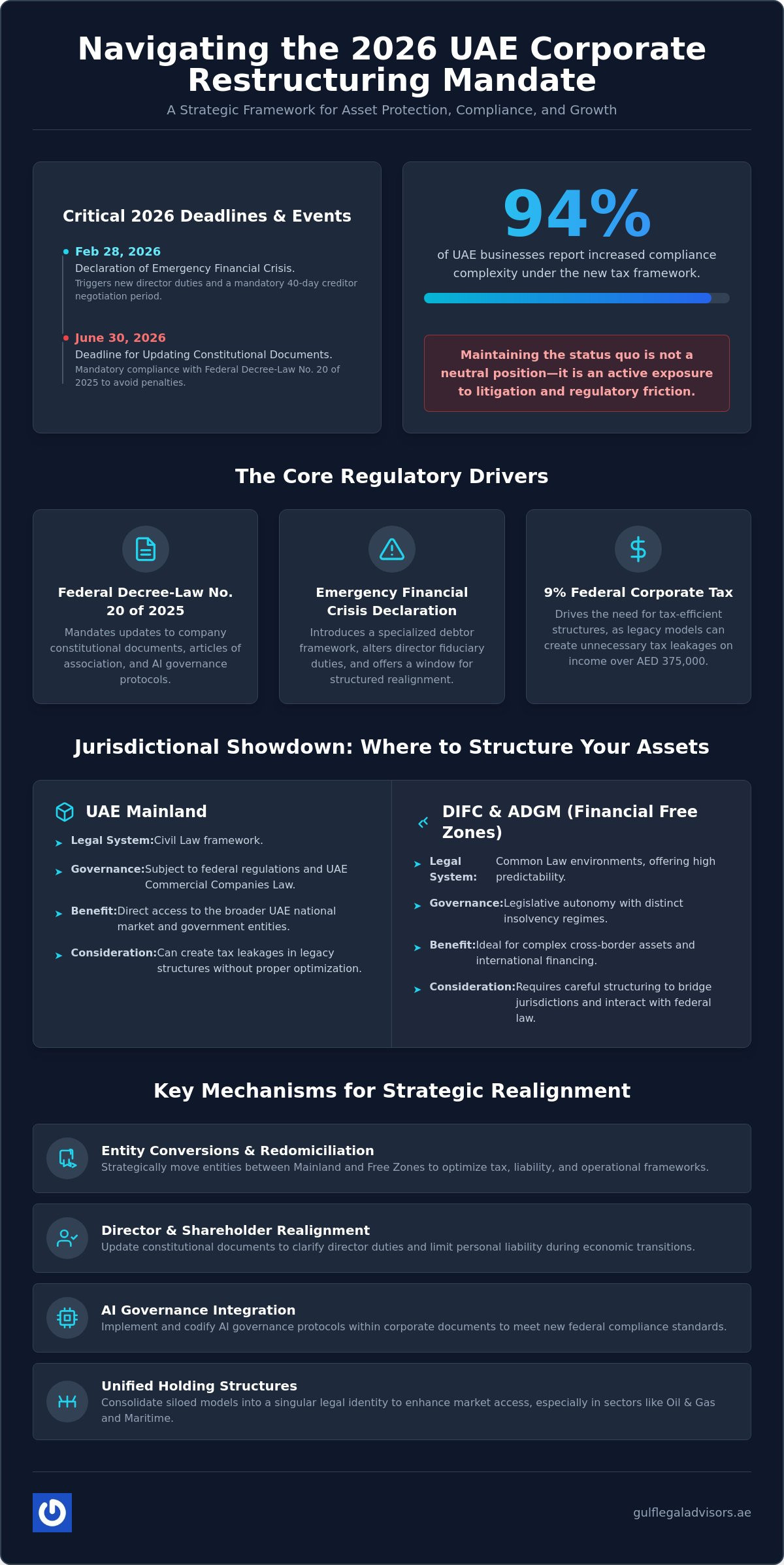
The June 30, 2026, deadline for updating constitutional documents represents more than a mere administrative requirement; it’s a definitive mandate for corporate survival. With 94% of businesses reporting increased complexity since the introduction of the current tax framework, the need for specialized corporate restructuring legal advisory UAE has never been more urgent. You likely recognize that the declaration of the Emergency Financial Crisis on February 28, 2026, has fundamentally altered the risk profile for directors and shareholders alike. Maintaining the status quo is no longer a neutral position; it’s an active exposure to litigation and regulatory friction.
This analysis provides an authoritative framework to secure your assets and align your operations with Federal Decree-Law No. 20 of 2025. We’ll examine the strategic application of redomiciliation between mainland and free zones, the implementation of AI governance mandates, and the protection of multi-jurisdictional holding structures. By prioritizing legal stability and tax efficiency, you can transform these regulatory pressures into a robust foundation for long-term growth and minimized liability.
Key Takeaways
- Assess the legal implications of the 2026 Emergency Financial Crisis declaration on director fiduciary duties and mandatory creditor negotiation periods.
- Compare the restructuring and insolvency frameworks of UAE Mainland, DIFC, and ADGM to identify the optimal jurisdiction for asset protection.
- Utilize specialized corporate restructuring legal advisory UAE to facilitate seamless entity conversions and balance sheet optimization through debt-to-equity swaps.
- Ensure full alignment with Federal Decree-Law No. 20 of 2025 by updating constitutional documents and AI governance protocols before the June 30, 2026, deadline.
- Implement a phased execution strategy for multi-jurisdictional realignment to mitigate litigation exposure during complex structural transitions.
The Strategic Imperative of Corporate Restructuring in the UAE (2026)
In the current fiscal environment, Corporate Restructuring has evolved from a remedy for insolvency into a high-level strategic instrument for operational excellence. Within the UAE, this process involves the fundamental realignment of a company’s legal, ownership, and operational frameworks to better suit a changing regulatory climate. The 2026 landscape is defined by a shift toward institutional maturity. While legacy models often relied on informal arrangements, the current era demands technical precision. Expert corporate restructuring legal advisory UAE is now essential for entities seeking to reconcile their historical structures with the rigorous demands of the federal tax regime and new corporate governance standards.
The Cabinet Decision No. 94/2026, which declared an Emergency Financial Crisis period effective from February 28, 2026, introduced a specialized framework for debtors. This declaration isn’t merely a signal of market volatility; it’s a legal trigger that alters director duties and mandates a 40-day creditor negotiation period. For high-stakes decision-makers, this period offers a window for structured realignment, provided the transition is managed with accuracy to avoid litigation exposure. Restructuring is no longer a reactive measure for distressed assets; it’s a proactive mechanism for tax optimization and future-proofing against shifting federal mandates.
Drivers of Structural Evolution in the Current Market
The transition from administrative preference to strategic necessity is driven by the 9% federal corporate tax on income exceeding AED 375,000. Research indicates that 94% of UAE businesses have reported increased compliance complexity since these tax laws took effect. Many firms find that legacy “Mainland-only” models create unnecessary tax leakages. Structural realignment allows for the optimization of tax groups and the utilization of domestic minimum top-up tax provisions. Additionally, the updated UAE Commercial Companies Law places a heightened burden of care on directors. Restructuring serves as a protective shield, clarifying roles and limiting personal liability during periods of economic transition.
Restructuring as a Catalyst for National Market Access
Unified holding structures are replacing the inefficient, siloed models of the past. This consolidation is vital in sectors like Oil & Gas and Maritime, where complex multi-jurisdictional matters require a singular, robust legal identity. The June 30, 2026, deadline for updating constitutional documents to comply with Federal Decree-Law No. 20 of 2025 acts as a critical trigger. Companies that fail to adapt their articles of association risk administrative penalties and restricted access to federal courts. Strategic corporate restructuring legal advisory UAE ensures these updates aren’t just compliant but are leveraged to enhance competitive positioning within the national market.
Navigating Multi-Jurisdictional Frameworks: Mainland vs. Financial Centres
Strategic jurisdictional arbitrage has become a cornerstone of modern corporate realignment. Choosing between the UAE Mainland and the financial free zones is no longer a matter of simple logistics; it’s a decision that dictates which judicial philosophy will govern your assets. Effective corporate restructuring legal advisory UAE must account for the distinct insolvency regimes and legislative autonomy of each zone. While the Mainland operates under a civil law framework, the Dubai International Financial Centre (DIFC) and Abu Dhabi Global Market (ADGM) provide common law environments. This distinction is critical when managing cross-border assets or complex debt realignments that require high levels of predictability.
The interplay between federal regulations and financial centre autonomy has matured significantly. The establishment of a specialized bankruptcy and restructuring court reflects the nation’s commitment to providing a sophisticated judicial infrastructure for commercial entities. For directors, this means that the choice of jurisdiction directly impacts their exposure to litigation during structural transitions. Developing a structure that bridges these jurisdictions requires a partner who understands the friction points between federal law and free zone autonomy. You might benefit from reviewing how our corporate restructuring legal advisory UAE addresses these multi-layered complexities.
The Strategic Role of ADGM and DIFC in Holding Structures
Financial centres serve as ideal environments for ring-fencing liabilities and protecting intellectual property. By utilizing Special Purpose Vehicles (SPVs) within the ADGM or DIFC, groups can isolate high-risk operational activities from core assets. These jurisdictions offer robust regimes for sector-specific acquisitions, particularly in the Oil & Gas and Maritime industries. The primary advantage remains the reliance on common law courts, which offer a familiar framework for international investors and a structured approach to complex commercial dispute resolution.
Mainland Realignment for National Operational Continuity
Mainland structures remain indispensable for entities requiring direct access to national government contracts and the broader domestic market. In 2026, navigating the requirements for national ownership and local partnership demands technical precision to ensure compliance without sacrificing operational control. Federal realignment allows companies to streamline licensing across multiple emirates, reducing administrative redundancy. This process involves converting fragmented local entities into a unified mainland structure, ensuring that constitutional documents are fully optimized for the federal tax regime while maintaining the agility needed for national expansion.
Legal Mechanisms for Operational and Financial Realignment
Realignment of a corporate group’s architecture requires more than a change in jurisdiction; it demands the precise application of statutory mechanisms to ensure balance sheet stability. Under the amended Commercial Companies Law, the legal process for mergers, demergers, and entity conversions has been significantly streamlined. These mechanisms allow for the consolidation of fragmented subsidiaries into a lean, tax-efficient hierarchy. For many organizations, seeking corporate restructuring legal advisory UAE is the first step in identifying which mechanism, be it a statutory merger or a complex redomiciliation, best serves the long-term governance objective.
Debt-to-equity swaps have emerged as a vital tool for balance sheet optimization, particularly for entities navigating the 2026 Emergency Financial Crisis. By converting liabilities into equity, companies can preserve cash flow while strengthening their capital structure. This process requires careful management of minority shareholder rights to prevent dilution-related litigation. Protecting these interests isn’t just a matter of regulatory compliance; it’s about maintaining the integrity of the corporate governance framework during aggressive realignment phases. Professional corporate restructuring legal advisory UAE ensures that these swaps are executed with technical precision, balancing the needs of creditors with the rights of existing shareholders.
M&A as a Catalyst for Structural Transformation
Integrating acquisition targets into a unified corporate hierarchy often serves as the primary driver for structural change. In high-stakes sectors like Oil & Gas and Maritime, the transfer of infrastructure assets involves complex regulatory approvals and technical due diligence. Engaged M&A legal advisors UAE ensure that these transitions are not only legally sound but also optimized for the current federal tax environment. This involves a rigorous assessment of distressed assets to mitigate successor liability and ensure a seamless operational handover during the restructuring process.
Debt Management and Creditor Resolution Strategies
Navigating the UAE Insolvency Law requires a focus on preventive composition and reorganization to maintain business continuity. The 40-day mandatory negotiation period established by Cabinet Decision No. 94/2026 provides a structured window for out-of-court workouts. Formalizing these agreements prevents the escalation of financial distress into court-supervised insolvency. When negotiations reach an impasse, strategic representation in commercial dispute resolution Dubai becomes essential to protect the interests of directors and shareholders. A structured approach to debt realignment supports the broader strategic framework while minimizing operational disruption.
Mitigating Risk: Compliance, Governance, and AI Integration
A successful realignment extends beyond the physical or jurisdictional relocation of assets. It requires the deep integration of compliance and governance protocols into the new corporate fabric. In 2026, the complexity of corporate restructuring legal advisory UAE is magnified by the intersection of traditional AML requirements and emerging technological mandates. Failure to synchronize these elements during a transition creates significant exposure to regulatory sanctions and reputational damage. A robust governance framework acts as a signal of institutional stability, providing lenders and international stakeholders with the confidence required to support high-stakes structural changes.
Legal risks associated with non-compliance have intensified following the 2026 technology mandates. Entities that neglect to update their internal bylaws to reflect new federal standards face administrative penalties and potential restrictions on their operational licenses. Maintaining a grounded, compliant structure is the only viable path for entities operating within the UAE’s sophisticated commercial ecosystem. Prioritizing these elements during the restructuring phase ensures that the resulting entity is not only leaner but also more resilient to future regulatory shifts.
AI Governance and Regulatory Adherence
The integration of artificial intelligence into core operations necessitates a corresponding evolution in the corporate constitutional framework. Under the current technology mandates, boards are now legally responsible for algorithmic accountability and data sovereignty. Restructuring provides a unique opportunity to establish specialized technology holding companies that ring-fence digital assets while ensuring compliance with the UAE AI Law. This involves drafting specific board-level oversight protocols that address the risks of automated decision-making. Professional corporate restructuring legal advisory UAE ensures that these digital safeguards are embedded within the articles of association, protecting the entity from the legal risks of algorithmic bias or data mismanagement.
AML Integrity and Corporate Transparency
Structural transitions often obscure ownership lines, making Ultimate Beneficial Ownership (UBO) transparency a critical focus for regulators. Maintaining AML integrity during a merger or demerger requires a rigorous internal audit process to map every tier of the new organization. Aligning these internal controls with international standards is essential for attracting foreign direct investment, which reached $45.6 billion in 2025. By prioritizing transparency, companies mitigate the risk of being flagged during post-restructuring reviews. If your organization requires a comprehensive audit of its current risk profile, our specialists in Compliance & AI Governance can provide the necessary oversight to secure your operations.
Executing the Restructuring: A Strategic Advisory Approach
Execution of a corporate realignment in the UAE requires a methodical, phased approach that prioritizes legal continuity over administrative speed. Restructuring is not a singular event or a mere filing; it’s a strategic journey that begins with a diagnostic phase and concludes with post-closing governance integration. High-stakes negotiations during this process demand a level of unwavering professionalism that balances the competing interests of multi-jurisdictional stakeholders. Whether managing international creditors or local regulatory bodies, the role of corporate restructuring legal advisory UAE is to provide a steady, authoritative hand that ensures the transition remains within the bounds of federal law.
Managing the expectations of shareholders and lenders across different legal systems requires intellectual depth and a focus on practical results. A phased framework allows for the identification of potential litigation exposure before it manifests into a commercial dispute. By coordinating with tax specialists and governance experts, legal counsel can ensure that the new structure is fully optimized for the 2026 regulatory environment. This methodical pace reflects the gravity of the subject matter, ensuring that the final corporate architecture is both robust and compliant. Utilizing specialized corporate restructuring legal services UAE provides the technical precision necessary for these high-stakes transitions.
Sector-Specific Considerations: Oil, Gas, and Maritime
Restructuring within the energy and maritime sectors involves unique regulatory nuances that standard corporate models often overlook. For upstream oil and gas entities, asset transfers must account for complex concession agreements and national security requirements. In the maritime sector, structural protections are required to manage admiralty liabilities and the complexities of multi-flag vessel registrations. High-value construction and real estate projects also require specific continuity clauses to prevent a structural change from triggering default provisions in financing agreements. Addressing these sector-specific needs ensures that the realignment supports operational stability rather than disrupting it.
Securing the Future with Gulf Legal Advisors
The value of a quiet, confident advisory presence cannot be overstated in complex environments where the stakes involve national-level assets and multi-billion dirham liabilities. Gulf Legal Advisors presents itself as a sophisticated navigator of these systems, possessing the deep-rooted expertise required for national success. As a leading legal consultancy firm Dubai, we provide the intellectual depth to handle intricate matters while delivering the practical focus decision-makers require. We invite you to contact our specialists to initiate a comprehensive structural audit, ensuring your organization is prepared for the 2026 landscape through expert corporate restructuring legal advisory UAE.
Securing Institutional Stability in a Changing Regulatory Landscape
The 2026 regulatory shift demands more than compliance; it requires a fundamental commitment to institutional maturity. Navigating the Emergency Financial Crisis declaration and the June 30 deadline for constitutional updates is a critical priority for directors. Success depends on the precise alignment of multi-jurisdictional holding structures with federal tax and AI governance mandates. It’s no longer sufficient to maintain legacy models; you must proactively realign to protect assets and mitigate litigation exposure.
Maintaining a robust corporate structure in this environment requires specialized expertise in high-stakes sectors like Maritime and Energy. Gulf Legal Advisors offers a proactive approach to the 2026 landscape, leveraging an authoritative presence in both UAE Federal Courts and International Arbitration Centers. Our specialists provide the intellectual depth needed to secure your assets while ensuring full adherence to algorithmic accountability standards. Consult with our strategic advisors for comprehensive corporate restructuring legal advisory UAE. We look forward to securing your firm’s future with the precision and professionalism your stakeholders expect.
Frequently Asked Questions
What is the impact of the 2026 Emergency Financial Crisis declaration on UAE businesses?
The declaration introduces a more flexible restructuring framework for debtors, specifically mandating a 40 day negotiation period with creditors under Cabinet Decision No. 94/2026. During this period, creditor initiated bankruptcy applications are postponed, allowing companies a window to stabilize operations. This shift requires directors to prioritize structured realignment over informal debt management to avoid personal liability during the crisis window.
How does the 9% federal corporate tax influence the choice between Mainland and Free Zone structures?
The 9% federal corporate tax has prompted a definitive shift toward multi jurisdictional holding structures to optimize tax groups and utilize domestic minimum top up tax provisions. While Free Zones offer specific incentives, Mainland entities remain essential for direct access to national contracts. Strategic corporate restructuring legal advisory UAE helps entities determine the optimal balance between these jurisdictions to minimize tax leakage while maintaining market access.
What are the key differences between restructuring in the DIFC versus the UAE Mainland?
Restructuring in the DIFC occurs under a common law framework, providing a high degree of predictability for international creditors and cross border asset protection. In contrast, the UAE Mainland operates under a civil law system, utilizing the specialized federal bankruptcy and restructuring courts. The choice depends on whether the entity requires the judicial precedents of a common law environment or the operational directness of a Mainland license.
Is corporate restructuring mandatory for all UAE companies by June 30, 2026?
Full corporate restructuring isn’t mandatory for every entity, but all companies must update their constitutional documents by June 30, 2026, to comply with Federal Decree Law No. 20 of 2025. Failure to meet this deadline results in administrative penalties and potential judicial friction. Many organizations use this compliance trigger as an opportunity for broader structural realignment to enhance tax efficiency and governance standards.
How can AI governance be integrated into an existing corporate structure?
Integration involves establishing board level oversight for algorithmic accountability and embedding data sovereignty requirements into the company’s articles of association. Entities often create specialized technology holding companies to ring fence AI assets. This structural approach ensures that the use of automated decision making systems remains compliant with the UAE AI Law, protecting the board from legal risks associated with algorithmic bias or data mismanagement.
What legal protections are available for directors during a financial restructuring?
Directors are protected during restructuring through the formalization of preventive composition and reorganization plans under the UAE Insolvency Law. These court supervised or out of court frameworks limit personal liability by providing a transparent, legally sanctioned path for debt resolution. Expert corporate restructuring legal advisory UAE is essential to ensure that all actions taken during the realignment phase satisfy the heightened fiduciary duties established under current federal standards.
Can a company restructure while involved in active commercial litigation or arbitration?
A company can proceed with restructuring during active litigation, though it requires precise coordination to ensure that the realignment doesn’t prejudice the rights of litigants or violate court orders. Legal counsel must manage the transfer of assets or liabilities to prevent claims of fraudulent conveyance. Maintaining transparency with judicial bodies and arbitration centers is vital to ensure that the structural transition remains legally robust and doesn’t disrupt ongoing proceedings.