



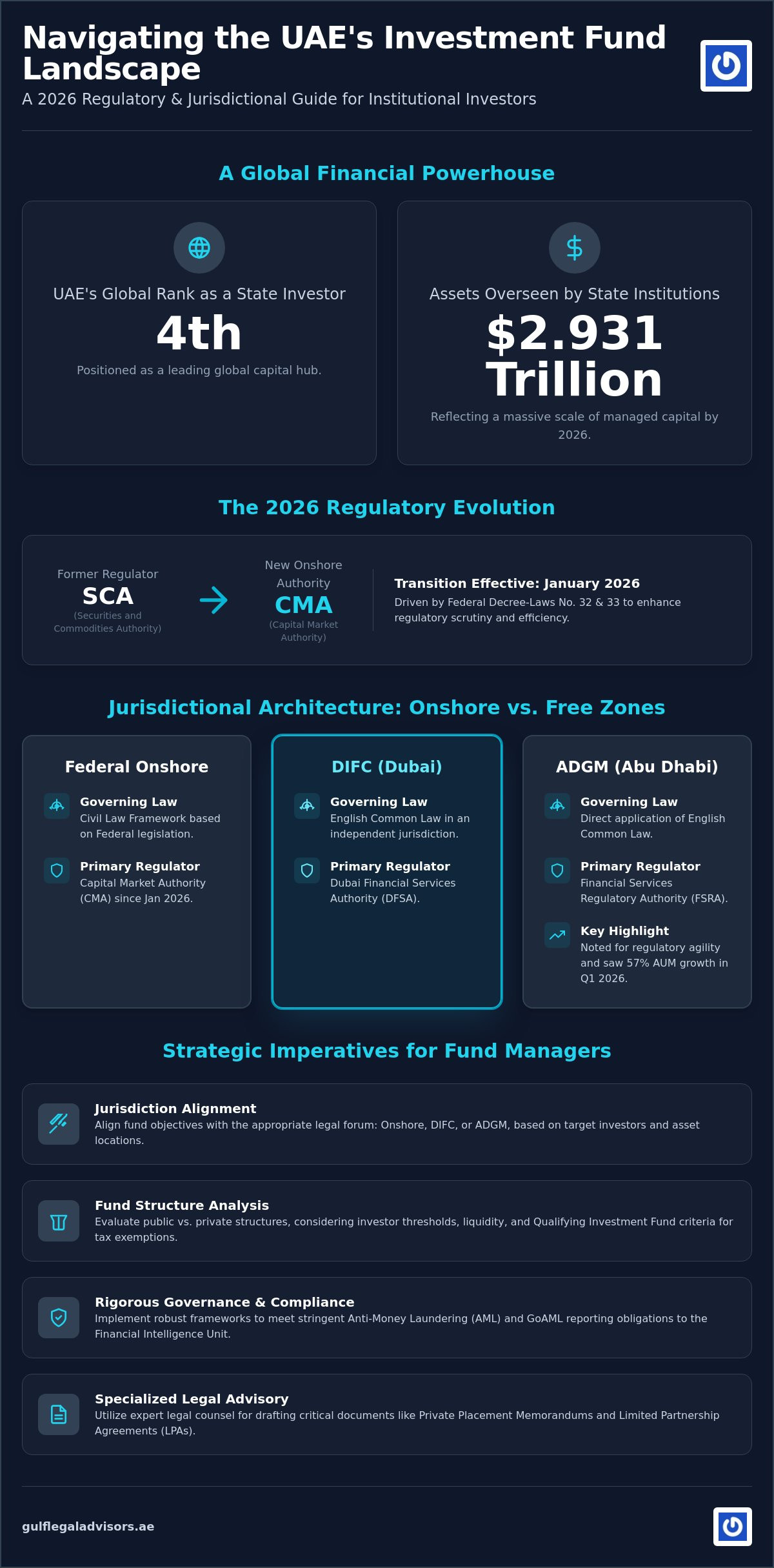
With state-owned institutions now overseeing approximately $2.931 trillion in assets, the UAE is established as the world’s fourth-largest state investor in 2026. This massive scale of capital has necessitated a sophisticated regulatory evolution, most notably the transition of primary oversight from the SCA to the newly formed Capital Market Authority (CMA). For institutional investors, securing specialized investment fund legal advisory UAE is no longer just a procedural step; it’s a strategic necessity to manage the intricate overlap between Federal Onshore, DIFC, and ADGM jurisdictions.
You likely recognize that the speed of these regulatory updates, including the January 2026 implementation of Federal Decree-Laws No. 32 and 33, creates a demanding environment for even the most seasoned fund managers. This article serves as a comprehensive reference to help you identify the optimal fund structure while ensuring strict compliance with the latest corporate tax exemptions and AML obligations. We will analyze the specific thresholds for Qualifying Investment Funds, the nuances of the 2026 CMA framework, and the distinct advantages of the UAE’s primary financial free zones.
Key Takeaways
- Distinguish between the regulatory environments of Federal Onshore and the financial free zones of DIFC and ADGM to align fund objectives with the appropriate legal forum.
- Evaluate the strategic implications of public versus private fund structures, including specific investor thresholds and liquidity management requirements.
- Implement robust governance frameworks that meet the rigorous AML and GoAML reporting obligations mandated by the Financial Intelligence Unit.
- Utilize specialized investment fund legal advisory UAE to navigate the complexities of drafting constitutional documents and negotiating Limited Partnership Agreements.
- Analyze the strategic shift toward specialized regimes to better position your fund for attracting global institutional capital.
The Evolution of the UAE Investment Fund Landscape
The UAE investment fund landscape has undergone a profound transformation, moving from a secondary market to a primary global destination for institutional capital. Central to this evolution is Federal Decree-Law No. 32 of 2021 regarding Commercial Companies, which provides the foundational legal definition of an investment fund as a collective investment scheme. Unlike standard commercial companies, these vehicles are designed for the pooling of investor capital to achieve specific financial returns under professional management. This strategic shift reflects a broader national commitment to economic diversification within the Economy of the UAE, fostering a sophisticated ecosystem that includes specialized fund managers, custodians, and administrators.
The success of these structures relies on the integration of international best practices with local statutory requirements. This is where specialized investment fund legal advisory UAE becomes critical. Advisors act as the technical bridge, ensuring that fund documents, such as Private Placement Memorandums and Articles of Association, align with both global investor expectations and the rigorous standards of the UAE’s multi-jurisdictional framework. The presence of a seasoned legal partner ensures that the interests of all participants are protected through precise governance and clear contractual obligations.
Fundamental Definitions in UAE Corporate Law
Under the 2021 Decree-Law, the distinction between a standard corporate entity and a collective investment scheme is defined by the fund’s purpose and the nature of its legal personality. While most funds possess independent legal personality, the specific structural choice, whether an investment company or a contractual arrangement, dictates the extent of limited liability and tax transparency. While the Securities and Commodities Authority (SCA) historically oversaw these entities, the 2026 transition to the Capital Market Authority (CMA) marks a new era of heightened regulatory scrutiny and administrative efficiency in the onshore market.
Market Drivers for 2026
The current expansion is propelled by the “We the UAE 2031” vision, which aims to double the nation’s GDP and position it as a global leader in capital markets. We’re seeing a notable surge in alternative asset classes, specifically venture capital and private equity, as domestic family offices and sovereign wealth funds seek higher yields through more sophisticated structures. By the start of 2026, the UAE had established itself as the fourth-largest state investor globally, with institutions managing nearly $3 trillion in assets. This concentration of wealth demands a robust investment fund legal advisory UAE presence to manage cross-border complexities and maintain the integrity of the domestic financial system. The growth in wealth management is further supported by the increased sophistication of family offices that now require the same level of institutional-grade governance as global hedge funds.
Jurisdictional Architecture: Federal Onshore vs. Financial Free Zones
The UAE’s investment landscape is defined by a tri-jurisdictional architecture that offers fund managers a choice between Civil Law and English Common Law environments. Onshore UAE, governed by the Capital Market Authority (CMA) since its official takeover from the SCA on January 1, 2026, operates under a Federal framework. In contrast, the Dubai International Financial Centre (DIFC) and the Abu Dhabi Global Market (ADGM) function as independent jurisdictions with their own regulatory bodies, the DFSA and FSRA respectively. Choosing the correct venue requires a meticulous analysis of the target investor base, the geographic location of underlying assets, and the specific capital requirements of the manager. For instance, while ADGM saw a 57% growth in Assets Under Management in the first quarter of 2026, the choice to domicile there often rests on its specific regulatory agility and the comprehensive nature of ADGM’s Fund Framework.
Navigating these choices demands sophisticated investment fund legal advisory UAE to ensure the structure aligns with long-term strategic goals. Each jurisdiction presents a different cost-to-benefit ratio; for example, a Category 4 license in the DIFC requires a minimum base capital of USD 10,000, whereas ADGM’s Category A license fees reflect its position as a premium hub for asset managers. The decision isn’t merely administrative; it’s a strategic selection of the judicial system that will govern the fund’s lifecycle. Managers seeking clarity on these structures often benefit from specialized counsel in Banking, Finance & Capital Markets to weigh the merits of each forum.
DIFC and ADGM: Common Law Environments
International institutional investors often prefer the DIFC and ADGM due to their reliance on English Common Law, which provides a high degree of judicial predictability. These zones allow for the efficient use of Special Purpose Vehicles (SPVs) to isolate assets and liabilities. Furthermore, the “Passporting” regime remains a critical tool, allowing funds licensed by the DFSA or FSRA to be marketed across the UAE without additional licensing from the CMA, provided they meet specific notification requirements. This cross-jurisdictional mobility is a primary driver for the 22% increase in wealth management firms seen in the DIFC through 2025.
Federal Onshore (CMA) Funds
Funds intended for the broader UAE retail public or those specifically targeting government-linked entities often find their home in the Federal Onshore regime. Compliance here is strictly dictated by the UAE Commercial Companies Law and the newly enacted Federal Decree-Laws of 2025. Onshore funds typically require the involvement of local licensed promoters for distribution, ensuring that the marketing of financial products adheres to national consumer protection standards. The 2026 regulatory shift has tightened these requirements, making investment fund legal advisory UAE essential for managers transitioning from the old SCA rules to the new CMA standards before the January 2027 deadline.
Strategic Fund Structures and Classification under UAE Law
Selecting an appropriate fund structure is a decision that dictates a manager’s regulatory burden, tax efficiency, and operational flexibility. UAE law distinguishes primarily between Public Funds, which are offered to a broad retail audience under rigorous oversight, and Private Funds, which target professional and institutional investors. The choice between open-ended and closed-ended structures further defines the fund’s liquidity profile. Open-ended funds allow for periodic redemptions based on Net Asset Value (NAV), making them suitable for liquid strategies, while closed-ended structures are the standard for illiquid assets like private equity or real estate, where capital is locked for a defined term. This structural alignment is central to sophisticated investment fund legal advisory UAE, ensuring that redemption rights do not compromise the fund’s underlying solvency.
The legal vehicle chosen for the fund significantly impacts liability management. Common vehicles include Investment Companies with variable capital, Limited Partnerships (LPs), and Segregated Portfolio Companies (SPCs). SPCs are particularly favored in the DIFC and ADGM for their ability to ring-fence assets and liabilities within individual sub-funds, protecting the broader structure from localized defaults. For managers engaging in complex leverage or mezzanine financing, securing structured finance legal counsel Dubai is essential to navigate the interplay between fund constitutional documents and credit facility requirements. This level of sophistication is a primary reason for the enduring investor confidence noted in the IMF Report on UAE Financial Resilience.
Alternative Investment Funds (AIFs)
Alternative Investment Funds have seen record growth in 2026, particularly in venture capital and digital assets. Real Estate Investment Trusts (REITs) remain a cornerstone of the market, though they must now meet the 2026 tax regime threshold of AED 100 million in total assets to qualify for specific exemptions. The new CMA framework has also introduced explicit provisions for digital asset funds, providing a regulated pathway for hedge funds to integrate virtual assets into their portfolios. These specialized AIFs require a nuanced investment fund legal advisory UAE approach to manage the unique valuation and custody risks associated with non-traditional asset classes.
Specialized Fund Regimes
The UAE offers streamlined regimes designed for sophisticated capital. The Qualified Investor Fund (QIF) is a prominent example; in the DIFC, it requires a minimum subscription of USD 500,000 and offers a fast-track notification process rather than a lengthy approval cycle. Similarly, Exempt Funds allow for a maximum of 100 professional investors with a lower minimum subscription of USD 50,000. These regimes provide fund managers with the speed-to-market necessary in a global commercial hub while maintaining a high standard of professional conduct. Umbrella structures further enhance efficiency by allowing multiple sub-funds to operate under a single regulatory license, each with its own distinct investment strategy and asset pool.
Regulatory Compliance and Governance Standards for Fund Managers
Maintaining regulatory standing in the UAE’s maturing financial ecosystem requires a rigorous commitment to institutional governance. The transition from the SCA to the Capital Market Authority (CMA) has introduced heightened expectations for internal controls and algorithmic transparency. Fund managers must now implement robust Anti-Money Laundering (AML) and Counter-Terrorism Financing (CTF) protocols that align with Federal Decree-Law No. (20) of 2018 and its subsequent 2025 amendments. These frameworks necessitate real-time monitoring and the systematic filing of Suspicious Activity Reports (SARs) through the GoAML portal, managed by the Financial Intelligence Unit (FIU). In this high-stakes environment, investment fund legal advisory UAE provides the necessary oversight to ensure that compliance programs are not merely reactive but are embedded into the fund’s operational DNA.
The integration of AI governance has become a critical focal point for 2026, particularly for funds utilizing automated trading strategies or AI-driven risk assessment models. Regulators now require that these technologies remain auditable and free from algorithmic bias that could jeopardize market integrity. Effective corporate governance further demands the appointment of qualified board members and management committees who can exercise independent judgment. Managers who fail to document their fiduciary decision-making processes face significant exposure during periodic regulatory audits. For firms seeking to fortify their internal frameworks, our team provides specialized counsel in Compliance & AI Governance to mitigate these evolving risks.
Private Placement Regimes (PPR)
Marketing foreign investment funds within the UAE remains a strictly regulated activity. Under the current PPR framework, fund managers must navigate a formal notification process before approaching professional investors. It’s the responsibility of legal counsel to verify that potential participants meet the “Professional Investor” criteria, which typically involves a net worth threshold or a demonstrated level of financial sophistication. Unauthorized “cold calling” or the distribution of marketing materials without the appropriate CMA or Free Zone notifications can lead to severe administrative penalties and the suspension of marketing privileges.
Ongoing Operational Compliance
Operational excellence is defined by a manager’s ability to handle annual audit requirements and maintain transparent conflict of interest policies. Fiduciary duties require that the interests of the fund and its investors always take precedence over those of the management company. This includes the fair allocation of investment opportunities and the disclosure of any related-party transactions. All investment funds must submit their comprehensive 2026 AML compliance reports through the GoAML portal no later than the final business day of the first quarter to ensure alignment with the Financial Intelligence Unit’s revised oversight schedule. Securing proactive investment fund legal advisory UAE ensures these deadlines are met while maintaining the highest standards of reporting accuracy.
The Role of Specialized Legal Advisory in Fund Lifecycle Management
The lifecycle of a collective investment scheme is a complex progression that demands meticulous oversight from inception through to eventual dissolution. Specialized investment fund legal advisory UAE serves as the strategic foundation for this journey, ensuring that the initial pre-formation strategy aligns perfectly with the fund’s long-term objectives and the specific benefits of the chosen jurisdiction. Whether a manager opts for the flexibility of the ADGM or the established institutional reach of the DIFC, the advisory role is to translate these jurisdictional advantages into a functional operational reality. This involves more than just filing paperwork; it’s about the sophisticated calibration of the fund’s legal architecture to withstand the pressures of a global commercial hub.
Advisors manage the precision drafting and negotiation of all constitutional documents, including Prospectuses, Articles of Association, and Limited Partnership Agreements (LPAs). These documents are the primary instruments for defining investor rights and manager responsibilities. A critical component of this management is the implementation of a robust banking and finance dispute resolution UAE framework. By embedding clear resolution mechanisms into the fund’s core documents, managers can protect the vehicle from the destabilizing effects of litigation. The final phase of the lifecycle, fund liquidation, involves navigating a rigid legal dissolution process to ensure capital is returned to investors while satisfying all 2026 regulatory and tax obligations.
Transactional Support and Due Diligence
Ongoing fund management requires continuous legal oversight of asset acquisitions and disposals to maintain the integrity of the investment strategy. Legal teams provide the intellectual depth necessary to manage multi-jurisdictional legal opinions, which are essential for cross-border investments involving diverse regulatory regimes. This transactional support ensures that every asset entry or exit is backed by a thorough due diligence process that identifies potential liabilities before they impact the fund’s Net Asset Value. When funds engage in leveraged acquisitions or require credit facilities to support portfolio investments, conducting a thorough loan agreement legal review UAE is essential to verify collateral enforceability and alignment with the 2026 Central Bank mandates. Advisors also maintain active coordination with regulators to ensure that any necessary license variations or updates are handled with professional efficiency.
Strategic Dispute Mitigation
Effective dispute mitigation is rooted in the intersection of corporate law and specialized fund governance. By drafting arbitration clauses tailored to both UAE and international enforcement standards, legal counsel provides a secure environment for resolving shareholder and investor disagreements. These structured resolution pathways are designed to address disputes with minimal disruption to the fund’s daily operations. As the UAE continues to attract massive state and private investment in 2026, the presence of a sophisticated legal partner ensures that fund managers can focus on capital allocation while their legal and regulatory standing remains beyond reproach.
Securing Strategic Resilience in the 2026 Regulatory Landscape
The 2026 regulatory framework represents a definitive shift toward institutional maturity, positioning the UAE as a premier global hub for sophisticated capital. Successful fund management now demands an integrated approach that views jurisdictional selection, whether within the ADGM, DIFC, or Onshore CMA, as a strategic asset rather than a mere compliance requirement. By aligning fund structures with the latest AML protocols and AI governance standards, managers can ensure operational continuity and maintain the highest levels of investor confidence. In this environment, securing specialized investment fund legal advisory UAE is the critical factor in navigating this multi-jurisdictional complexity with precision.
Gulf Legal Advisors provides the intellectual depth required to manage these high-stakes environments. Our team offers deep expertise in multi-jurisdictional UAE regulatory frameworks, providing strategic counsel for corporate governance and AI compliance. With specialized sector knowledge in Energy, Maritime, and Finance, we deliver the practical results necessary for fund success. Consult with Gulf Legal Advisors for strategic investment fund advisory to ensure your fund remains at the forefront of the region’s evolving financial landscape.
Frequently Asked Questions
What are the main regulators for investment funds in the UAE?
The UAE operates under a tri-jurisdictional regulatory framework. Onshore investment funds are now governed by the Capital Market Authority (CMA), which officially replaced the Securities and Commodities Authority (SCA) on January 1, 2026. The Dubai International Financial Centre (DIFC) is regulated by the Dubai Financial Services Authority (DFSA), while the Abu Dhabi Global Market (ADGM) falls under the oversight of the Financial Services Regulatory Authority (FSRA).
Can a foreign fund manager market their products in the UAE without a local license?
Foreign fund managers cannot market products to the general public without a local license. However, they may utilize the Private Placement Regime (PPR) to target professional investors. This process requires a formal notification to the relevant regulator, such as the CMA or DFSA. Engaging an expert in investment fund legal advisory UAE is essential to verify investor “Professional” status and avoid administrative penalties during the placement process.
What is the difference between a DIFC fund and an ADGM fund?
While both jurisdictions utilize an English Common Law framework, they maintain distinct regulatory environments and fee schedules. The DIFC is a mature hub with over 500 wealth management firms as of 2025. Conversely, the ADGM is experiencing rapid expansion, reporting a 57% growth in Assets Under Management in early 2026. Differences in minimum capital requirements and license fees often dictate the choice between these two financial centers.
How long does it typically take to register a Private Fund with the SCA?
Registration timelines for Private Funds vary based on the complexity of the structure and the manager’s alignment with the 2026 regulatory shift. Under the new CMA framework, entities must ensure all constitutional documents comply with Federal Decree-Laws No. 32 and 33 of 2025. While the transition period for existing funds extends to January 1, 2027, new applications are processed according to the CMA’s streamlined administrative protocols.
Are there specific legal requirements for Real Estate Investment Trusts (REITs) in the UAE?
Real Estate Investment Trusts (REITs) must meet specific asset and ownership thresholds to qualify for the UAE’s specialized tax regime. According to 2026 standards, a REIT must hold total assets exceeding AED 100 million. Additionally, at least 20% of its share capital must be listed on a recognized stock exchange or held by a minimum of two institutional investors to maintain its status as a qualifying investment vehicle.
What are the AML compliance obligations for UAE-based fund managers in 2026?
Fund managers must adhere to the 2025 amendments to Federal Decree-Law No. (20) of 2018 regarding Anti-Money Laundering. This includes mandatory registration with the GoAML system and regular reporting to the Financial Intelligence Unit (FIU). Managers are also required to implement AI governance protocols to ensure that automated risk assessment models remain transparent and auditable. Proactive investment fund legal advisory UAE helps firms meet the Q1 reporting deadlines.
Is it possible to “passport” a fund between the DIFC and the UAE mainland?
A “passporting” regime exists that facilitates the marketing of funds across different UAE jurisdictions. Funds established and regulated within the DIFC or ADGM can be marketed to professional investors in mainland UAE through a notification process with the CMA. This arrangement eliminates the need for full re-registration, provided the fund manager complies with the specific marketing and disclosure requirements of the target jurisdiction.
What legal structures are most common for Venture Capital funds in the ADGM?
Venture Capital funds in the ADGM typically utilize Limited Partnerships (LPs) or Investment Companies with variable capital. These structures provide the necessary flexibility for capital calls and the distribution of returns to investors. The ADGM’s framework is particularly attractive for VC managers due to the clear ring-fencing of assets and the availability of specialized Special Purpose Vehicles (SPVs) for individual portfolio investments.