



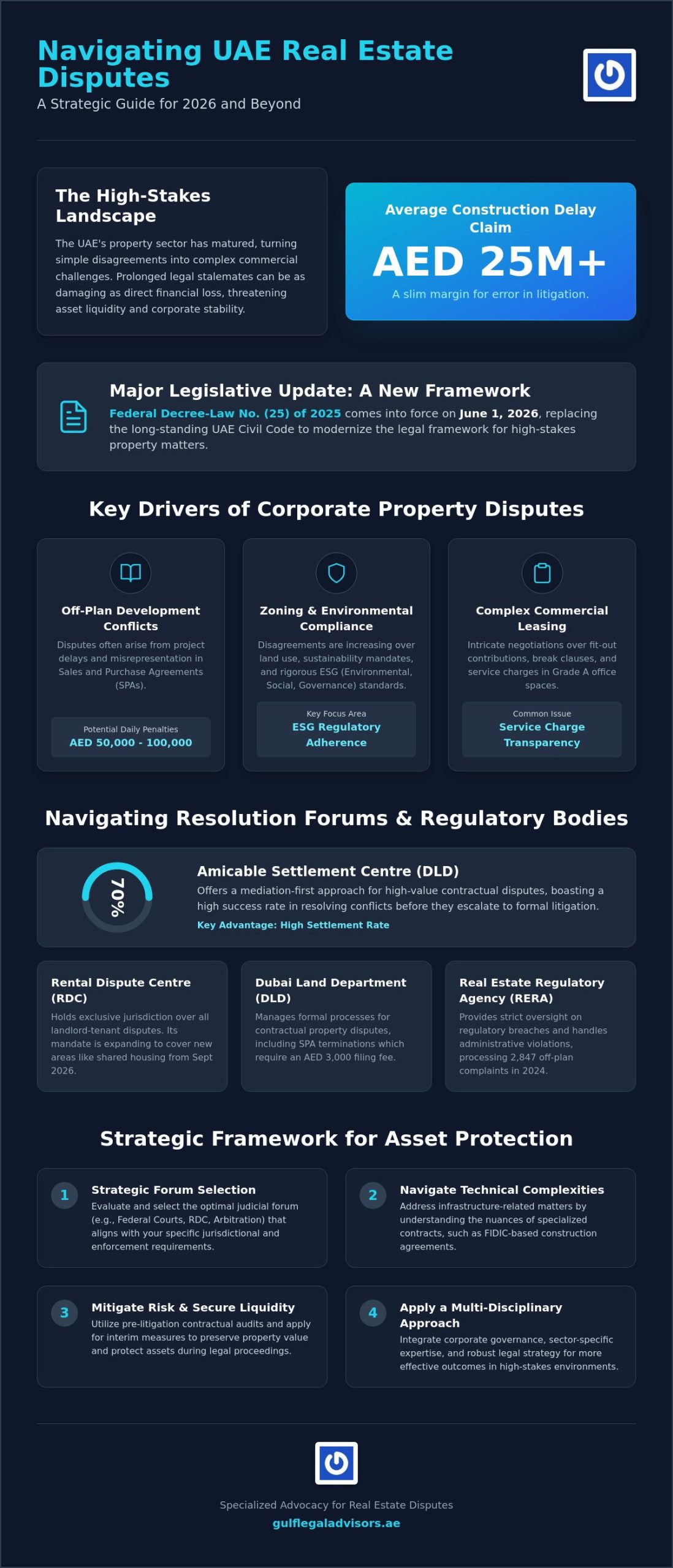
With average construction delay claim values across the UAE now exceeding AED 25 million, the margin for error in property litigation has never been slimmer. For high-stakes decision-makers, the prospect of frozen liquidity and the complexities of multi-jurisdictional enforcement represent a significant threat to corporate stability. You recognize that in a market as dynamic as the UAE, a prolonged legal stalemate is often as damaging as a direct financial loss. Uncertainty regarding the correct judicial forum or the impact of shifting regulations can stall even the most robust portfolios, making a structured approach to real estate dispute resolution in the UAE an essential component of modern asset management.
This article provides an authoritative framework for navigating these complexities, offering the clarity required to secure swift results and mitigate reputational risk. We will examine the strategic advantages of the new Alternative Dispute Resolution systems and the implications of Federal Decree-Law No. (25) of 2025, which comes into force on June 1, 2026. By understanding the nuances of specialized tribunals for rental disputes and the mediation protocols of relevant land departments, you can ensure the rigorous enforcement of contractual obligations while preserving asset value in a sophisticated commercial landscape.
Key Takeaways
- Understand the transition of the UAE property market toward institutional maturity and how to categorize complex commercial conflicts beyond standard rental disagreements.
- Evaluate the strategic selection of judicial forums to ensure real estate dispute resolution Dubai aligns with your specific jurisdictional and enforcement requirements.
- Navigate the technical complexities of infrastructure-related property matters through the lens of FIDIC-based construction agreements and specialized advocacy.
- Secure asset liquidity and mitigate risk by utilizing pre-litigation contractual audits and interim measures designed to preserve property value during legal proceedings.
- Apply a multi-disciplinary approach to litigation that integrates corporate governance and sector-specific expertise for more robust outcomes in high-stakes environments.
Navigating the UAE Real Estate Dispute Landscape in 2026
The UAE property sector has transitioned from a phase of rapid transactional expansion into a period of deep institutional maturity. This evolution necessitates a more sophisticated approach to real estate dispute resolution Dubai as assets become increasingly complex and valuations rise. In this landscape, a dispute is rarely a simple disagreement over occupancy. Instead, it represents a strategic commercial challenge involving intricate financing structures, multi-layered development agreements, and rigorous regulatory standards. High-stakes decision-makers must view these conflicts through the lens of asset preservation and long-term liquidity.
The legal foundation for these matters is currently undergoing a significant shift. Federal Decree-Law No. (25) of 2025 is scheduled to come into force on June 1, 2026, replacing the long-standing UAE Civil Code. This legislative update provides a modernized framework for governing high-stakes property matters, ensuring that the judicial system remains aligned with the needs of a global commercial hub. Managing a multi-million dollar asset portfolio in this environment requires more than just legal knowledge; it demands a strategic understanding of how these new laws interact with specialized property regulations. Professional legal consultancy has become an essential safeguard against the volatility of multi-jurisdictional enforcement and shifting judicial precedents.
Key Drivers of Property Disputes for Corporate Entities
Commercial property conflicts often stem from the intersection of large-scale infrastructure and complex contractual obligations. With the average claim value for construction disputes in Dubai exceeding AED 25 million, the financial stakes are substantial. Key drivers include:
- Breach of contract in off-plan development: Disputes often arise from project delays or misrepresentation, where developers may face penalties of AED 50,000 to AED 100,000 per day.
- Zoning and environmental compliance: As ESG (Environmental, Social, and Governance) standards become more rigorous, disagreements regarding land use and sustainability mandates are increasing.
- Commercial leasing complexities: Multinational corporations often face intricate negotiations regarding fit-out contributions, break clauses, and service charge transparency in Grade A office spaces.
The Importance of Regulatory Adherence
Success in real estate dispute resolution Dubai depends heavily on precise regulatory adherence. The Dubai Real Estate Regulatory Agency (RERA) maintains a strict oversight role, particularly regarding regulatory breaches and off-plan sales complaints, which totaled 2,847 in 2024. While RERA handles administrative violations, the Dubai Land Department (DLD) manages the formal processes of contractual property disputes. For instance, developers must now notify the DLD and pay a filing fee of AED 3,000 when initiating a formal Sales and Purchase Agreement (SPA) termination. Navigating these requirements requires a methodical approach that accounts for both traditional legal tradition and modern technological shifts, such as the increasing use of AI in construction management and smart contract implementation.
Jurisdictional Nuances: Selecting the Optimal Forum for Resolution
Strategic forum selection is the cornerstone of effective real estate dispute resolution Dubai. Selecting between the Federal Courts, the Rental Dispute Centre (RDC), or international arbitration depends on the nature of the asset and the desired speed of enforcement. For instance, the RDC holds exclusive jurisdiction over landlord-tenant disputes and, as of September 2026, all matters related to shared housing under Law No. 4 of 2026. However, for high-value contractual disputes, the Dubai Land Department’s Amicable Settlement Centre offers a mediation-first approach that maintains a 70% settlement rate. Decision-makers must understand that navigating UAE’s dispute resolution systems requires a nuanced appreciation of both onshore civil law and the specific procedural requirements of each tribunal.
The impact of arbitration clauses in high-value real estate and construction contracts can’t be overstated. These provisions often dictate whether a dispute is resolved in a public courtroom or a private tribunal. Choosing the wrong forum can lead to significant delays, particularly if a jurisdictional challenge arises mid-proceedings. A methodical evaluation of the underlying contract and the specific commercial objectives is necessary to determine the most efficient path to a binding resolution.
Litigation in UAE Federal Courts
The procedural journey through the UAE Federal Courts is rigorous. All proceedings are conducted in Arabic, which requires precise legal translations of all evidence and documentation. A central feature of this system is the role of court-appointed experts; their technical findings often form the basis of the final judicial decision. While the courts provide a robust framework for asset protection, stakeholders should prepare for extended timelines. Title disputes that reach the civil courts can take up to 24 months to conclude, making a structured litigation strategy vital for preserving liquidity.
International Arbitration for Real Estate Matters
Sophisticated investors often prefer international arbitration for its confidentiality and the ability to select arbitrators with specialized technical expertise. The Dubai International Arbitration Centre (DIAC) is the primary forum for these matters, particularly when managing complex commercial property disputes or FIDIC-based construction agreements. Once a tribunal issues a decision, the focus shifts to enforcing arbitral awards in UAE Federal Courts. This process has become increasingly streamlined, ensuring that the finality of the arbitration is respected and the award is converted into an enforceable judgment.
Resolving High-Stakes Commercial and Construction Property Disputes
High-value real estate assets in the UAE are frequently tethered to complex infrastructure projects and large-scale residential developments. Resolving these matters requires a deep understanding of the technical and legal frameworks that govern the built environment. In this context, real estate dispute resolution Dubai extends far beyond simple title transfers; it involves the management of intricate financial interests and multi-party liability. With Dubai’s construction sector reaching a value of AED 16 billion in the first half of 2025, the potential for high-value friction is considerable. These disputes often involve institutional investors and joint venture partners, where disagreements regarding capital contributions or the realization of asset value can stall multi-million dirham projects.
A methodical approach to these conflicts prioritizes the mitigation of financial risk and the preservation of corporate reputation. When multi-jurisdictional entities are involved, the complexity of enforcement increases, necessitating a strategy that accounts for both local regulatory adherence and international commercial standards. Strategic resolution in this sector is not merely about winning a case; it’s about ensuring the long-term viability of the asset and the fulfillment of broader commercial objectives.
Construction Contract Advisory and Mitigation
Management of FIDIC contract disputes represents a significant portion of property litigation in the region. These agreements require proactive evidence gathering and a precise application of liquidated damages clauses to address performance failures. Given that developers can face penalties ranging from AED 50,000 to AED 100,000 per day for construction delays, the financial implications are severe. With the average claim value for construction disputes in Dubai exceeding AED 25 million, a structured legal remedy must account for both the technical project specifications and the overarching civil law requirements of the UAE.
Commercial Leasing and Asset Management Disputes
Commercial leasing in retail and industrial hubs involves high-value disagreements that can directly affect an entity’s operational liquidity. Disputes often arise from service charge transparency and facility management liabilities, where the costs of maintenance and utilities are contested by multinational tenants. Terminating a commercial lease requires strict adherence to procedural requirements to avoid substantial legal risks. A precise strategy for real estate dispute resolution Dubai ensures that contractual obligations are enforced while the commercial viability of the asset is maintained through specialized advocacy and rigorous negotiation.
Strategic Steps in Property Litigation and Asset Protection
Effective real estate dispute resolution Dubai begins long before a formal claim is filed in the civil courts or an arbitration tribunal. A methodical pre-litigation strategy serves as the foundation for successful asset protection, focusing on rigorous evidence gathering and comprehensive contractual audits. Identifying vulnerabilities early allows for the deployment of interim measures, such as precautionary attachments or injunctions. These are essential for preserving property value and preventing the dissipation of assets during a legal stalemate. Integrating professional due diligence into this phase ensures that latent legal risks are identified before they escalate into multi-million dirham liabilities.
Navigating multi-jurisdictional asset recovery adds another layer of complexity. Corporate entities must ensure their litigation strategy accounts for the practicalities of enforcement across different Emirates or international borders. This requires a structured approach that prioritizes clear, verifiable documentation over speculative claims. Ensuring the legal position remains defensible throughout the procedural journey is paramount for high-stakes decision-makers who require clarity and security in complex environments.
Mitigating Financial Exposure
Calculating real damages is a critical exercise in property litigation. Courts and tribunals in the UAE favor concrete proof of loss over speculative projections of future profit. Strategic settlement negotiations often provide a more efficient path to preserving liquidity, especially given the 70% settlement rate observed in mediation-first approaches. Timing legal filings to coincide with commercial milestones can also mitigate financial strain. This ensures that the pursuit of a resolution doesn’t compromise an entity’s operational stability or affect its overall liquidity in a fast-paced market.
Enforcement and Recovery
The successful resolution of a dispute is only finalized when a judgment or arbitral award is converted into tangible recovery. Executing judgments against corporate assets or land holdings requires a precise understanding of the execution judge’s requirements and the specific protocols of the Dubai Land Department. Stakeholders may benefit from the strategic use of banking and finance dispute resolution protocols when dealing with asset-backed claims or complex financing arrangements. For expert assistance in securing your property interests through specialized advocacy, consult our litigation and arbitration specialists to develop a robust recovery framework.
Gulf Legal Advisors: Specialized Advocacy for Real Estate Disputes
Gulf Legal Advisors operates as a sophisticated navigator within the UAE’s intricate legal environment. We provide expert representation in high-stakes Litigation & Arbitration, with a specialized focus on the Real Estate & Construction sector. Our approach is characterized by a methodical, structured rhythm that mirrors the gravity of the matters we handle. For institutional clients, a real estate dispute isn’t merely a legal hurdle; it’s a strategic challenge that requires a partner capable of balancing intellectual depth with practical efficiency. By prioritizing information density and clarity, we ensure that decision-makers possess the security they require to operate in a global commercial hub.
Our firm’s ability to resolve multi-jurisdictional matters is strengthened by our cross-sectoral capabilities. We leverage specialized knowledge from our Oil & Gas / Maritime practice to address complex property disputes involving industrial zones, port facilities, and energy infrastructure. This breadth of expertise ensures that real estate dispute resolution Dubai is handled with an understanding of the broader corporate landscape. As the UAE moves toward the June 2026 regulatory shifts, our contemporary practice remains fully engaged with evolving standards in Compliance & AI Governance, providing a future-proof framework for asset management.
Our Strategic Resolution Framework
We offer grounded, reassuring representation designed for those who manage high-value asset portfolios. Our framework moves beyond traditional advocacy, integrating comprehensive advisory services that span Corporate & Mergers & Acquisitions and Banking, Finance & Capital Markets. This multi-disciplinary perspective allows us to identify risks that others might overlook, such as the impact of a property dispute on a pending merger or a capital market instrument. We prioritize the preservation of asset value and the mitigation of reputational risk through a deliberate, purpose-driven flow of communication that focuses on results over stylistic flair.
Securing Your Corporate Interests
Securing long-term institutional success in Dubai requires a legal partner that respects the gravity of tradition while innovating within the modern business landscape. We focus on the enforcement of contractual obligations and the strategic resolution of conflicts to ensure your corporate interests remain protected. Our commitment to regulatory adherence and methodical dispute management provides the stability needed to navigate the complexities of 2026 and beyond. This proactive focus is essential for maintaining liquidity and operational continuity in a fast-paced environment. Contact our expert consultants at Gulf Legal Advisors for a confidential assessment of your matter and to develop a strategic framework tailored to your specific objectives.
Securing Long-Term Asset Value in a Modern Commercial Landscape
The evolution of the property market requires a shift from reactive litigation to strategic asset management. High-stakes decision-makers must prioritize precise forum selection and rigorous pre-litigation audits to avoid the liquidity traps associated with prolonged legal stalemates. Success in real estate dispute resolution Dubai depends on a partner who understands the technical nuances of large-scale infrastructure and the shifting regulatory mandates scheduled for 2026. Specialized representation in DIAC and Federal Court proceedings ensures that your contractual rights are enforced with intellectual depth and a practical focus on results. We provide authoritative counsel on UAE regulatory compliance and governance, helping you navigate complex multi-jurisdictional matters with unwavering stability.
Engage Gulf Legal Advisors for Strategic Dispute Resolution to ensure your property interests remain secure. By integrating these methodical resolution frameworks into your broader corporate strategy, you’ll protect your interests and ensure sustained growth in one of the world’s most dynamic investment hubs.
Frequently Asked Questions
What are the primary grounds for a real estate dispute in the UAE?
The primary grounds for disputes include contractual breaches in off-plan developments, project cancellations, and misrepresentation of property specifications. Conflicts frequently arise from the failure to meet construction milestones or disagreements regarding service charge transparency in commercial assets. These matters often involve high-stakes infrastructure projects where the financial implications of project stagnation require a methodical and structured approach to resolution.
How long does it typically take to resolve a property dispute through UAE courts?
Resolution timelines depend heavily on the chosen judicial forum and the complexity of the asset involved. Title disputes handled by the Dubai Land Department typically average 8 to 12 months for a final decision. If the matter reaches the civil courts, the procedural journey can take up to 24 months. Utilizing specialized advocacy for real estate dispute resolution Dubai ensures that all requirements are met efficiently to mitigate the risk of prolonged litigation.
Is arbitration more effective than litigation for commercial real estate claims?
Arbitration is often preferred for high-value commercial claims due to the confidentiality of the proceedings and the ability to select arbitrators with technical expertise. While litigation in federal courts provides a robust public framework, arbitration through the Dubai International Arbitration Centre (DIAC) offers a more tailored process. Sophisticated investors choose this route to manage complex construction disputes where specialized knowledge of FIDIC-based agreements is essential for a precise outcome.
Can a foreign investor file a real estate dispute against a local developer?
Foreign investors possess the full legal right to initiate dispute proceedings against local developers within the UAE judicial system. The legal framework ensures equal treatment before specialized tribunals and courts, regardless of the investor’s nationality or corporate domicile. Successful resolution often hinges on the precise documentation of the Sales and Purchase Agreement (SPA) and strict adherence to the regulatory standards established by the Dubai Land Department.
What is the role of the Dubai Land Department in resolving property disagreements?
The Dubai Land Department (DLD) serves as the primary regulatory body for managing contractual property disputes between buyers, sellers, and developers. Through its Amicable Settlement Centre, the DLD offers mediation services that maintain a 70% settlement rate for property conflicts. Settlements reached in this forum are binding and enforceable without a court order, providing a streamlined alternative for those seeking to preserve asset liquidity and avoid traditional litigation.
What legal remedies are available for significant delays in property handover?
Legal remedies for significant handover delays include the right to terminate the agreement, recover paid amounts, and claim compensation for documented losses. Developers in Dubai may face penalties ranging from AED 50,000 to AED 100,000 for each day of construction delay. Effective real estate dispute resolution Dubai involves a rigorous application of these statutory penalties alongside the strategic enforcement of specific contractual obligations to protect the investor’s financial interests.
How are legal costs and attorney fees handled in UAE real estate litigation?
Legal costs in the UAE include court filing fees, expert fees, and attorney fees, which are often awarded to the prevailing party at the court’s discretion. For instance, initiating a formal SPA termination procedure requires a filing fee of AED 3,000 paid to the DLD. While the court may award a portion of legal fees to the winner, these awards are typically based on a judicial schedule rather than the actual costs incurred.
What is the impact of a force majeure clause on UAE real estate contracts in 2026?
The impact of force majeure is governed by the new Civil Transactions Law, Federal Decree-Law No. (25) of 2025, which comes into force on June 1, 2026. This legislation provides a modernized framework for evaluating whether external events excuse contractual performance. Parties must demonstrate that the event was unforeseeable and made performance impossible, rather than merely more burdensome, to successfully invoke these clauses in high-stakes commercial disputes.