

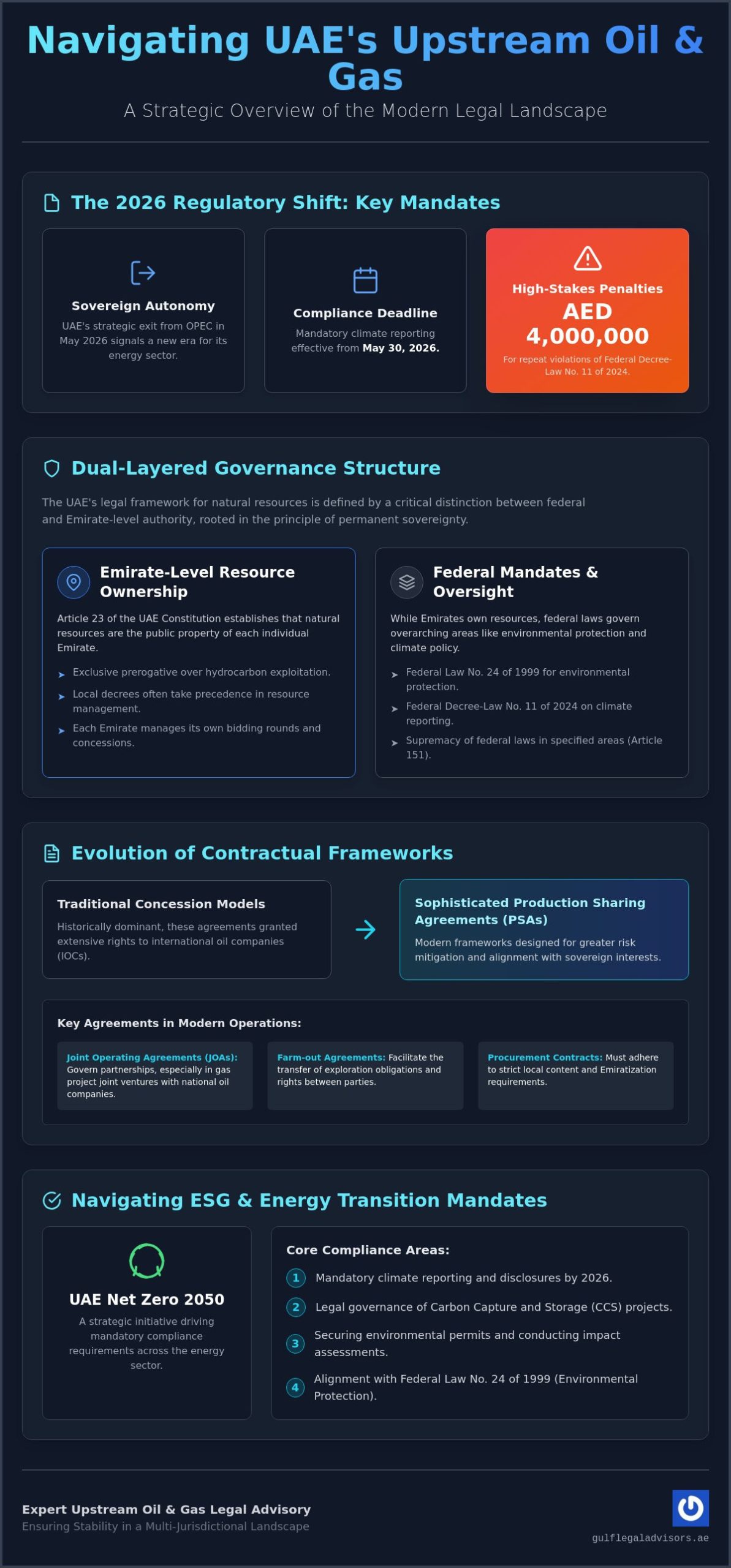
The UAE’s strategic exit from OPEC in May 2026 signaled a new era of sovereign autonomy for the energy sector, yet it also intensified the requirement for specialized upstream oil and gas legal advisory UAE to navigate the resulting regulatory nuances. You likely recognize that the dual-layered governance between federal mandates and Emirate-level resource ownership creates a landscape where traditional operational assumptions no longer suffice. With the May 30, 2026, deadline for mandatory climate reporting now in effect, the cost of oversight is substantial; repeat violations of Federal Decree-Law No. 11 of 2024 can result in penalties reaching AED 4,000,000.
This article delivers a comprehensive strategic overview of the legal architectures and contractual frameworks governing modern exploration and production. We’ll examine the shift toward sophisticated concession agreements, the nuances of Emirate-level taxation for extraction activities, and the critical role of national oil companies in gas project joint ventures. By the end of this guide, you’ll possess the clarity needed to mitigate contractual risks and align your operations with the UAE’s rigorous 2026 governance standards.
Key Takeaways
- Gain clarity on the foundational legal principle of permanent sovereignty, distinguishing between federal mandates and Emirate-level ownership of natural resources.
- Analyze the jurisdictional architecture of energy governance, focusing on the policy-making authority of the Supreme Council for Financial and Economic Affairs.
- Evaluate the evolution of contractual frameworks, from traditional concession models to sophisticated Production Sharing Agreements designed for risk mitigation.
- Understand the mandatory compliance requirements under the UAE Net Zero 2050 Strategic Initiative, including the legal governance of carbon capture and storage projects.
- Secure a roadmap for high-stakes operations through expert upstream oil and gas legal advisory UAE, ensuring stability within the region’s complex multi-jurisdictional landscape.
Defining Upstream Oil and Gas Legal Advisory in the UAE
The term upstream oil and gas legal advisory UAE refers to the management of multi-jurisdictional regulatory compliance and contractual risk for E&P entities. This specialized field encompasses the legal governance of exploration, drilling, and the subsequent extraction of crude oil and natural gas. In the United Arab Emirates, the legal framework is rooted in the principle of permanent sovereignty over natural resources by individual Emirates. Article 23 of the UAE Constitution establishes that these resources are the public property of each Emirate, meaning there is no single federal law governing the entire sector. Instead, a complex interplay of local decrees and federal mandates dictates the operational landscape.
Strategic advisory isn’t merely a transactional service; it’s a lifecycle commitment to the management of a resource. Counsel must oversee every phase of development, beginning with the initial bidding rounds and the formation of legal vehicles for entry. It extends through the operational phase, where adherence to evolving governance standards is paramount, and concludes with the management of decommissioning liabilities. Each stage presents distinct legal challenges that require a proactive approach to risk mitigation. This ensures that the rights of concessionaires are protected while meeting the sovereign expectations of the host Emirate.
The Scope of Upstream Legal Representation
Representation in this sector involves the acquisition of exploration rights and the meticulous negotiation of concession terms. These agreements serve as the bedrock of upstream operations, defining the relationship between the investor and the state. Legal advisors facilitate critical interactions with governmental ministries and regulatory bodies, such as the Abu Dhabi National Oil Company (ADNOC). Counsel ensures that entities remain compliant with Federal Law No. 24 of 1999 regarding environmental protection, while also aligning with the stringent requirements of the 2024 climate legislation. This scope includes:
- Negotiating complex Joint Operating Agreements (JOAs) and Farm-out agreements.
- Securing environmental permits and conducting mandatory impact assessments.
- Drafting procurement contracts that satisfy specific local content and Emiratization requirements.
The Importance of Specialized Energy Counsel
The high-capital nature of energy projects demands a level of stability that only specialized upstream oil and gas legal advisory UAE can provide. Long-duration projects are vulnerable to shifting regulatory tides and economic transitions. Expert legal guidance mitigates these risks by providing the structural stability required for international joint ventures and consortiums. When disputes arise, the complexity of the sector often requires multi-tier resolution strategies. These might involve technical expert determination followed by formal arbitration in specialized forums. Specialized counsel ensures that your contractual protections are robust enough to withstand the multi-decade lifespan of an upstream asset.
The Jurisdictional Architecture of UAE Energy Governance
The constitutional framework of the United Arab Emirates establishes a decentralized model for natural resource management. While Article 151 of the UAE Constitution addresses the supremacy of federal laws in specific areas, the ownership and exploitation of hydrocarbons remain the exclusive prerogative of individual Emirates. This foundational principle creates a multi-layered regulatory environment where state-level decrees often take precedence over federal oversight. Consequently, securing effective upstream oil and gas legal advisory UAE requires a granular understanding of how these jurisdictional boundaries interact during the lifecycle of an energy project.
The Supreme Council for Financial and Economic Affairs (SCFEA) serves as the primary architect of energy policy in Abu Dhabi. Established to consolidate oversight of the Emirate’s financial and petroleum resources, the SCFEA has assumed the responsibilities formerly held by the Supreme Petroleum Council. This body dictates production targets, approves major investment programs, and oversees the strategic direction of the UAE’s oil and gas sector. For international operators, the SCFEA represents the ultimate authority for concession approvals and long-term fiscal terms.
At the federal level, the Ministry of Energy and Infrastructure manages international representation and ensures alignment with broader national objectives. Although the UAE ceased its participation in the OPEC+ framework on May 1, 2026, the Ministry continues to coordinate federal environmental standards and energy transition initiatives. National Oil Companies (NOCs) function as both commercial partners and regulatory conduits. They maintain majority stakes in most ventures while enforcing technical and safety standards on behalf of their respective governments.
Emirate-Level Sovereignty and Resource Management
Legislative autonomy allows each Emirate to develop bespoke concession models tailored to its specific geological and economic needs. This sovereignty means that a legal strategy successful in Abu Dhabi may require significant adjustment for operations in Dubai or Sharjah. Navigating these local decrees requires a focus on Emirate-specific resource management policies. Success in these jurisdictions depends on deep-rooted local knowledge and the ability to interpret the nuances of specific regulatory bodies. For those managing offshore assets, it’s also vital to consider how these regulations intersect with Admiralty Law in the UAE: A Strategic Reference for Maritime Operations to ensure the security of subsea infrastructure.
Regulatory Oversight and Compliance Bodies
International oil companies (IOCs) entering the UAE market must adhere to rigorous compliance mandates that span both local and federal levels. The SCFEA’s influence on national strategy ensures that all upstream activities align with the UAE’s broader economic diversification goals. Compliance isn’t a static requirement; it involves continuous monitoring of evolving governance standards and environmental reporting milestones. Entities seeking to establish a presence in this competitive landscape often benefit from the strategic resolution provided by Gulf Legal Advisors to ensure their corporate structures meet all regulatory prerequisites.
Principal Contractual Frameworks in Exploration and Production
The contractual architecture of the UAE energy sector has undergone a significant transformation, moving from traditional royalty-based models to sophisticated, multi-layered frameworks. While the concession system remains the cornerstone of the industry, the specific terms within these agreements have evolved to reflect the complexities of a transition economy. Securing effective upstream oil and gas legal advisory UAE is essential for interpreting these shifts, as modern agreements now incorporate stringent performance mandates and environmental benchmarks that were absent in earlier iterations. These frameworks must balance the long-term capital requirements of international investors with the sovereign interests of the host Emirate.
Joint Operating Agreements (JOAs) represent a critical component of the upstream legal landscape, particularly as consortium-led projects become the norm. These agreements govern the relationship between partners, detailing the management of consortium liabilities and the allocation of operational costs. In Abu Dhabi, for instance, the national oil company typically maintains a significant interest in these ventures. Specifically, for any joint agreement involving gas projects, a minimum 51% stake is required to be held by the state entity. This structural requirement necessitates precise legal drafting to ensure that minority voting rights and technical contributions are adequately protected within the JOA framework.
Concession Agreements vs. Production Sharing Agreements
The distinction between traditional concessions and Production Sharing Agreements (PSAs) lies primarily in the fiscal regime and the ownership of production. Under a concession, the state grants the operator exclusive rights to explore and extract resources in exchange for taxes and royalties. Conversely, PSAs allow the state to retain ownership of the resource while the operator recovers its costs through a share of the production, known as “cost oil.” The allocation of exploration risk is a central tenet of these negotiations. While concessions offer more operational autonomy, PSAs provide a mechanism for cost recovery that can be more attractive in high-risk frontier basins or unconventional gas developments. Operators working in the Arabian Gulf should also review the implications of offshore energy legal counsel UAE frameworks to ensure that EPC contracts and subsea infrastructure agreements remain resilient against the multi-jurisdictional maritime shifts now reshaping the 2026 regulatory landscape.
Strategic Contractual Clauses for Risk Mitigation
Stabilisation clauses serve as a vital safeguard for international investments, protecting projects against potential legislative shifts over their multi-decade lifespans. As the UAE’s climate policies continue to evolve in alignment with global standards, these clauses provide the fiscal certainty required to commit billions in capital. Dispute resolution provisions are equally paramount. Modern contracts often favor a tiered approach, utilizing expert determination for technical matters while reserving formal arbitration in specialized forums like the ADGM or DIAC for legal breaches. Understanding these upstream nuances is also critical for managing the broader energy portfolio, as explored in our guidance on LNG Contract Legal Advisory UAE: Strategic Counsel for the Energy Value Chain, where downstream synergy meets upstream production.
Service contracts occupy a distinct niche, often utilized for the redevelopment of mature fields or when technical assistance is required without the transfer of resource ownership. These arrangements focus on fixed-fee structures or performance-linked incentives rather than a share of the hydrocarbons. This model allows the Emirate to retain full control over its reserves while leveraging the technical expertise of international service providers. Each of these frameworks requires a tailored legal strategy to address the specific geological and regulatory risks inherent in the UAE’s upstream sector.
Navigating the 2026 ESG and Energy Transition Mandates
The regulatory environment for 2026 is defined by the rigid enforcement of climate accountability and the integration of advanced technology into compliance workflows. As the UAE Net Zero 2050 Strategic Initiative moves from a policy vision to a legally enforceable framework, upstream operators must adapt to a landscape where environmental performance is as critical as production volume. Securing specialized upstream oil and gas legal advisory UAE is now essential for managing the transition toward “Green Oil” branding, a shift that requires verified data to mitigate the risk of greenwashing litigation and to maintain access to international capital markets.
A significant development in this transition is the mandatory requirement for Carbon Capture, Utilisation, and Storage (CCUS) in new upstream projects. These mandates are coupled with stringent methane emission reporting standards that necessitate real-time monitoring. To manage these complexities, many E&P entities are deploying artificial intelligence to optimize exploration and monitor emissions. This technological shift introduces the requirement for robust AI Governance, ensuring that algorithmic outputs used for regulatory reporting are transparent, auditable, and compliant with federal data standards. For organizations seeking to align their technological and environmental strategies, the Compliance & AI Governance expertise at Gulf Legal Advisors provides the necessary framework for secure implementation.
The Legal Implications of the Energy Transition
Concession agreements drafted in previous decades often lack the flexibility required for modern decarbonisation targets. Operators must now review these contracts to ensure alignment with sustainability mandates and to facilitate the integration of renewable energy into traditional upstream infrastructure. Failure to adapt these legal instruments can result in the creation of “stranded assets,” where resources become economically unviable due to high carbon costs or regulatory restrictions. Legal strategy must focus on future-proofing investments by incorporating adaptive fiscal terms that account for carbon pricing and renewable energy credits.
Compliance with Emerging Environmental Standards
Federal Decree-Law No. 11 of 2024 on the Reduction of Climate Change Effects established a critical compliance milestone on May 30, 2026. This law requires all entities, including those in offshore drilling, to measure and report greenhouse gas emissions with precision. The penalties for non-compliance are substantial, ranging from AED 50,000 to AED 2,000,000 for a first offense, and doubling for repeat violations. Beyond federal mandates, upstream developments are subject to:
- Mandatory Environmental Impact Assessments (EIAs) that prioritize biodiversity and marine protection.
- Rigorous ESG disclosure frameworks that demand transparency in supply chain carbon footprints.
- Adherence to Emirate-specific resource management policies that may exceed federal baselines.
The intersection of these environmental standards with traditional resource extraction requires a proactive legal stance. Ensuring that every phase of an upstream project, from seismic testing to decommissioning, meets these evolving criteria is the only way to maintain operational stability in the current Gulf energy landscape. Capital-intensive offshore platforms and subsea installations face particular scrutiny under these mandates, making it essential to engage strategic offshore energy legal counsel in the UAE to address the specific maritime overlaps and sovereign control provisions that define the 2026 compliance framework.
Strategic Legal Counsel for High-Stakes Upstream Operations
Successful upstream operations in the UAE demand a synthesis of legal precision and commercial agility. As the 2026 regulatory framework matures, the requirement for upstream oil and gas legal advisory UAE has shifted from basic compliance to the provision of strategic resolution. High-stakes decision-makers require a partner who understands that regulatory adherence must coexist with commercial velocity. Navigating the sophisticated interplay between Emirate-level sovereignty and federal mandates requires a grounded, reassuring presence that only deep-rooted expertise can provide. This ensures that long-term energy investments remain stable despite the fast-paced shifts in the global energy landscape.
Gulf Legal Advisors employs a methodology characterized by the integration of intellectual depth and pragmatic execution. We recognize that the Gulf energy sector involves complex multi-jurisdictional matters that require a logical, top-down flow of information and strategy. By prioritizing information density and clarity, we enable our partners to move forward with quiet confidence. Our role as a strategic partner is to act as a sophisticated navigator of these systems, providing the structural security required for multi-decade projects while remaining fully engaged with contemporary technological shifts.
The Gulf Legal Advisors Advantage
Our approach to corporate governance is built upon a foundation of unwavering professionalism and serious reliability. We offer a sophisticated perspective on the UAE’s judicial and regulatory landscapes, ensuring that every facet of an upstream project is legally sound. This includes a contemporary focus on Compliance & AI Governance, which is essential for modern operators utilizing automated systems for production monitoring and emission reporting. Our expertise allows for the seamless integration of these new technologies into existing legal frameworks, mitigating the risks of non-compliance in an increasingly scrutinized sector.
Securing Your Upstream Interests in the UAE
Securing interests in the UAE’s energy sector requires specialized support for high-value transactions and potential disputes. Our practitioners provide critical guidance for Corporate & Mergers & Acquisitions, including the negotiation of farm-out agreements and the structuring of international consortiums. When conflicts arise, our Litigation & Arbitration team provides robust representation in the region’s most prominent legal forums. We are committed to delivering the following strategic outcomes:
- Clarity and security in complex multi-jurisdictional energy disputes.
- Strategic resolution for mergers and acquisitions involving distressed or transitioning assets.
- Regulatory adherence that supports, rather than hinders, operational progress.
- Intellectual depth in the management of multi-tier dispute resolution provisions.
In the UAE’s most complex industrial environments, the difference between success and stagnation often lies in the quality of legal counsel. We provide the intellectual depth to handle intricate matters and the practical focus to deliver results, ensuring your upstream portfolio is both protected and positioned for growth.
Securing Operational Longevity in the UAE Energy Sector
Navigating the 2026 regulatory landscape requires more than just technical compliance; it demands a proactive alignment with the UAE’s sophisticated jurisdictional architecture and evolving sustainability mandates. You’ve seen how the interplay between Emirate-level resource ownership and federal environmental laws creates a complex environment for exploration and production entities. By prioritizing the evolution of concession agreements and integrating robust AI governance, operators can transform regulatory challenges into strategic advantages.
Establishing a foundation of stability within this transition economy is predicated on securing specialized upstream oil and gas legal advisory UAE. This partnership provides the intellectual depth necessary to manage multi-jurisdictional complexities while maintaining the commercial velocity required for high-stakes projects. Gulf Legal Advisors offers a grounded, reassuring presence, acting as a sophisticated navigator of the region’s legal frameworks. With deep-rooted expertise in Oil & Gas and Maritime law, and a contemporary focus on ESG compliance, we ensure your interests are protected against shifting global standards.
Consult with Gulf Legal Advisors for Strategic Upstream Counsel to secure the clarity and security your operations deserve. We look forward to supporting your long-term success in the Gulf’s dynamic energy market.
Frequently Asked Questions
How are upstream oil and gas rights granted in the UAE?
Upstream rights are granted through concession agreements or production sharing contracts issued by individual Emirates. Article 23 of the UAE Constitution vests resource ownership in each Emirate; therefore, companies negotiate directly with local authorities or National Oil Companies. These agreements grant exclusive rights for exploration and extraction over a defined period. Successful entry depends on aligning with the specific fiscal and technical requirements of the host Emirate’s regulatory body.
What is the role of the Supreme Council for Financial and Economic Affairs in upstream governance?
The Supreme Council for Financial and Economic Affairs (SCFEA) is the primary governing body for Abu Dhabi’s petroleum sector. It formulates energy policy, approves production targets, and oversees the strategic direction of the national oil company. Its role is central to any upstream oil and gas legal advisory UAE, as it acts as the final authority on concession approvals and fiscal terms within the Emirate, ensuring alignment with national economic goals.
Can international oil companies own upstream assets in the UAE?
International oil companies hold minority interests in upstream assets through joint ventures with state-owned entities. While the UAE lifted the 49% cap on foreign ownership in 2020, strategic sectors like oil exploration in Abu Dhabi remain subject to specific restrictions. Typically, the national oil company retains a majority stake, often 60% or higher, in these concessions. This structure ensures state control over natural resources while leveraging international technical expertise.
What are the primary differences between Abu Dhabi and other Emirates regarding upstream law?
Abu Dhabi possesses a centralized regulatory framework managed by the SCFEA, whereas other Emirates utilize distinct local decrees and petroleum trading frameworks. For instance, Dubai’s activities are governed by Executive Council Resolution No. 85 of 2025. These variations mean that upstream oil and gas legal advisory UAE must be tailored to the specific legislative environment of each Emirate. Each jurisdiction maintains its own national oil company and resource management policies.
How does the UAE Net Zero 2050 initiative affect existing upstream concessions?
The initiative introduces mandatory decarbonization targets that require the integration of emissions reduction technologies into existing operations. Federal Decree-Law No. 11 of 2024 established a May 30, 2026, deadline for mandatory greenhouse gas reporting. Concessionaires must now comply with stringent methane reduction standards and carbon capture requirements. Failure to meet these milestones results in substantial financial penalties, reflecting the shift toward a more regulated and environmentally conscious energy sector.
What legal protections exist for offshore energy infrastructure in the UAE?
Offshore infrastructure is protected through a combination of federal environmental laws, maritime security protocols, and international conventions. Federal Law No. 24 of 1999 establishes the baseline for marine protection during drilling and extraction. Local port authorities and maritime regulators provide a framework for the security of subsea pipelines and platforms. These legal protections ensure operational continuity and mitigate the risks associated with third-party interference in the UAE’s maritime zones.
What is the preferred method for resolving upstream energy disputes in the UAE?
Tiered dispute resolution is the standard method, beginning with technical expert determination followed by formal arbitration. Modern contracts frequently specify arbitration in specialized forums such as the Abu Dhabi Global Market or the Dubai International Arbitration Centre. These venues provide the sophisticated legal expertise necessary for high-stakes energy matters. Arbitration ensures that complex technical and commercial disputes are resolved in a confidential manner with enforceable awards across international jurisdictions.
How are decommissioning liabilities managed under UAE upstream law?
Decommissioning liabilities are managed through contractual provisions requiring operators to provide financial guarantees or set aside funds during the production lifecycle. These clauses ensure that the costs of infrastructure removal and environmental restoration are covered. The legal framework follows the “polluter pays” principle, requiring detailed abandonment plans to be approved by the relevant Emirate-level regulator. This process ensures that the host Emirate isn’t left with the financial burden of site remediation.