


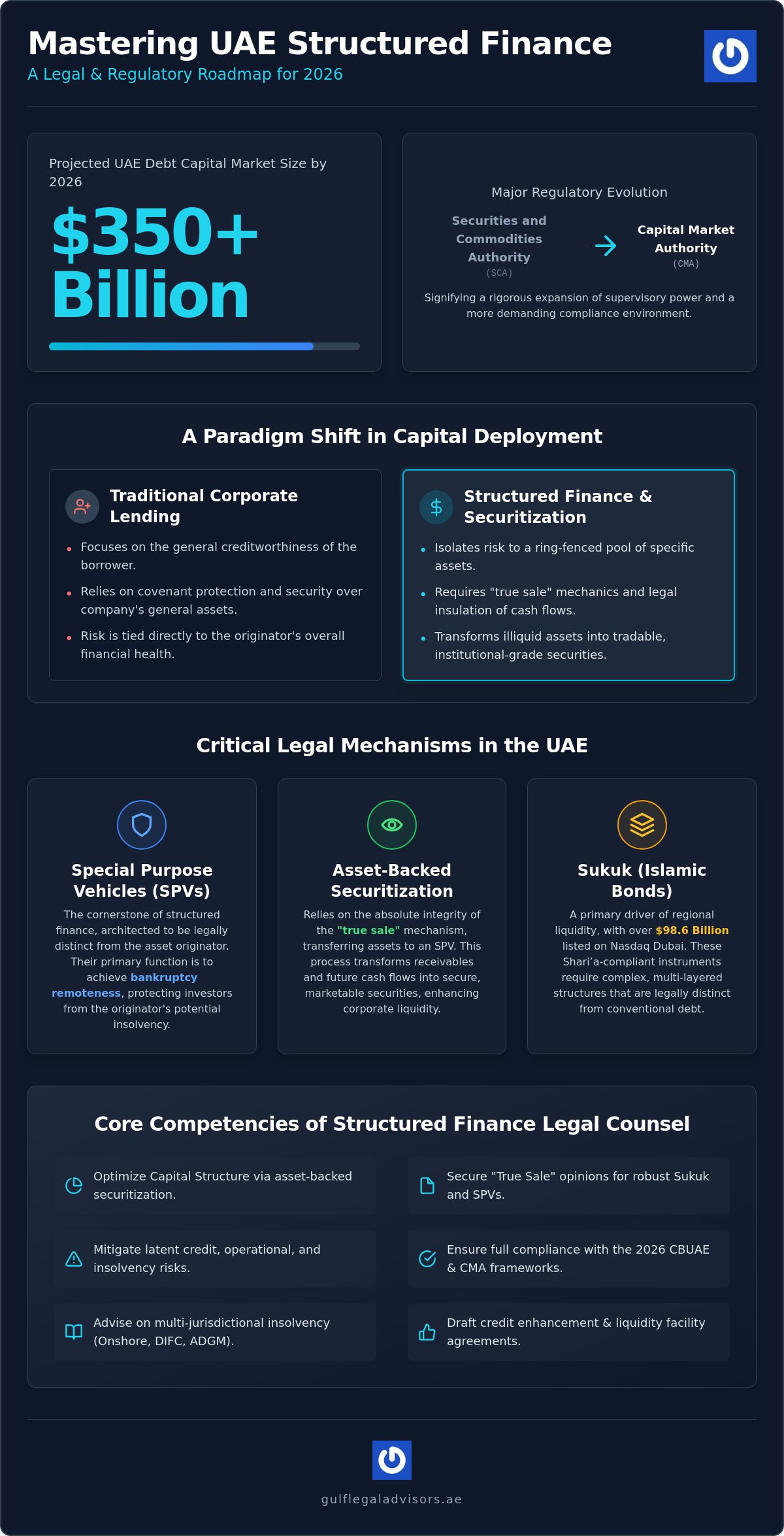
With the UAE debt capital market projected to surpass $350 billion in 2026, the margin for structural error in high-stakes transactions has never been thinner. Institutional investors and global corporations understand that the recent reconstitution of the Securities and Commodities Authority into the Capital Market Authority (CMA) represents more than a name change; it is a rigorous expansion of supervisory power. Securing sophisticated structured finance legal counsel Dubai is no longer a peripheral requirement but a core strategic necessity for those managing complex portfolios. You likely recognize that achieving true bankruptcy remoteness for Special Purpose Vehicles (SPVs) under evolving UAE laws requires a level of technical precision that standard corporate frameworks cannot provide.
This guide offers a comprehensive analysis of the strategic advisory required to master the current UAE financial ecosystem. We provide a technical roadmap for executing legally sound financial structures that align with the 2026 Central Bank Law and the latest CMA Virtual Assets Framework. You’ll gain clarity on mitigating latent credit risks and managing the complexities of cross-border securitization within both onshore and offshore jurisdictions like the DIFC and ADGM. Our objective is to ensure your capital market activities remain resilient, compliant, and optimized for the sophisticated demands of the modern Middle Eastern economy.
Key Takeaways
- Understand the fundamental legal distinctions between traditional corporate lending and asset-backed securitization to optimize your capital structure.
- Master the technical requirements for establishing bankruptcy-remote SPVs and securing true sale opinions essential for robust Sukuk and securitization vehicles.
- Navigate the 2026 regulatory landscape, including the Capital Market Authority’s expanded supervisory powers and the new CBUAE mandates on liquidity coverage.
- Identify the core technical criteria for selecting structured finance legal counsel Dubai, specifically focusing on multi-jurisdictional insolvency expertise and strategic dispute resolution.
- Implement sophisticated governance frameworks that mitigate latent credit and operational risks while ensuring full adherence to evolving UAE financial regulations.
The Role of Structured Finance Legal Counsel in the UAE
Structured finance represents a paradigm shift in how capital is deployed across the Emirates. It isn’t a simple extension of credit. Instead, it’s a sophisticated method of structured finance that isolates specific asset risks from the broader corporate entity. While traditional corporate lending focuses on the general creditworthiness of a borrower, structured transactions rely on the performance of a ring-fenced pool of assets. For institutional players, engaging structured finance legal counsel Dubai ensures that these complex arrangements remain resilient against the volatility often found in emerging capital markets. This strategic advisory is essential for transforming illiquid assets into tradable, institutional-grade securities.
The distinction between these models is legally profound. General banking advice usually centers on covenant protection and security over a company’s general assets. Structured finance, however, requires a deep understanding of true sale mechanics and the legal insulation of cash flows. In the UAE, where the legal system is undergoing rapid modernization through the 2025 Federal Decree-Laws, the technical requirements for achieving bankruptcy remoteness are exacting. Specialized counsel provides the intellectual depth needed to bridge the gap between commercial ambitions and the rigorous standards of the Capital Market Authority (CMA).
Navigating Complex Capital Architectures
The creation and management of Special Purpose Vehicles (SPVs) form the foundation of any structured transaction. These entities must be architected to ensure they’re legally distinct from the originator, protecting investors from the originator’s insolvency. Counsel oversees the structuring of multi-tranche debt, allowing issuers to cater to diverse risk appetites while staying compliant with UAE federal financial laws. This precision is vital as the UAE debt capital market expands toward its projected $350 billion milestone in 2026. Without rigorous legal oversight, the structural integrity of these vehicles can’t withstand the scrutiny of international underwriters.
Strategic Risk Mitigation in Securitization
Securitization demands a granular analysis of asset pools to identify latent legal risks, such as pre-existing encumbrances or future flow volatility. Structured finance legal counsel Dubai plays a pivotal role in drafting credit enhancement mechanisms that bolster the instrument’s rating. Whether it’s through over-collateralization or liquidity facility agreements, the legal framework must be robust enough to satisfy international rating agencies. This level of strategic advisory transforms a collection of receivables into a secure investment, effectively distributing risk and enhancing corporate liquidity for UAE enterprises.
Critical Legal Mechanisms: Sukuk, Securitization, and SPVs
The legal architecture of the UAE capital markets is increasingly defined by the evolution of Sukuk as a sophisticated alternative to conventional debt. With over $98.6 billion in outstanding sukuk listed on Nasdaq Dubai, these instruments have transitioned from niche products to primary drivers of regional liquidity. Success in these transactions hinges on the precision of the underlying legal framework. Engaging structured finance legal counsel Dubai is critical for navigating the transition from traditional asset-backed structures to complex, multi-layered Shari’a-compliant vehicles. This evolution requires a rigorous application of the UAE Commercial Transactions Law to ensure that asset transfers are legally insulated from the originator’s operational risks.
Asset-backed securitization relies on the absolute integrity of the “true sale” mechanism. In the UAE, the establishment of a Special Purpose Vehicle (SPV) serves as the cornerstone for achieving bankruptcy remoteness. This legal isolation ensures that the underlying asset pool remains beyond the reach of the originator’s creditors in the event of insolvency. For long-term infrastructure projects and large-scale real estate developments, integrating project finance within these structured vehicles allows for more efficient debt service and risk distribution. It’s a technical process where the legal opinion on asset transfer is as vital as the financial modeling itself.
Sukuk Structures and Shari’a Compliance
Modern structured products in the region utilize diverse frameworks, including Ijarah (lease-based), Musharaka (partnership), and Mudaraba (profit-sharing) models. Each structure demands a distinct set of documentation to satisfy both federal law and the standards set by the Higher Sharia Authority (HSA). Technical legal sign-off from Shari’a Supervisory Boards is a prerequisite for international Sukuk issuance, ensuring the instrument’s tradability across global Islamic finance hubs. Precision in these documents prevents the risk of structural recharacterization, which could jeopardize the tax and regulatory status of the debt.
SPV Management and Asset Consolidation
The choice of jurisdiction for SPV incorporation remains a strategic decision for institutional issuers. While the Dubai International Financial Centre (DIFC) and Abu Dhabi Global Market (ADGM) offer robust common-law frameworks preferred for cross-border transactions, the onshore UAE market is modernizing its approach to collateral management. Legal protocols must be meticulously drafted to manage the servicing of assets and the enforcement of security interests. Establishing clear protocols for the “true sale” of receivables is essential to prevent these transactions from being viewed as simple secured loans. For entities navigating these high-stakes structural requirements, securing a partner with expertise in commercial dispute resolution Dubai provides an additional layer of security against future litigation or structural challenges.
The 2026 Regulatory Landscape: CBUAE, SCA, and VARA
The transition of the Securities and Commodities Authority into the Capital Market Authority (CMA) as of January 1, 2026, marks a pivotal shift in supervisory oversight for the Emirates. This reconstitution empowers the regulator with expanded enforcement mechanisms for both public and private debt offerings. For institutional participants, the necessity of structured finance legal counsel Dubai becomes evident when aligning multi-jurisdictional portfolios with these expanded mandates. Compliance is no longer a static checklist but a dynamic requirement of the CMA’s modernised framework, which now oversees a broader range of regulated financial activities. Institutional fund managers operating across Federal Onshore, DIFC, and ADGM jurisdictions should also consider how specialized investment fund legal advisory UAE intersects with these expanded CMA supervisory powers to ensure full regulatory alignment.
Parallel to these shifts, the Central Bank of the UAE (CBUAE) has established a definitive compliance deadline of September 16, 2026, for the new Central Bank Law, Federal Decree-Law No. 6 of 2025. This legislation unifies the regulatory requirements for banks and insurance companies, placing a particular emphasis on liquidity coverage ratios and capital adequacy within structured vehicles. Institutions that fail to meet this deadline face significant exposure, and a thorough understanding of banking and finance dispute resolution UAE mechanisms is essential for managing the administrative fines and enforcement actions that may arise from non-compliance. Additionally, the issuance of Circular No. 5/2026 introduces strict remuneration regulations for financial institutions. A mandatory gap analysis for this circular is due by October 11, 2026, requiring firms to audit their internal structures to ensure full alignment with these governance standards before the 2027 enforcement date.
Enhanced due diligence remains a cornerstone of the 2026 landscape. The CBUAE issued updated Anti-Money Laundering (AML) and Countering Proliferation Financing (CPF) guidance on April 16, 2026. These updates require a more granular approach to the “know your customer” protocols for complex financial structures, particularly those involving asset pools with international receivables. Maintaining a grounded, compliant posture in this environment requires a deep understanding of how these federal mandates intersect with the operational realities of capital markets.
Virtual Assets and Tokenized Debt Structures
The integration of the Virtual Asset Regulatory Authority (VARA) into the broader financial ecosystem has accelerated with the release of the Exchange Services Rulebook Version 2.1 on March 31, 2026. This update permits exchange-traded virtual asset derivatives for the first time under a permanent regime. Furthermore, the CMA’s new Virtual Assets Framework, issued in April 2026, expanded regulated activities from three to eight. These developments provide a clear legal pathway for tokenizing real-world assets (RWA), allowing issuers to utilize regulatory sandboxes to test innovative, blockchain-based structured products within a secure, supervised environment.
AI Governance in Financial Compliance
As financial institutions increasingly rely on automated systems for credit risk assessment and the structuring of asset-backed securities, the legal implications of algorithmic transparency have become paramount. UAE law now requires specific disclosures regarding how AI models influence financial decision-making to prevent latent bias and operational failure. Expert advisory is essential to ensure these technological integrations don’t inadvertently breach federal transparency mandates. For a comprehensive analysis of these requirements, stakeholders should consult Gulf Legal Advisors’ AI governance legal compliance UAE framework to ensure their automated systems meet the highest standards of regulatory adherence.
Strategic Criteria for Appointing Structured Finance Counsel
Selecting structured finance legal counsel Dubai requires an evaluation that goes beyond basic banking credentials. The complexity of the 2026 regulatory framework, particularly the new Central Bank Law compliance deadline on September 16, 2026, demands a firm capable of rapid adaptation. High-stakes decision-makers must prioritize technical proficiency in multi-jurisdictional insolvency. This is essential for ensuring that structured vehicles remain insulated during regional or global economic shifts. A firm’s track record in commercial dispute resolution Dubai serves as a critical indicator of their ability to defend a structure’s integrity. If a transaction faces a challenge, the strength of the original drafting determines the legal outcome.
Sector-specific depth in industries like Oil & Gas or Construction is also indispensable. Asset-backed deals in these fields involve unique regulatory hurdles and physical asset risks that generalist firms often overlook. It’s not enough to understand the law in a vacuum; counsel must understand how the law interacts with the operational realities of the UAE’s primary economic drivers. This specialized knowledge ensures that credit enhancement mechanisms are both legally sound and commercially viable.
Technical Depth vs. Generalist Advisory
General corporate counsel may handle standard loan agreements, but they often lack the specialized knowledge required for asset-backed securitization. The ability to issue robust ‘true sale’ and ‘non-consolidation’ legal opinions is the hallmark of sophisticated structured finance legal counsel Dubai. These documents are vital for rating agencies and international investors who require absolute certainty that assets won’t be re-absorbed into an originator’s estate during insolvency proceedings. When evaluating a prospective partner, consider these technical requirements:
- Does the firm demonstrate a verified understanding of the 2026 CMA framework?
- Can they provide evidence of successful ‘true sale’ opinions in cross-border contexts?
- Is there a dedicated team for Banking, Finance & Capital Markets with a focus on structured products?
- Do they maintain professional relationships with federal regulatory bodies to anticipate policy shifts?
Cross-Disciplinary Integration
There’s a significant synergy between structured finance and the work performed by M&A legal advisors UAE. Large-scale acquisitions often utilize structured debt to optimize capital efficiency. Similarly, construction expertise is vital for infrastructure-based deals where future cash flows are tied to project milestones. This cross-disciplinary approach allows for a more holistic risk assessment. For organizations architecting complex capital structures, engaging with a partner like Gulf Legal Advisors ensures that every technical nuance is addressed with unwavering professionalism and strategic foresight.
Gulf Legal Advisors: Sophisticated Solutions for Complex Finance
Gulf Legal Advisors functions as a strategic navigator for entities operating within the UAE’s high-stakes financial corridors. As structured finance legal counsel Dubai, the firm provides a grounded, reassuring presence for institutional investors and global corporations navigating the reconstituted Capital Market Authority (CMA) framework. We offer more than technical drafting; we provide a strategic partnership that prioritizes stability and clarity in a global commercial hub. Our expertise in Banking, Finance & Capital Markets allows us to architect structures that withstand regulatory volatility while optimizing capital efficiency. We rely on a deep-rooted understanding of UAE federal law to provide a sense of weight and importance to every transaction we oversee.
Our methodology is methodical and purpose-driven. We manage the entire transaction lifecycle, from the initial isolation of asset risks to the final regulatory filing. This process includes a rigorous assessment of 2026 technology governance standards, ensuring that automated credit assessments and tokenized structures remain fully compliant with UAE federal mandates. By focusing on risk isolation and bankruptcy remoteness, we deliver the security that high-stakes decision-makers require in complex environments. We don’t just respond to changes; we anticipate the strategic resolution of regulatory shifts before they impact your portfolio. Our commitment to quiet confidence ensures that our clients move through the market with the certainty of full compliance.
Our Methodology for Structured Finance
Success in capital markets requires a disciplined approach to risk isolation. We utilize a multi-disciplinary framework that integrates our knowledge of corporate governance with the latest financial technology regulations. This includes ensuring that all structures meet the CBUAE’s updated AML and CPF guidance issued in April 2026. Our focus is on delivering a clear hierarchy of information, moving from broad institutional goals to the specific technical niches of your transaction. We eliminate unnecessary ornamentation in our prose and our structures, focusing instead on the sheer clarity and professional polish required for international business excellence.
Direct Engagement for Capital Market Strategy
Institutional fund requirements demand bespoke solutions that reflect the nuances of the local judicial landscape. As a premier legal consultancy firm Dubai, we provide the intellectual depth to handle intricate matters across the DIFC, ADGM, and onshore UAE. Our advisors are available for confidential discussions regarding your capital structure objectives, ensuring your organization is positioned for success within the evolving UAE capital markets. We invite you to engage with our partners to secure a stable and compliant financial future in the region through a strategic and profoundly competent legal partnership.
Securing Strategic Capital Stability in the UAE
The rapid evolution of the Emirates’ financial architecture requires a transition toward technical mastery and regulatory foresight. Achieving bankruptcy remoteness within the 2026 CMA framework is no longer a matter of standard documentation; it’s an exercise in rigorous legal engineering. Organizations that prioritize the structural integrity of their SPVs and Sukuk vehicles will find themselves better positioned to capture opportunities in a debt capital market projected to surpass $350 billion. This level of precision ensures that your financial instruments remain resilient against regional volatility and international scrutiny.
Selecting the right structured finance legal counsel Dubai ensures that your capital objectives remain insulated from latent credit and operational risks. Our firm provides specialized advisory for Oil & Gas and infrastructure capital markets, alongside authoritative counsel on 2026 AI and Virtual Asset compliance. We maintain a steady presence across both ADGM and DIFC regulatory frameworks to deliver results that align with the highest global standards. Engage Gulf Legal Advisors for Strategic Structured Finance Counsel to secure the clarity and security your high-stakes transactions demand. We look forward to architecting your next phase of institutional growth with unwavering professionalism.
Frequently Asked Questions
What is the primary role of structured finance legal counsel in the UAE?
The primary role involves architecting complex capital structures that isolate specific financial risks from a corporation’s general balance sheet. Counsel ensures that transactions comply with the 2026 Capital Market Authority (CMA) framework while maintaining the structural integrity required by international rating agencies. This strategic advisory is essential for transforming illiquid assets into tradable, institutional-grade securities through meticulous risk distribution and legal insulation.
How do Special Purpose Vehicles (SPVs) operate under UAE federal law?
SPVs operate as bankruptcy-remote entities designed to hold specific assets, ensuring they remain beyond the reach of an originator’s creditors. Under the 2025 Commercial Transactions Law, these vehicles provide a legal firewall that protects investor interests during insolvency proceedings. While often established in offshore jurisdictions like the ADGM or DIFC for their common-law benefits, they must still align with federal mandates regarding transparency and ultimate beneficial ownership.
What are the legal requirements for a ‘true sale’ in UAE securitization?
A ‘true sale’ requires the absolute transfer of title and all associated risks from the originator to the SPV without any right of recourse. Legal counsel must issue a formal non-consolidation opinion to confirm that the assets won’t be re-absorbed into the originator’s estate during a liquidation. This process involves a granular audit of the transfer documentation to prevent the transaction from being legally recharacterized as a secured loan.
How does the 2026 Virtual Assets Framework affect structured finance?
The April 2026 CMA Virtual Assets Framework expanded regulated activities from three to eight, providing a clear legal pathway for tokenizing real-world assets (RWA). This framework allows market participants to integrate blockchain technology into structured products within a supervised environment. It also permits exchange-traded virtual asset derivatives, offering new avenues for hedging and capital efficiency within the modern UAE financial ecosystem.
Can Sukuk structures be used for private corporate structured finance?
Sukuk structures are frequently utilized for private corporate finance as a Shari’a-compliant alternative to traditional securitization. These instruments allow private enterprises to access deep pools of Islamic liquidity by issuing asset-backed certificates to a select group of institutional investors. Given that dollar sukuk issuance in the UAE surged by over 130% in 2025, they remain a primary vehicle for sophisticated corporate debt strategies.
What is the difference between onshore and offshore structured finance regulations?
Onshore regulations are governed by UAE Federal Laws and the CMA, utilizing a civil law approach to asset security and corporate governance. Conversely, offshore jurisdictions like the DIFC and ADGM operate under independent common-law frameworks. These free zones are often preferred for complex securitizations because their judicial systems and insolvency laws are closely aligned with international standards, providing greater certainty for global underwriters and investors.
How does AI governance impact legal compliance in the financial sector?
AI governance requires financial institutions to maintain algorithmic transparency and bias mitigation when using automated systems for credit risk assessment. UAE law now mandates specific disclosures regarding how AI models influence the structuring of asset-backed securities. Ensuring that these automated processes don’t inadvertently breach federal transparency standards is a critical component of modern regulatory adherence and operational risk management.
What should a corporation look for when appointing a structured finance legal partner?
A corporation should prioritize firms with a proven track record in issuing ‘true sale’ opinions and navigating multi-jurisdictional insolvency laws. Engaging structured finance legal counsel Dubai with deep roots in both federal and free-zone regulations provides the stability required for high-stakes transactions. It’s vital to select a partner who demonstrates a methodical approach to risk isolation and a clear understanding of the September 2026 Central Bank Law compliance deadlines. For fund managers navigating the parallel demands of the CMA’s expanded oversight, engaging specialized investment fund legal advisory UAE counsel ensures that both structured finance vehicles and fund structures remain fully compliant with the latest Federal Decree-Laws.