



With the enforcement of Federal Decree-Law No. 25 of 2025, the foundational architecture of UAE credit facilities has undergone its most significant transformation in four decades. You likely understand that in this high-stakes environment, the margin for error regarding collateral enforceability and regulatory alignment has narrowed considerably. A comprehensive loan agreement legal review UAE is no longer a routine administrative task; it is a critical strategic imperative for protecting asset value and ensuring long-term governance.
This article provides a rigorous legal framework and a 2026 strategic checklist to help you evaluate credit facilities within the current regulatory landscape. We will examine how the new Civil Code and the 2023 Bankruptcy Law impact your existing and future obligations, ensuring your agreements remain compliant with Central Bank mandates such as the 50% debt-burden ratio. This preview of the evolving judicial landscape offers a clear path for securing your interests and establishing a transparent mechanism for dispute resolution should a default occur.
Key Takeaways
- Understand the critical interplay between the 2026 Federal Civil Code and Central Bank regulations to maintain compliance within the evolving UAE financial landscape.
- Conduct a thorough loan agreement legal review UAE to confirm signatory capacity and ensure financial covenants align with your corporate governance standards.
- Identify the legal distinctions between possessory and non-possessory security interests to protect the value of your collateral and underlying asset base.
- Formulate a strategic dispute resolution plan by establishing clear notice requirements and selecting a judicial forum that offers the greatest transactional security.
- Integrate modern AI governance and technology compliance into your lending frameworks to mitigate specific risks that standard agreement templates often overlook.
The Regulatory Landscape for Credit Facilities in the UAE
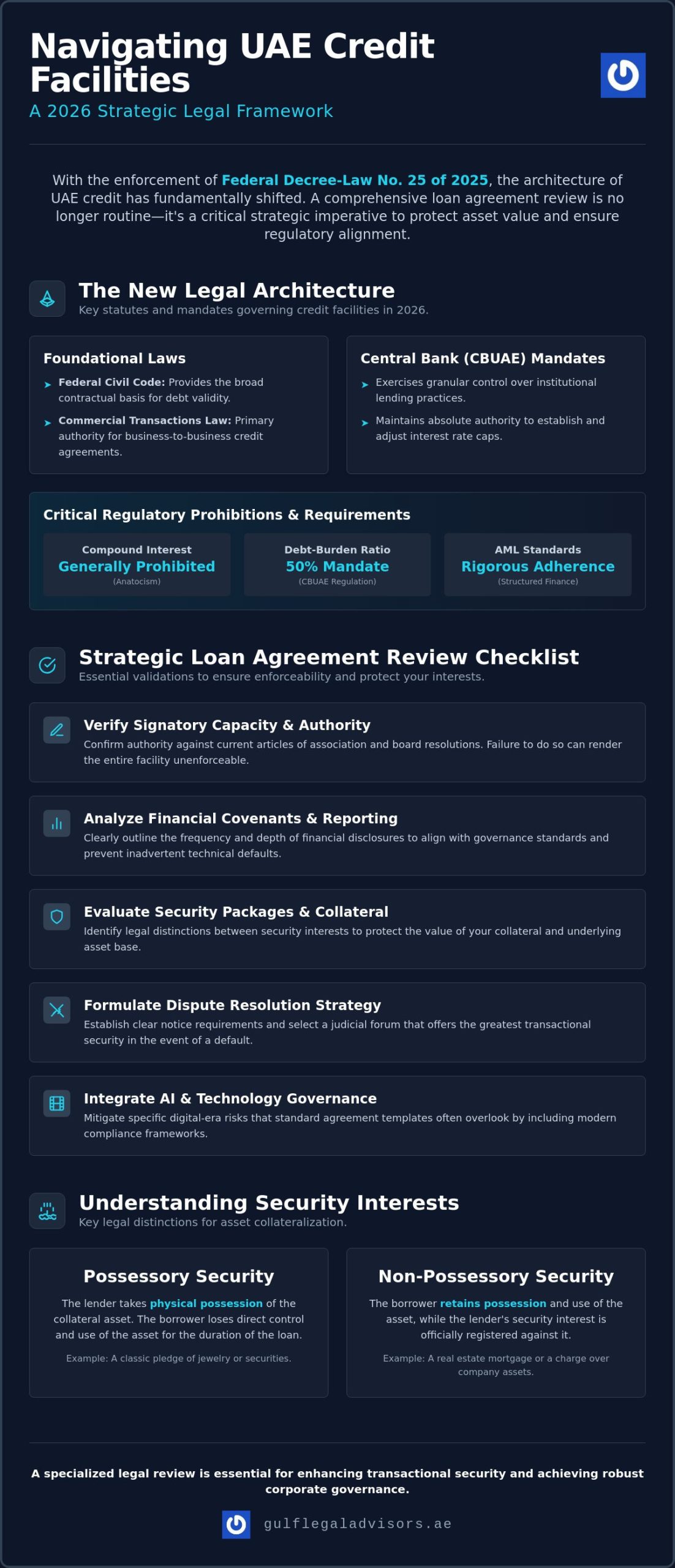
The legal architecture governing credit facilities in the Emirates rests upon a sophisticated hierarchy of federal statutes and specialized circulars. A meticulous loan agreement legal review UAE must account for the interplay between the Federal Civil Code and the mandates issued by the Central Bank of the UAE (CBUAE). While the Civil Code provides the broad contractual foundation for debt validity, the CBUAE exercises granular control over institutional lending practices. This distinction is vital. Commercial lending often enjoys greater contractual flexibility compared to the rigid consumer protections found in retail banking. The UAE Central Bank maintains absolute authority to establish and adjust interest rate caps to ensure market stability and prevent usurious practices as of 2026.
Federal Civil Code and Commercial Transactions Law
The Federal Decree-Law No. 25 of 2025, which entered into force on June 1, 2026, has refined the standards for debt recognition and repayment. It’s essential to recognize that the UAE Commercial Transactions Law serves as the primary authority for credit agreements between business entities. One of the most critical areas of focus remains the legal limitation on compound interest, or anatocism. Under UAE law, interest on interest is generally prohibited unless specifically permitted under commercial custom or institutional banking regulations. Ensuring that the key components of a loan agreement adhere to these statutory requirements is a prerequisite for enforceability in the national courts. High-value transactions must be documented in writing to satisfy evidentiary standards, reflecting a move toward greater transparency in the 2026 regulatory environment.
Regulatory Adherence in Structured Finance
Structured finance operations require a rigorous approach to compliance, particularly regarding national Anti-Money Laundering (AML) standards. Large-scale credit facilities often involve complex layers of security, necessitating a specialized investment fund legal advisory UAE to align the financing structure with current governance norms. Beyond internal compliance, entities must navigate mandatory reporting requirements for cross-border capital movements. These regulations ensure that the influx and outflow of liquidity remain within the parameters of the UAE’s strategic economic objectives. A successful loan agreement legal review UAE identifies these reporting triggers early, preventing administrative delays or penalties that could compromise the facility’s value. Proactive adherence to these standards reinforces the stability of the transaction and protects the reputations of all participating parties.
Strategic Checklist for Loan Agreement Legal Review
The execution of a rigorous loan agreement legal review UAE begins with the absolute authentication of corporate capacity. Signatory authority must be verified against current articles of association and the most recent board resolutions. Since the 2026 Civil Code update, which lowered the age of legal capacity to 18, the verification process for individual guarantors and family office representatives has become more streamlined but requires precise documentation. A failure to confirm that the signing party possesses the requisite power to bind the entity can render the entire facility unenforceable in the event of a dispute.
Corporate decision-makers must also prioritize the analysis of reporting obligations. In the current UAE’s regulatory landscape, transparency is a mandate rather than a preference. Loan documents should clearly outline the frequency and depth of financial disclosures. This ensures that the lender remains informed of the borrower’s fiscal health while the borrower avoids inadvertent technical defaults due to administrative oversight. Sophisticated entities often engage specialized banking and finance advisors to calibrate these reporting requirements against their existing operational capacities.
Repayment Structures and Financial Covenants
Evaluating the repayment profile is essential for managing long-term liquidity risk. Bullet repayment structures offer immediate capital flexibility but carry a significant refinancing burden at maturity. Conversely, amortizing schedules provide a steady path to deleveraging, which may be preferable in volatile sectors. Interest calculation methods must strictly align with national banking standards to avoid legal challenges regarding compound interest. Furthermore, the definition of a “Material Adverse Change” (MAC) requires modern precision. In the 2026 market, UAE courts look for specific financial triggers or regulatory events rather than broad, ambiguous declarations of economic shifts to justify the invocation of a MAC clause.
Representations, Warranties, and Negative Covenants
Representations and warranties function as the factual foundation of the credit relationship. “No Default” and “Pari Passu” representations are critical for ensuring that the borrower’s obligations to the lender remain on equal footing with other unsecured creditors. Negative covenants serve to protect the lender’s position by restricting the borrower from incurring further indebtedness or disposing of key assets without prior consent. The integration of structured finance legal counsel Dubai allows for the drafting of bespoke covenants that address the nuances of multi-jurisdictional capital markets and complex corporate structures.
The final pillar of the checklist involves a critical assessment of events of default and acceleration triggers. These clauses must be scrutinized for “cross-default” provisions, where a failure to pay one creditor triggers a default across all facilities. Ensuring these triggers are balanced with appropriate cure periods and notice requirements is a hallmark of a well-negotiated agreement. Aligning these default mechanisms with the 2023 Bankruptcy Law provides a clear, predictable path for restructuring or recovery, safeguarding the interests of all stakeholders involved in the transaction.
Evaluating Security Packages and Asset Collateralization
The security package represents the primary mechanism for mitigating credit exposure in high-stakes lending. A detailed loan agreement legal review UAE must distinguish between possessory security, where the lender physically holds the asset, and non-possessory security, which allows the borrower to maintain operational use. Federal Law No. 4 of 2020, commonly referred to as the Pledge Law, revolutionized this area by establishing the Emirates Movable Collateral Registry (EMCR). This electronic system provides a centralized platform for registering security over movable assets, ensuring that a lender’s priority is clearly documented and searchable by third parties. Corporate guarantees must be formally notarized to satisfy the statutory requirements for enforceability in national courts.
Perfection of Security over Tangible and Intangible Assets
Perfecting a security interest is the formal process of making it legally binding against third parties and liquidators. For real estate, this involves mandatory registration with the local Land Department. In jurisdictions like Dubai, a mortgage registration fee of 0.25% of the secured debt is required for perfection. Pledging shares in a UAE-based entity requires specific filings with the Department of Economy and Tourism or the relevant free zone authority. Security over bank accounts and receivables necessitates a formal notice of assignment to the account-holding institution. This notification is vital; without it, the lender may lose priority to subsequent creditors or find the account funds depleted before they can exercise their rights.
Corporate and Personal Guarantees
Guarantees serve as secondary obligations that provide lenders with additional recourse beyond the primary borrower’s assets. Drafting these instruments requires a deep understanding of the 2025 Civil Code to ensure they remain valid during corporate restructurings or potential insolvency. “All monies” guarantees are frequently utilized to cover all present and future liabilities, but they must be reviewed to ensure the guarantor’s obligations are clearly defined and limited. The intersection of banking and finance dispute resolution UAE is particularly relevant here, as courts strictly interpret guarantee terms during enforcement actions. Sophisticated agreements include specific waivers of statutory rights to prevent the guarantor from delaying payment through procedural objections. This level of technical precision ensures the security package provides the intended protection when financial distress arises.
Default Management and Dispute Resolution Strategy
Effective default management begins with the precise calibration of cure periods and notice protocols. A strategic loan agreement legal review UAE identifies potential friction points before they escalate into formal litigation. Notice requirements must be strictly followed to avoid procedural challenges in the Federal Courts; even minor deviations can delay enforcement for months. Cross-default provisions require particular attention in multi-facility environments. These clauses can trigger a systemic collapse across a corporate group’s entire debt portfolio if one minor obligation is missed, making the negotiation of materiality thresholds a vital exercise for the borrower. It’s essential to ensure these triggers are balanced with realistic timeframes for remediation to maintain operational continuity.
Jurisdictional Strategy and Arbitration
Selection of the appropriate dispute resolution forum is a tactical decision that impacts the speed of recovery. National arbitration centers offer confidentiality and specialized expertise for complex commercial credit disputes, often proving more efficient than traditional court systems for high-value matters. Drafting water-tight arbitration clauses prevents the jurisdictional delays that often plague financial litigation. While arbitration provides a final award, the Federal judiciary remains the essential partner for the recognition and enforcement of these financial awards. The UAE’s commitment to international treaties ensures that foreign judgments and arbitral awards are increasingly enforceable, provided they meet specific reciprocity and procedural standards. For organizations requiring specialized representation in these matters, our team provides expert Litigation & Arbitration services to secure your financial interests.
Remedies and Asset Recovery
Asset recovery in the 2026 landscape is governed by a modernized framework that prioritizes economic stability. The Federal Decree Law No. 51 of 2023 concerning Financial Restructuring and Bankruptcy significantly altered lender priority, introducing structured restructuring paths that may stay traditional foreclosure actions. Foreclosure of mortgaged assets requires a court order and a public auction process, which can be time-consuming if the underlying documentation is flawed. Pre-emptive measures, such as seeking interim relief or attachment orders, are necessary to protect asset value while litigation proceeds. Decision-makers must ensure their security documentation allows for rapid execution under these evolving rules to prevent the dissipation of collateral value during the recovery phase.
The Value of Specialized Legal Review: Enhancing Transactional Security
Reliance on standard templates often introduces systemic vulnerabilities into corporate credit structures. These generic documents fail to account for the unique operational risks or the multi-jurisdictional complexities inherent in modern UAE finance. A comprehensive loan agreement legal review UAE transcends basic proofreading. It involves a strategic audit of the entire facility to ensure alignment with the latest federal mandates and institutional requirements. Proactive advisory serves as the cornerstone of corporate integrity, preventing the hidden penalties and non-compliant interest clauses that frequently arise from using archaic or ill-fitted documentation. In a high-stakes environment, the difference between a functional agreement and an enforceable one lies in the technical precision of its drafting.
Modern Compliance and AI Governance in Finance
The digital transformation of the financial sector has introduced a new layer of regulatory scrutiny. As of 2026, the integration of AI-driven credit scoring and automated risk assessment tools requires specialized governance frameworks within loan documentation. Compliance with evolving data privacy standards is no longer optional; it’s a fundamental requirement for maintaining the validity of a credit agreement. Loan documents must reflect these 2026 technology governance standards to mitigate the risks associated with algorithmic bias and automated decision-making. Addressing these regulatory shifts early ensures that your financial structures remain resilient in an increasingly digitized commercial hub, where transparency and technological adherence are prioritized by the Central Bank.
Securing Your Financial Future
The strategic advantage of noun-heavy, precise legal drafting cannot be overstated. In a judicial environment that prioritizes clarity and evidentiary weight, the specific wording of a covenant or a representation often determines the outcome of a dispute. Maintaining stability in the fast-paced UAE commercial landscape requires a legal partner who functions as a sophisticated navigator of complex systems. Gulf Legal Advisors secures high-stakes financial transactions by combining deep-rooted expertise in Banking, Finance & Capital Markets with a contemporary understanding of regulatory shifts. Our focus remains on the delivery of results that protect asset value and provide a clear path for governance, ensuring that your capital remains secure despite market volatility.
A meticulous loan agreement legal review UAE is the ultimate safeguard for your institutional interests. It transforms a standard repayment schedule into a robust risk-mitigation instrument that stands up to the rigors of the national court system. By prioritizing technical precision and regulatory adherence, you ensure that your credit facilities support long-term growth without exposing the entity to unnecessary legal friction. To ensure your documentation meets these rigorous standards, consult with Gulf Legal Advisors for a strategic loan agreement review.
Securing Transactional Stability in the 2026 Regulatory Landscape
The evolution of the UAE financial landscape necessitates a transition from generic templates to bespoke, high-stakes legal frameworks. A meticulous loan agreement legal review UAE is the primary instrument for aligning your credit facilities with the new Federal Civil Code and the sophisticated mandates of the Central Bank. By integrating precise financial covenants and ensuring the rigorous perfection of security interests, you mitigate the risks of hidden penalties and unenforceable collateral. This strategic approach transforms a standard debt instrument into a robust asset-protection mechanism that withstands judicial scrutiny.
Gulf Legal Advisors offers the specialized expertise in UAE Banking and Finance law essential for managing complex corporate transactions. Our proven authority in high-stakes multi-jurisdictional dispute resolution and strategic advisory for corporate governance ensures your interests remain protected in a fast-paced global market. We specialize in navigating AI compliance and regulatory shifts, providing the intellectual depth needed to deliver results in the most intricate legal environments. Your path to transactional security begins with a partner who understands the gravity of your financial future. Maintaining a proactive legal posture ensures your business remains resilient and ready for the opportunities of the modern Emirates economy.
Secure Your Transaction with Expert Legal Review
Frequently Asked Questions
Is a loan agreement legally binding in the UAE without notarization?
Standard loan agreements are legally binding upon execution by authorized signatories; however, specific security instruments require formal notarization to be enforceable. Corporate guarantees and real estate mortgages must be notarized or registered with the relevant land department to satisfy evidentiary standards during a loan agreement legal review UAE. Failure to satisfy these formal requirements can lead to significant procedural delays in the national court system during enforcement actions.
What is the maximum interest rate allowed for commercial loans in the UAE?
The Central Bank of the UAE (CBUAE) regulates interest rates through periodic circulars rather than a single static cap for all commercial facilities. While fixed mortgage rates for 2026 often start at 3.99% per annum, commercial lending rates are determined by market conditions and specific risk profiles. Parties must ensure their agreed rates don’t exceed the prevailing legal limits established by the CBUAE to avoid potential challenges regarding contract validity.
Can a lender claim compound interest under UAE law?
Compound interest, or anatocism, is generally prohibited under the UAE Commercial Transactions Law. Courts typically disallow the charging of interest upon interest unless it aligns with specific banking customs or institutional regulations approved by the Central Bank. A comprehensive loan agreement legal review UAE identifies non-compliant interest clauses that could be struck down during judicial enforcement, protecting the borrower from unauthorized financial burdens.
How is security over movable assets perfected in the UAE?
Perfection of security over movable assets is achieved through registration with the Emirates Movable Collateral Registry (EMCR). Under Federal Law No. 4 of 2020, this electronic registration establishes a lender’s priority over other creditors without requiring physical possession of the asset. This system allows businesses to leverage their equipment and inventory while providing lenders with a secure, searchable record of their security interest.
What happens if a borrower defaults on a loan in the UAE?
A default grants the lender the authority to accelerate the total debt and initiate recovery procedures as defined in the agreement. This often involves invoking corporate guarantees, seeking attachment orders through the Federal Courts, or initiating arbitration proceedings. The process is governed by the 2023 Bankruptcy Law, which may introduce restructuring stays if the borrower enters formal financial distress proceedings to protect the entity’s remaining value.
Are electronic signatures valid for loan agreements in the UAE?
The 2026 Civil Code explicitly recognizes the validity of electronic signatures and digital communications for all contractual obligations. Federal Decree-Law No. 25 of 2025 provides the legal framework for the execution of digital contracts, supporting the continued modernization of banking services. Lenders must ensure their electronic signing platforms comply with national security standards to maintain the full evidentiary weight of the document in a legal forum.
How does the UAE Bankruptcy Law affect loan repayment priority?
Federal Decree Law No. 51 of 2023 prioritizes the restructuring of viable businesses, which can temporarily stay a lender’s right to enforce security. While secured creditors generally maintain their priority over the collateral value, the law introduces specific mechanisms for the distribution of assets during a formal liquidation. Understanding these shifts is a critical component of a modern loan agreement legal review UAE for institutional lenders and corporate borrowers alike.
What is the role of the Emirates Movable Collateral Registry (EMCR)?
The EMCR functions as the centralized national platform for the registration of non-possessory pledges over movable property. It provides a transparent mechanism for lenders to secure rights over assets like machinery, receivables, and inventory. This registry is vital for maintaining transactional security, as it determines the legal order of priority among multiple competing creditors in the event of a borrower’s insolvency or default.