



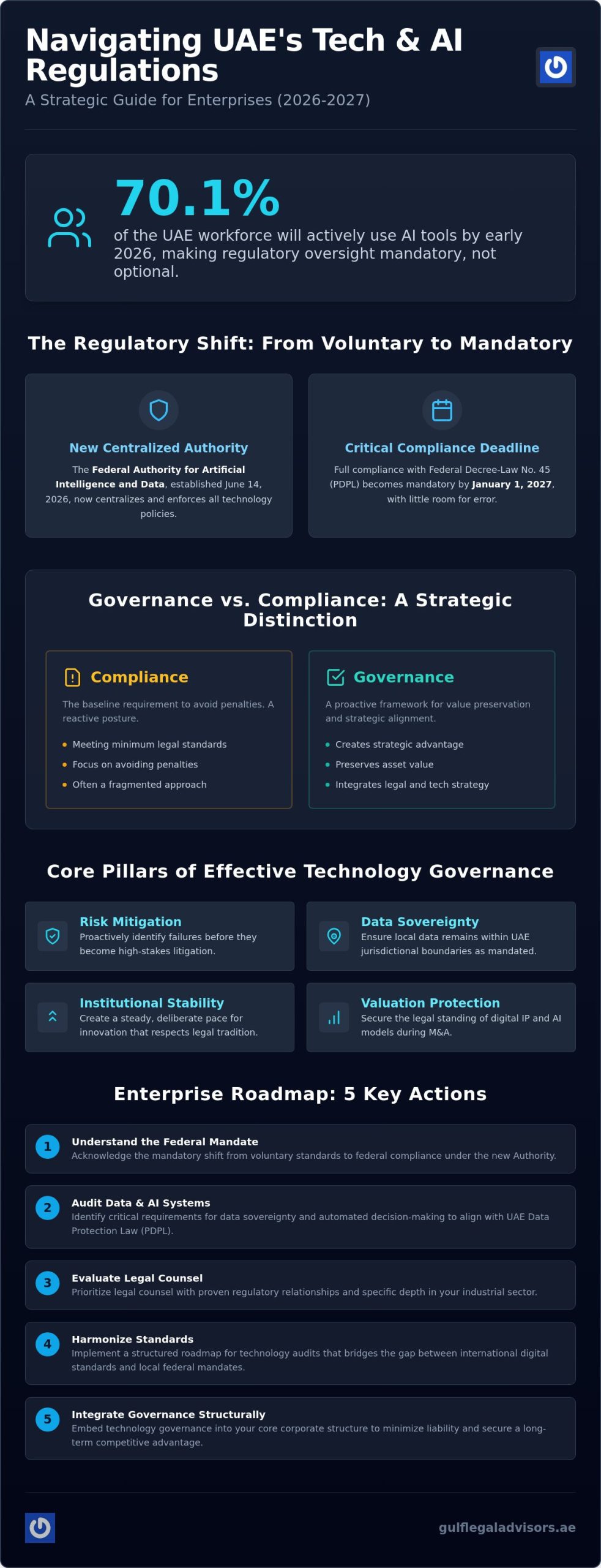
With 70.1% of the UAE workforce actively utilizing AI tools in early 2026, the shift from voluntary innovation to mandatory regulatory oversight is absolute. For enterprises operating within this high-velocity digital economy, securing sophisticated technology governance legal counsel UAE is the only way to transform regulatory pressure into a strategic advantage. The recent establishment of the Federal Authority for Artificial Intelligence and Data has centralized policy and enforcement, making it clear that fragmented compliance strategies are no longer sufficient to protect corporate assets or executive reputations.
You’re likely aware that the January 1, 2027, deadline for full PDPL compliance is approaching rapidly, leaving little room for error in data processing frameworks or cross-border transfers. This guide provides a comprehensive roadmap for aligning your digital innovation with federal mandates while effectively mitigating the risk of high-stakes litigation. We’ll examine the specific requirements of the new executive regulations, strategies for liability reduction in autonomous systems, and the essential steps for harmonizing international technology standards with the UAE’s evolving legal landscape.
Key Takeaways
- Understand the mandatory transition from voluntary digital standards to federal compliance under the newly established Federal Authority for Artificial Intelligence and Data.
- Identify critical requirements for data sovereignty and automated decision-making to ensure enterprise alignment with the UAE Data Protection Law.
- Establish a framework for evaluating technology governance legal counsel UAE by prioritizing regulatory relationships and specific industrial sector depth.
- Implement a structured roadmap for technology audits that bridges the gap between international digital standards and local federal mandates.
- Integrate technology governance into your broader corporate structure to minimize liability and secure a competitive advantage in the 2026 landscape.
The Shifting Landscape of Technology Governance Legal Counsel in the UAE
Technology governance represents the essential convergence of legal oversight, risk management, and digital strategy. It’s no longer a peripheral IT concern but a core pillar of corporate integrity. Engaging professional technology governance legal counsel UAE ensures these components aren’t siloed but integrated into the primary corporate architecture. This integration is vital during organizational changes, where corporate restructuring legal services UAE must now account for the transfer and valuation of algorithmic assets and data repositories. Legal counsel serves as the critical bridge between technical execution and board-level liability, translating complex code and data flows into actionable legal risk profiles.
The 2026 Regulatory Mandate
The UAE’s regulatory environment reached a definitive turning point on June 14, 2026, with the establishment of the Federal Authority for Artificial Intelligence and Data. This body has consolidated oversight, moving the nation from voluntary digital ethics toward mandatory federal compliance. Organizations now operate under a rigorous framework of Federal Decree-Laws that govern every facet of digital transformation. The UAE Cybersecurity Council has also seen its authority expand, taking a more active role in corporate oversight and incident response protocols. Standard corporate law is often insufficient for modern technology assets; it doesn’t possess the nuance required to address algorithmic bias, automated decision-making, or the specific requirements of Federal Decree-Law No. 45 of 2021 (PDPL) as now enforced by the 2026 executive regulations.
Governance vs. Compliance: A Strategic Distinction
While often used interchangeably, governance and compliance serve different functions within a sophisticated enterprise. Compliance is the baseline. It’s the act of meeting the minimum legal requirements to avoid penalties. In contrast, a formal approach to Technology Governance provides a proactive framework for value preservation and strategic alignment. It’s a differentiator that signals to investors and partners that an organization possesses the intellectual depth to manage technological shifts responsibly.
Effective governance frameworks focus on several key outcomes:
- Risk Mitigation: Identifying potential technology failures before they escalate into high-stakes litigation.
- Data Sovereignty: Ensuring local data remains within jurisdictional boundaries as mandated by federal law.
- Institutional Stability: Creating a steady, deliberate pace for innovation that respects the gravity of legal tradition.
- Valuation Protection: Securing the legal standing of digital IP and AI models during mergers or restructuring.
For the modern executive, the goal isn’t just to stay out of court. It’s to build a resilient system where digital innovation and regulatory adherence coexist. When technology governance legal counsel UAE is embedded in the decision-making process, the result is a robust, legally sound framework that prioritizes clarity and security in a complex global commercial hub. This methodical approach ensures that even as the pace of innovation accelerates, the legal foundations of the business remain immovable.
Core Pillars of Technology Governance and AI Regulation
The regulatory architecture in the UAE has matured into a structured system that demands granular oversight. The June 14, 2026, mandate establishing the Federal Authority for Artificial Intelligence and Data signifies a move toward unified enforcement across all digital portfolios. This transition requires technology governance legal counsel UAE to move beyond high-level advisory and into the technical specifics of algorithmic transparency and data localization. Securing specialized technology governance legal counsel UAE allows firms to align their cross-border data strategies with the specific requirements of this new federal authority, ensuring that innovation doesn’t outpace legal safety.
AI Governance and Algorithmic Accountability
The UAE’s approach to AI, influenced by the adoption of UNESCO’s Recommendation on the Ethics of Artificial Intelligence, now includes rigorous requirements for automated decision-making. Boards must ensure that “Agentic AI” models, which the government aims to deploy across 50% of sectors by 2028, are implemented with clear liability frameworks. If an autonomous system fails in an industrial or financial setting, the legal burden regarding bias mitigation and safety testing rests entirely with the enterprise. Drafting internal policies for ethical AI deployment is no longer a matter of corporate social responsibility; it’s a necessary step to mitigate high-stakes litigation and ensure algorithmic accountability.
Data Sovereignty and the Federal Data Law
Data sovereignty is an enforceable requirement under the now fully operational Executive Regulations for Federal Decree-Law No. 45 of 2021 (PDPL). Organizations have until January 1, 2027, to achieve full compliance with these mandates. This involves appointing qualified Data Protection Officers (DPOs) and securing legal pathways for cross-border transfers that satisfy both federal and free-zone regulators. Integrating these protocols with AML compliance legal advice UAE is essential for financial institutions, especially following the Central Bank’s April 2026 deadline prohibiting the use of instant messaging platforms like WhatsApp for customer services.
Cybersecurity resilience for Critical National Infrastructure (CNI) has also become a matter of national security, with the UAE Cybersecurity Council mandating rigorous stress-testing and incident disclosure protocols. For enterprises in the energy or maritime sectors, these requirements are legal obligations that define the scope of corporate liability during a breach. Expert guidance in compliance and AI governance helps your organization navigate these multi-layered mandates with a methodical and steady approach. This ensures that your digital strategy remains both compliant and strategically aligned with the UAE’s vision for a global commercial hub.
Evaluating Technology Governance Legal Counsel: A Strategic Framework
Selecting technology governance legal counsel UAE requires a definitive move away from generalist oversight toward specialized industrial depth. While generalist firms often handle broad corporate matters with competence, they frequently lack the technical fluency needed to interpret the intersection of UAE federal mandates and international frameworks like ISO/IEC 38500. Sophisticated decision-makers prioritize counsel with established regulatory relationships and a proven record in high-stakes environments. This specialized expertise is vital for navigating the transition from transactional advisory to commercial dispute resolution Dubai, where the technical cause of a system failure often dictates the legal outcome.
The evaluation of external legal partners involves assessing their ability to harmonize UAE Federal Law with global standards such as the NIST Cybersecurity Framework or the ISO/IEC 42001 standard for AI management. A firm’s profile should reflect a deep-rooted expertise that suggests stability in the face of rapid technological shifts. It’s about finding a strategic partner who possesses both the intellectual depth to handle intricate multi-jurisdictional matters and the practical focus to deliver results within the UAE’s specific judicial landscape. The right counsel doesn’t just identify risks; they build the frameworks that allow for secure, confident innovation.
Sector-Specific Expertise: Oil, Gas, and Maritime
Industrial sectors such as Oil, Gas, and Maritime present unique governance challenges that consumer-facing technology advice simply can’t address. In the energy sector, governance must encompass the security of SCADA systems and the legal implications of AI-driven predictive maintenance in offshore environments. Similarly, the rise of autonomous vessels and digital port operations in the UAE necessitates a legal framework that addresses multi-jurisdictional maritime laws alongside federal digital transformation decrees. These industrial assets require a grounded, reassuring presence from counsel who understands that a technology failure in a port or refinery carries far greater consequences than a software bug in a retail application. The legal approach must be as robust as the infrastructure it protects.
The Role of Counsel in Dispute Mitigation
Mitigating risk starts long before a conflict reaches a tribunal. Counsel should implement “Governance-by-Design” by drafting technical performance standards and data ownership rights directly into commercial agreements. This proactive approach is particularly relevant in maritime dispute resolution Dubai, where digital evidence from autonomous systems now plays a central role in arbitration. Preparing for technology-related arbitration in UAE forums, such as the Dubai International Arbitration Centre (DIAC), requires a methodical hierarchy of information that bridges the gap between engineering reality and judicial interpretation. Effective counsel ensures that the governance framework is not just a policy document but an enforceable shield in the event of a dispute.
Implementing a Robust Technology Governance Roadmap
Transitioning from regulatory awareness to operational resilience requires a methodical progression. A roadmap isn’t merely a checklist; it’s a strategic alignment of digital assets with the UAE’s evolving legal standards. Securing technology governance legal counsel UAE ensures that this roadmap remains grounded in federal reality while facilitating innovation. This process moves through four distinct phases: comprehensive auditing, legislative alignment, board-level accountability, and compliance integration. By following this structured path, enterprises can transform their digital infrastructure into a legally sound asset that withstands scrutiny from the Federal Authority for Artificial Intelligence and Data.
The Technology Audit: Identifying Latent Legal Risks
The first stage involves a rigorous assessment of the enterprise’s technological footprint. Legacy systems often harbor significant vulnerabilities that fail to meet modern cybersecurity mandates established by the UAE Cybersecurity Council. Mapping data flows is essential to verify adherence to the sovereignty requirements of Federal Decree-Law No. 45 of 2021, especially with the January 1, 2027, compliance deadline approaching. A critical focus of the audit is the identification of “Shadow IT,” which includes unauthorized cloud services or software used by departments without central oversight. These hidden assets create unaccounted liability and potential points of failure that can lead to high-stakes litigation if they aren’t properly governed and brought into the formal corporate structure.
Board-Level Reporting and Fiduciary Duty
Technology risk is now a matter of fiduciary responsibility. Directors can’t view digital strategy as a technical silo; they must treat it as a core component of corporate oversight. Establishing a dedicated Technology Governance Committee allows for specialized focus on AI ethics, data privacy, and infrastructure resilience. Professional technology governance legal counsel UAE plays a vital role in these committees by providing quarterly governance reviews that translate technical metrics into legal risk profiles. This ensures the board possesses the clarity needed to make informed decisions regarding digital investments and risk appetite, fulfilling their duty to protect shareholder value from technological failure or regulatory breach.
The final phase integrates technology risk into the broader corporate compliance framework. This alignment prevents the fragmentation of governance and ensures that digital protocols are as robust as the firm’s financial or operational controls. For enterprises seeking to secure their digital future, a structured approach is the only way to mitigate liability effectively. Organizations requiring a sophisticated navigator for these complex systems should consult with expert legal counsel to begin their governance audit and roadmap development.
Gulf Legal Advisors: Strategic Technology Counsel for the UAE
Gulf Legal Advisors functions as a sophisticated navigator within the UAE’s increasingly intricate technological and regulatory frameworks. We provide a grounded, reassuring presence for high-stakes decision-makers who require clarity in complex environments. By serving as technology governance legal counsel UAE, the firm ensures that digital innovation remains anchored in legal stability. Our approach is methodical and purpose-driven, moving from broad institutional strengths to specific technical niches that define the modern business landscape. We don’t just react to change; we prepare our clients to lead through it with a focus on long-term institutional security.
A Multi-Disciplinary Approach to Digital Law
Our expertise as M&A legal advisors UAE directly informs our approach to technology due diligence. During corporate restructuring or acquisition, the valuation of AI models and data repositories depends entirely on their regulatory standing. We bridge the gap between industrial sector advisory and digital law, ensuring that technology governance is never treated as a standalone silo. This synergy is particularly vital for clients in the Oil, Gas, and Maritime sectors, where the integration of autonomous systems and predictive algorithms requires a deep understanding of both federal mandates and operational realities. Our multi-disciplinary teams ensure that technical assets are protected from the moment of inception through to global deployment.
Our firm specializes in several core areas of digital and corporate law:
- Compliance & AI Governance: Establishing frameworks for algorithmic accountability and transparency.
- Litigation & Arbitration: Resolving high-stakes technology disputes in UAE and international forums.
- Corporate & M&A: Managing the legal complexities of digital asset transfers and technology-driven mergers.
- Regulatory Adherence: Navigating the mandates of the Federal Authority for Artificial Intelligence and Data.
Securing Your Digital Future
Engaging technology governance legal counsel UAE early in the digital transformation journey is a strategic necessity. We protect asset value through the implementation of rigorous governance frameworks that anticipate regulatory shifts before they manifest as liabilities. Our commitment to unwavering professionalism ensures that every client receives a bespoke strategy aimed at long-term security. Whether handling technology-related arbitration or establishing a compliance roadmap for the January 1, 2027, PDPL deadline, Gulf Legal Advisors delivers results through intellectual depth and practical focus. Secure your organization’s digital future by aligning with a partner that respects the gravity of legal tradition while navigating the frontiers of innovation.
Securing Operational Stability in a Digital Economy
The regulatory shifts of 2026 have redefined the legal obligations of UAE enterprises. With the establishment of the Federal Authority for Artificial Intelligence and Data, the transition from voluntary digital ethics to mandatory federal compliance is complete. Organizations must now prioritize the audit of digital assets and the alignment of data flows with sovereignty mandates to protect corporate value. Securing technology governance legal counsel UAE provides the intellectual depth required to navigate these complex multi-jurisdictional requirements while maintaining a steady focus on practical results.
Gulf Legal Advisors offers a grounded, reassuring presence for leaders in high-stakes sectors. Our expertise in UAE Federal Decree-Laws and specialized advisory for industrial sectors like maritime and energy ensures your innovation remains legally sound. We combine proactive governance with comprehensive dispute resolution and arbitration capabilities to mitigate liability effectively. Contact Gulf Legal Advisors for Strategic Technology Governance Counsel to ensure your digital strategy is both resilient and compliant. Your organization’s transition into this new regulatory era can be a source of enduring competitive strength.
Frequently Asked Questions
What is the primary role of technology governance legal counsel in the UAE?
The primary role is to align an organization’s digital innovation with federal legal mandates while mitigating board-level liability. This includes drafting enforceable governance frameworks that address algorithmic accountability and data sovereignty. Engaging technology governance legal counsel UAE ensures that technical execution doesn’t outpace regulatory compliance, particularly during complex cross-border operations or high-stakes industrial deployments where the legal risks of technology failure are most acute.
How does the UAE Federal AI Law affect existing corporate operations?
Existing operations must now integrate transparency and bias mitigation protocols as required by the 2026 federal mandates. Companies using automated decision-making systems are legally responsible for the outputs and ethical deployment of their models. This shift requires a methodical review of all AI-driven processes to ensure they meet the national AI strategy standards and avoid potential litigation resulting from system failures or discriminatory outcomes in automated processing.
Are international technology companies subject to UAE federal data laws?
International entities are subject to UAE federal data laws if they process the personal data of UAE residents, regardless of where the company is headquartered. The Personal Data Protection Law (PDPL) and its 2026 Executive Regulations apply to any organization targeting the UAE market. Non-compliance by the January 1, 2027, deadline can result in significant penalties and may lead to restrictions on future regional operations and data processing activities.
What are the legal consequences of a cybersecurity breach for a UAE board?
A cybersecurity breach can lead to claims of a breach of fiduciary duty if the board failed to implement adequate oversight and risk mitigation frameworks. Under the guidance of the UAE Cybersecurity Council, directors are increasingly held accountable for institutional resilience. Legal consequences include regulatory fines, high-stakes litigation from affected parties, and potential judicial intervention in corporate management if negligence in technology governance is proven during a breach investigation.
How does technology governance impact corporate restructuring in the UAE?
Technology governance is a critical component of due diligence during mergers, acquisitions, or restructuring. It ensures that digital assets, such as proprietary algorithms and data repositories, are legally protected and transferable under federal law. Failure to establish clear governance can lead to significant valuation drops or the collapse of a deal if the target’s digital infrastructure doesn’t meet mandatory compliance standards or contains unaccounted liability risks.
Is technology governance mandatory for private companies in the UAE?
Technology governance is mandatory for private companies that handle personal data or utilize artificial intelligence in their decision-making processes. While specific frameworks vary by sector, the federal mandates regarding data sovereignty and AI accountability apply to all commercial entities. Professional technology governance legal counsel UAE helps private firms navigate these requirements to ensure their digital strategy remains compliant with the latest executive regulations and federal decree-laws.
How can legal counsel help in technology-related arbitration?
Legal counsel facilitates the translation of complex technical failures into actionable legal arguments within arbitration forums like DIAC. By drafting “Governance-by-Design” clauses into initial contracts, counsel establishes the evidentiary standards used during a dispute. This proactive approach ensures that digital logs and algorithmic performance data are admissible and structured to support the organization’s position in the event of a system failure or a breach of technical performance standards.
What is the difference between IT governance and technology governance legal counsel?
IT governance focuses on the internal management and operational efficiency of technology systems within an organization. In contrast, technology governance legal counsel addresses the external legal risks, regulatory adherence, and liability frameworks associated with those systems. Counsel provides the strategic oversight needed to protect the enterprise from litigation and ensures that all technological deployments remain within the boundaries of UAE federal law and international regulatory standards.