



In the high-stakes environment of global shipping, the choice of forum in the Emirates is not merely a procedural formality; it’s a strategic lever that dictates the speed of asset recovery and the ultimate enforceability of a claim. Many shipowners and charterers find themselves caught between the jurisdictional nuances of federal courts and offshore centers like the DIFC, often facing the immediate threat of vessel arrest or the uncertainty of enforcing foreign arbitral awards. It’s a complex landscape where operational downtime can quickly erode commercial value.
This resource provides a comprehensive examination of maritime dispute resolution Dubai, offering the clarity required to navigate the UAE legal framework with precision. You’ll gain insights into the strategic protection of maritime assets and the mechanisms for swift resolution of charterparty or cargo disputes. We analyze the critical shifts introduced by the 2024 Federal Maritime Law and the 2026 amendments to the Civil Procedure Code; focusing on how these regulatory updates influence everything from precautionary arrests to the mandatory mediation thresholds now required for commercial claims.
Key Takeaways
- Understand the foundational shifts in maritime governance under Federal Decree-Law No. 43 of 2023 to ensure alignment with the latest UAE shipping regulations.
- Evaluate the tactical advantages of maritime dispute resolution Dubai by balancing the confidentiality of international arbitration against the rapid asset-seizure capabilities of Federal Courts.
- Identify the specific legal thresholds required to secure vessel arrest warrants and distinguish between the enforcement of maritime liens and statutory rights of action.
- Implement robust pre-action protocols, prioritizing the systematic preservation of technical evidence and the rigorous analysis of governing law clauses within Bills of Lading.
Table of Contents
-
The Regulatory Landscape of Maritime Law in the United Arab Emirates
-
Comparative Analysis: Maritime Arbitration vs. Federal Litigation
-
Strategic Asset Protection: Managing Vessel Arrests and Liens
-
Gulf Legal Advisors: Authoritative Counsel in Maritime Dispute Resolution
The Regulatory Landscape of Maritime Law in the United Arab Emirates
The foundation of maritime governance in the UAE rests upon a dual-layered legislative framework. Historically, Federal Law No. 26 of 1981, known as the Maritime Code, established the bedrock for vessel registration, mortgage enforcement, and crew management. While this code remains influential in contemporary judicial interpretations, the enactment of Federal Decree-Law No. 43 of 2023 marks a transformative shift in the nation’s approach to shipping. This modern legislation addresses evolving challenges in maritime dispute resolution Dubai, enhancing the UAE’s position as a global logistics hub through refined standards for vessel arrests and maritime liens.
Regulatory oversight is centralized under the UAE Ministry of Energy and Infrastructure. This body manages the technical and administrative aspects of maritime transport, ensuring domestic operations align with the broader principles of global maritime law. The Ministry’s role is critical for maintaining safety standards and environmental compliance. It provides the necessary administrative stability that international shipowners require when operating within the region’s busy trade routes.
Federal Law vs. International Standards
The UAE maintains a sophisticated balance between local statutes and international treaties. Although the nation is a signatory to the Hamburg Rules, the interplay between these conventions and federal law requires precise strategic navigation. The 1981 Code continues to provide a predictable baseline for admiralty courts, particularly regarding carrier liability and cargo claims. The United Arab Emirates maintains absolute sovereign jurisdiction over its territorial sea, extending twelve nautical miles from the coastal baseline, encompassing all maritime activities and disputes occurring within these limits.
Corporate Structures and Maritime Liability
Vessel ownership in the UAE often utilizes complex corporate arrangements to ring-fence liability and optimize operational efficiency. Effective governance within these structures is paramount for mitigating risks associated with maritime debts or operational negligence. For entities considering expansion or consolidation, understanding the intersection of shipping law and The Strategic Framework of M&A Legal Advisory in the United Arab Emirates is essential for managing the legal complexities of maritime mergers. These corporate vehicles must be structured with a clear view of maritime dispute resolution Dubai to ensure that parent companies remain insulated from the specific liabilities of individual vessels or specialized fleets. Shipowners and operators engaged in fleet reorganisation or ownership transfers should also consider how corporate restructuring legal services UAE can provide the legal architecture necessary to manage liability exposure and optimize corporate structures in alignment with the 2026 regulatory environment.
Comparative Analysis: Maritime Arbitration vs. Federal Litigation
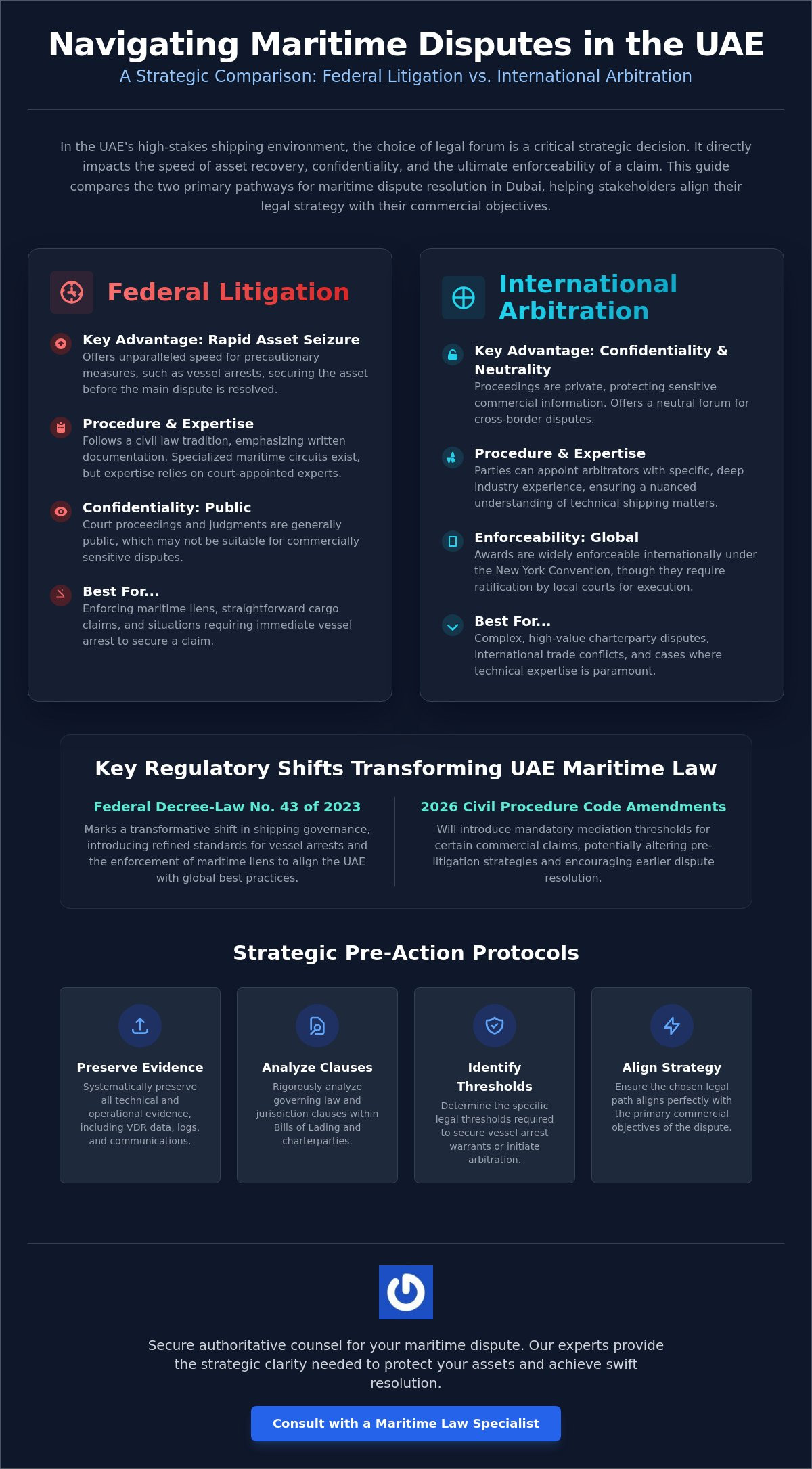
Selecting the appropriate forum for maritime dispute resolution Dubai is a decision that impacts both the timeline and the finality of a legal claim. While arbitration is often the preferred choice for complex charterparty disagreements, federal litigation offers unique tactical advantages, particularly when immediate asset security is required. The strategic selection depends on whether a claimant prioritizes the confidentiality of an arbitral award or the coercive power of a court-ordered vessel arrest. Each path presents distinct procedural requirements and cost structures that must be aligned with the commercial objectives of the dispute.
Technical expertise varies significantly between these two pathways. The UAE court system has established specialized maritime circuits within the commercial divisions to handle shipping matters, yet the civil law tradition emphasizes written documentation and court-appointed experts. Conversely, arbitration allows parties to appoint adjudicators with specific industry experience, ensuring a deeper understanding of technical shipping nuances. Choosing the right forum isn’t just about legal preference; it’s about matching the complexity of the dispute to the forum’s capacity for technical analysis.
The Role of International Arbitration Centers
Arbitration provides a neutral, specialized environment for resolving cross-border shipping conflicts. The Dubai International Arbitration Centre (DIAC) serves as the primary regional hub, offering updated rules that align with UNCITRAL standards. This forum is especially effective for high-value disputes where parties require arbitrators with deep technical knowledge of maritime commerce. As of January 2025, DIAC has implemented a revised fee structure, including a non-refundable registration fee of USD 3,000. This administrative framework is designed for efficiency, though parties must account for arbitrator fees that scale with the claim’s value.
Navigating Federal Maritime Litigation
Federal litigation remains the indispensable route for claims requiring summary relief or the enforcement of maritime liens. UAE Federal Courts possess exclusive jurisdiction over precautionary vessel arrests, a critical tool for securing claims before a ship leaves territorial waters. Unlike the private nature of arbitration, court proceedings are conducted in Arabic, and all documentary evidence must be legally translated. This environment prioritizes a formalistic approach to evidence. For claimants seeking the most robust enforcement mechanism, the national court system provides a direct path to execution, often with lower administrative costs. In onshore Dubai Courts, commercial fees are capped at AED 40,000, providing a predictable ceiling for significant claims. Engaging experienced maritime counsel ensures that the chosen path remains strategically sound throughout the litigation lifecycle.
Strategic Asset Protection: Managing Vessel Arrests and Liens
The ability to secure a vessel arrest warrant remains the most decisive tactical instrument within maritime dispute resolution Dubai. It’s a procedure that requires more than a mere allegation of debt; claimants must present prima facie evidence of a maritime debt as defined under the 22 categories specified in Article 53(2) of the new Federal Maritime Law. This high threshold ensures that the power to detain a commercial asset is exercised with legal precision, protecting the flow of international trade while providing creditors with a robust mechanism for security. It’s not enough to simply claim a loss; the documentation must be irrefutable and translated with technical accuracy.
Strategic asset protection also involves managing the inherent risks of wrongful arrest. Under the regulatory shifts effective as of March 2024, claimants are now required to provide a financial guarantee to cover the vessel’s maintenance and crew expenses during the period of detention. This counter-security serves as a critical check against frivolous claims and protects the interests of the shipowner. For owners facing detention, the recent acceptance of P&I Club Letters of Undertaking (LOU) to lift arrests provides a more efficient alternative to traditional cash deposits, allowing for the rapid restoration of operational status without tying up significant liquidity.
Procedural Requirements for Arrest Warrants
Executing an arrest warrant involves a coordinated effort between the judiciary and port authorities. Success depends on the immediate submission of translated documents that verify the existence and maturity of the claim. Once the court issues the order, the relevant port authority takes custody of the vessel’s certificates, effectively grounding the ship. Following the execution of a precautionary arrest, the claimant must file a substantive lawsuit on the merits of the case within eight days to maintain the validity of the detention and prevent the arrest from being automatically vacated.
Maritime Liens and Priority of Claims
The ranking of claims is a fundamental aspect of maritime governance in the UAE. Maritime liens, which attach to the vessel regardless of ownership changes, hold a privileged status over general commercial debts. The priority of these claims is strictly defined:
-
Crew wages and repatriation expenses incurred during service on the vessel.
-
Salvage rewards and contributions to general average.
-
Claims for loss of life or personal injury resulting from vessel operations.
-
Port, canal, and other waterway dues.
Mortgagees and other secured creditors must understand these rankings to protect their interests in distressed assets. Strategic counsel ensures that claimants accurately categorize their rights of action, whether they stem from a true maritime lien or a statutory right, to maximize the probability of recovery during a judicial sale. For entities managing complex portfolios,
[specialized maritime advisory
](https://gulflegaladvisors.ae)is essential for navigating these priority hierarchies and ensuring that claims aren’t diluted by lower-priority obligations.
Procedural Roadmap for International Maritime Claims
Successful maritime dispute resolution Dubai begins with a rigorous analysis of the contractual framework, specifically the Bill of Lading and any incorporated charterparty terms. These documents dictate the governing law and the designated forum, which are the primary determinants of the litigation strategy. In the wake of the 2026 amendments to the Civil Procedure Code, the UAE has moved toward a front-loaded evidence system. This requires claimants to present a comprehensive body of evidence at the initial filing stage, making the early assessment of jurisdictional clauses and limitation periods a critical priority for any international shipping entity. For maritime enterprises undergoing ownership transitions or group reorganisations, proactively engaging corporate restructuring legal services UAE alongside maritime counsel ensures that procedural obligations and corporate compliance requirements are addressed in a coordinated and strategically coherent manner.
Pre-action protocols now demand a methodical approach to formal notices and the preservation of technical data. When a maritime incident occurs on the high seas, managing multi-jurisdictional complexities requires immediate coordination between legal counsel and technical teams. It’s essential to issue "letters of protest" and formal notices of claim without delay to protect future rights of action. Drafting the statement of claim for specialized maritime circuits within the UAE courts involves a precise alignment of factual allegations with the specific requirements of Federal Decree-Law No. 43 of 2023, ensuring that every legal argument is supported by admissible evidence from the outset.
In the UAE, maritime labour claims are governed primarily by the UAE Maritime Law (Federal Decree-Law No. 43 of 2023) rather than the ordinary labour law provisions that apply to most shore-based employees. The law specifically protects seafarers working under a Seafarer Employment Agreement.
Who Can File a Maritime Labour Claim?
1. UAE Residents Working on Vessels
A resident employed as a captain, officer, engineer, deck crew member, or other seafarer on a vessel may file claims for:
-
Unpaid wages and salary
-
Overtime or contractual benefits
-
Annual leave pay
-
End-of-service entitlements
-
Medical expenses and compensation for injury or illness
-
Repatriation expenses
-
Wrongful termination
-
Breach of Seafarer Employment Agreement
The Maritime Law expressly provides that wages must be paid according to the employment contract and that seafarers may bring claims arising from their employment agreements before UAE courts.
2. Offshore Workers (Foreign Crew / Non-Residents)
Non-resident seafarers and foreign crew members working on:
-
UAE-flagged vessels,
-
Vessels operating in UAE waters,
-
Ships calling at UAE ports,
may also bring maritime labour claims in the UAE in many circumstances.
The law grants UAE courts jurisdiction over claims arising from seafarer employment contracts unless another valid jurisdiction agreement exists.
Special Protection for Seafarers’ Wages
One of the strongest remedies available to maritime workers is a maritime lien for wages.
This means unpaid wages rank among the highest-priority claims against a vessel and can support an application to arrest the ship in appropriate cases. UAE maritime law recognizes employment-related debts of captains and crew as maritime claims.
Injury, Illness and Death Claims
If a seafarer becomes injured or ill while serving on board:
-
The shipowner must generally pay wages during the period of incapacity until repatriation.
-
Medical treatment and accommodation costs must be covered.
-
Compensation may also be payable depending on the circumstances.
Abandoned Crew and Unpaid Salaries
The Maritime Law contains specific protections where:
-
Crew salaries remain unpaid.
-
A vessel is abandoned.
-
Seafarers are stranded.
If wages remain unpaid for two consecutive months and the vessel is abandoned, the authorities may take action against the shipowner’s vessels and sell assets to satisfy wage claims.
Procedure for Filing a Maritime Labour Claim
Depending on the facts, a claimant may:
-
File a labour or maritime claim before the competent UAE court.
-
Seek a precautionary arrest of the vessel where wage claims qualify as maritime debts.
-
Claim unpaid wages, leave, compensation, medical costs, repatriation expenses and other contractual benefits.
-
Enforce the judgment against the vessel, shipowner or other liable parties.
Key Difference Between Shore-Based and Maritime Employees
| Shore-Based Employees | Seafarers / Offshore Maritime Workers |
|---|---|
| Governed mainly by UAE Labour Law | Governed primarily by UAE Maritime Law |
| MOHRE usually handles disputes first | Maritime courts may have direct jurisdiction |
| No ship arrest remedy | Vessel arrest may be available |
| Standard labour claims | Maritime liens and maritime claims available |
Practical Example
If an Indian or Filipino crew member working on a UAE-flagged vessel is owed 6 months’ salary and the vessel arrives in Dubai, the crew member may seek:
-
Recovery of unpaid wages,
-
Repatriation expenses,
-
Compensation where applicable, and
-
In appropriate circumstances, arrest of the vessel as security for the claim.
If you are dealing with a specific maritime labour dispute in the UAE (unpaid wages, abandonment, injury, termination, vessel arrest, offshore oil-rig worker status, etc.), Gulf Legal Advisors, can provide the exact legal basis, jurisdiction, limitation period, and claim procedure applicable to that situation.
Evidence Gathering and Expert Testimony
The role of independent surveyor reports is indispensable in cargo damage or collision disputes. UAE courts place significant weight on the findings of experts who are formally recognized by the federal judicial system. Beyond traditional surveys, the utilization of digital evidence, including Automatic Identification System (AIS) data and Voyage Data Recorder (VDR) logs, has become a standard requirement in contemporary maritime dispute resolution Dubai. This data provides an objective record of vessel movements and operational parameters, which is vital for reconstructing incidents and establishing liability in complex admiralty matters; for specialized cybersecurity solutions to protect such critical enterprise data.
Enforcement of Awards and Judgments
Securing a favorable award is only the midpoint of the resolution process; the ultimate objective is the successful recovery of assets. The UAE’s status as a signatory to the 1958 New York Convention ensures that foreign arbitral awards are enforceable in over 170 countries, provided the procedural requirements for domestication are met. Within the region, the GCC Convention facilitates a streamlined process for the recognition of judgments across member states. For claims exceeding AED 500,000, the right to appeal to the Court of Cassation provides a final layer of judicial review. Once a judgment is finalized, practical steps for asset seizure, such as the attachment of bank accounts or the judicial sale of a vessel, must be executed with speed to prevent the dissipation of assets. Maritime entities operating in the UAE must also ensure that their financial flows and ownership structures remain fully compliant with evolving anti-money laundering regulations; securing AML compliance legal advice UAE is an increasingly critical component of any comprehensive asset recovery and enforcement strategy. For entities requiring a structured approach to these complex procedures, engaging authoritative maritime counsel is the most effective way to ensure a successful outcome.
Gulf Legal Advisors: Authoritative Counsel in Maritime Dispute Resolution
Gulf Legal Advisors operates at the nexus of technical shipping expertise and sophisticated legal strategy. Our firm provides a grounded, reassuring presence for high-stakes decision-makers who require clarity and security within the UAE’s complex judicial environment. We recognize that maritime dispute resolution Dubai demands more than a general understanding of commercial law; it requires a deep, functional integration with the nation’s regulatory bodies and specialized maritime circuits. Our approach is characterized by a commitment to resolute action and the meticulous preservation of commercial asset value through every stage of a dispute.
The firm serves as a sophisticated navigator of complex systems, possessing the intellectual depth to handle intricate multi-jurisdictional matters. We prioritize a logical, top-down flow of information, ensuring that our clients are fully informed of the tactical implications of every procedural choice. By maintaining a steady, deliberate pace in our communication and execution, we provide the stability required to manage the risks of vessel arrest and operational downtime. Our focus remains on delivering results through the sheer clarity and professional polish of our legal presentation, ensuring that claims are enforced and assets are protected with unwavering precision.
Specialized Sector Expertise
Our capabilities extend to the critical intersection of Oil & Gas and maritime transport liabilities. This specialized focus allows for the comprehensive management of disputes involving offshore energy infrastructure and complex charterparty agreements. We provide authoritative representation in high-profile admiralty matters across the UAE, utilizing a lexicon that reflects a high level of specialized knowledge in both the corporate and maritime sectors. This expertise ensures that our advisory services are contemporary and attuned to the fast-paced, modern business landscape of a global commercial hub, where the boundary between maritime law and energy regulation is often fluid.
To maintain a competitive edge in this global trade hub, many maritime enterprises are now utilizing AI-driven tools to optimize their outreach; for example, Global AI Reps provides specialized sales automation that helps shipping firms grow their client base while maintaining focus on operational compliance.
Strategic Partnership and Resolution
The personality of our firm is that of the authoritative expert and the strategic partner. We move beyond traditional representation to offer strategic commercial counsel that prioritizes regulatory adherence and long-term structural stability. Our resolution strategies are designed to be methodical and highly efficient, moving from broad institutional strengths to specific technical niches. We invite entities requiring a serious, focused, and profoundly competent approach to shipping law to contact our consultants for a confidential review of their maritime legal requirements. Engaging with Gulf Legal Advisors ensures that your maritime interests are managed by a modern innovator that respects the gravity of legal tradition while delivering practical, resolute results.
Securing Commercial Stability in UAE Maritime Operations
The evolving legal landscape in the Emirates demands a proactive approach to risk management and asset protection. Successfully navigating maritime dispute resolution Dubai requires a precise understanding of the interplay between the 2024 Maritime Law and the procedural nuances of both federal courts and international arbitration centers. By prioritizing the systematic preservation of evidence and selecting the most effective forum for enforcement, shipowners and charterers can mitigate the operational risks of vessel detention and secure their commercial interests in this global trade hub.
Gulf Legal Advisors provides the specialized expertise necessary to resolve high-stakes shipping conflicts with unwavering professionalism. Our established track record in maritime and oil & gas law ensures that our clients receive sophisticated representation across UAE Federal Courts and international arbitration forums. We remain committed to delivering resolute legal action that prioritizes your commercial stability and asset value. Engage Gulf Legal Advisors for Strategic Maritime Counsel to ensure your interests are protected by a partner with deep-rooted regional expertise and a focus on practical results. It’s our priority to provide the clarity and security your business requires in this complex environment.
Frequently Asked Questions
What are the primary grounds for vessel arrest in the UAE?
Grounds for vessel arrest are strictly categorized as "maritime debts" under Article 53(2) of Federal Decree-Law No. 43/2023. These categories include claims for damage caused by the vessel, loss of life, salvage operations, and disputes related to charterparty agreements. Creditors must demonstrate a maritime claim that’s certain and due, while providing a financial guarantee to cover potential damages in the event of a wrongful arrest.
How long does a typical maritime arbitration take in the UAE?
A typical maritime arbitration through the Dubai International Arbitration Centre (DIAC) generally spans six to twelve months from the constitution of the tribunal to the final award. This timeline varies based on the complexity of the technical evidence and the volume of witness testimony. Expedited procedures are available for smaller claims to ensure a more efficient resolution of straightforward commercial disagreements and contractual disputes.
Can foreign maritime court judgments be enforced in the UAE?
Foreign maritime judgments are enforceable in the UAE provided there’s a treaty for the mutual enforcement of judgments or established reciprocity with the issuing jurisdiction. The UAE courts will verify that the foreign court had jurisdiction and that the judgment doesn’t contradict UAE public policy. This domestication process is essential for claimants seeking to seize local assets based on overseas judicial decisions or international maritime orders.
What is the difference between DIAC and ADGM for maritime arbitration?
The primary distinction lies in the underlying legal framework; DIAC operates within Dubai’s civil law context, whereas the Abu Dhabi Global Market (ADGM) is a common law jurisdiction. While DIAC is the traditional hub for maritime dispute resolution Dubai, ADGM offers a framework based on English common law principles. Both institutions provide specialized rules and panels tailored to international shipping and logistics disputes, allowing parties to choose their preferred judicial environment.
Are maritime liens recognized under UAE Federal Law?
UAE Federal Law explicitly recognizes maritime liens and grants them priority over other claims, including mortgages. These liens cover crew wages, salvage rewards, and compensation for personal injury or vessel collisions. They attach to the vessel itself and remain enforceable even if the ship’s ownership is transferred. This provides a powerful security mechanism for specific classes of maritime creditors seeking to recover debts through judicial sale.
What documents are essential for filing a cargo damage claim in the UAE?
Filing a cargo damage claim requires a comprehensive set of original documents, including the Bill of Lading, commercial invoices, and a detailed packing list. Claimants must also provide independent surveyor reports and any formal "letters of protest" issued at the time of discharge. All foreign documents must be legally translated into Arabic to be admissible in UAE federal court proceedings and to establish the maturity of the claim.
Is mediation a mandatory step in UAE maritime dispute resolution?
Mediation is a mandatory prerequisite for maritime claims not exceeding AED 5,000,000 as of May 2026. In Dubai, these matters are referred to the Centre for Amicable Settlement of Disputes (CASD) before any court claim becomes admissible. This requirement aims to reduce litigation volume and encourage the swift settlement of smaller commercial maritime disagreements through structured negotiation, avoiding the costs associated with a full trial.
How does the UAE Maritime Code handle collision liability?
Collision liability under the UAE Maritime Code is determined based on the degree of fault attributable to each vessel. If the collision is accidental or caused by force majeure, each party bears its own losses. However, if fault is established, damages are apportioned according to the severity of the negligence. This aligns UAE practice with international standards for maritime casualty management and ensures a fair distribution of financial liability.