


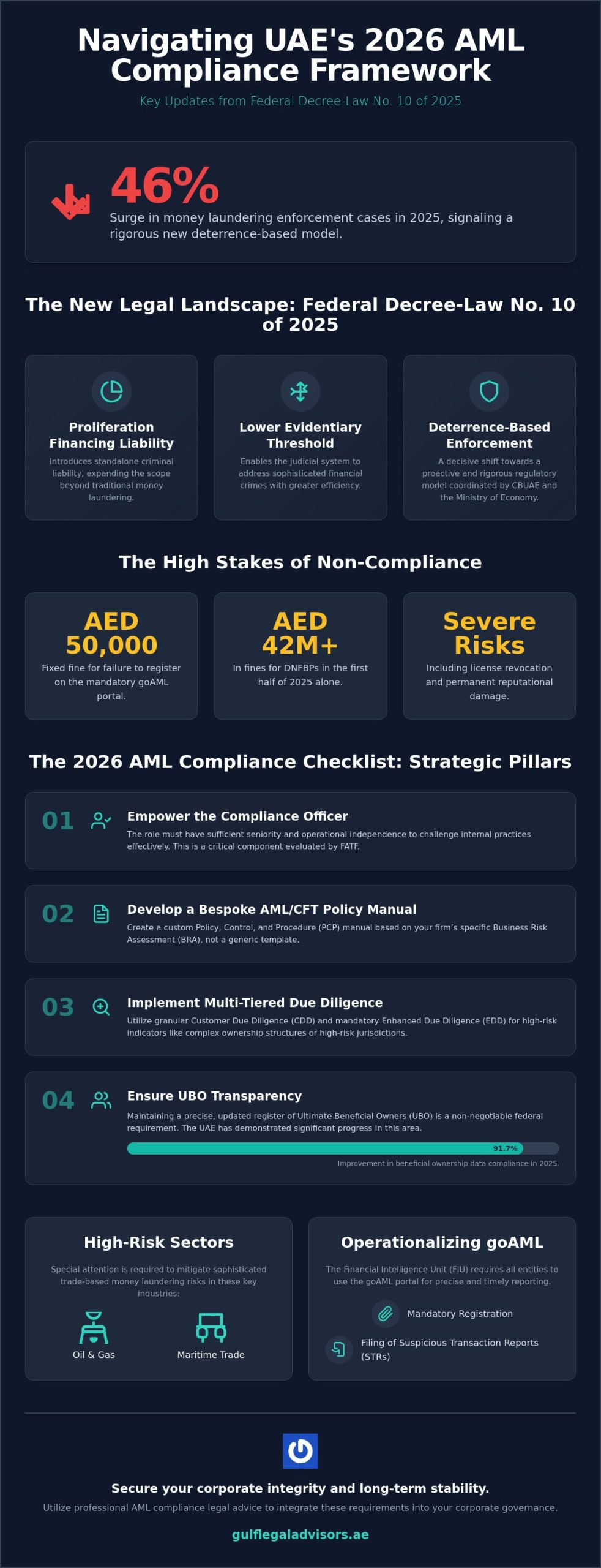
In 2025, money laundering enforcement cases in the UAE surged by 46 percent, signaling a decisive shift toward a rigorous, deterrence-based regulatory model. For corporate leaders, the transition to Federal Decree-Law No. 10 of 2025 presents a sophisticated challenge that extends far beyond routine administrative filing. You likely recognize that unintentional non-compliance now carries the weight of substantial administrative fines and heightened senior management accountability under the newest legal framework.
Securing specialized AML compliance legal advice UAE is no longer a peripheral concern; it’s a core requirement for institutional integrity and long-term stability. This guide provides a professional framework to navigate the expanded scope of the 2025 Decree-Law while protecting your corporate reputation from emerging risks. We examine the critical updates to UBO transparency, mandatory goAML protocols, and the strategic integration of these requirements into your existing governance structures for 2026.
Key Takeaways
- Understand the expanded regulatory scope of Federal Decree-Law No. 10 of 2025 and its specific implications for standalone proliferation financing.
- Establish a resilient 2026 compliance framework by developing bespoke policy manuals and formalizing the independence of the Compliance Officer role.
- Mitigate sector-specific vulnerabilities in maritime and energy trade by addressing sophisticated trade-based money laundering risks.
- Implement a robust workflow for goAML portal registration to ensure the precise and timely filing of suspicious transaction reports.
- Utilize professional AML compliance legal advice UAE to integrate regulatory adherence into broader corporate governance, enhancing your standing in international M&A and capital markets.
The Evolution of UAE AML Legislation: Federal Decree-Law No. 10 of 2025
The enactment of Federal Decree-Law No. 10 of 2025 on October 14, 2025, marked a definitive transition in the UAE’s legislative approach to financial integrity. This mandate superseded the 2018 framework, introducing a more rigorous architecture for the detection and prevention of illicit financial flows. For organizations operating within the region, obtaining specialized AML compliance legal advice UAE is essential to interpret these expanded mandates, which now include standalone criminal liability for proliferation financing. The 2025 Decree-Law specifically lowers the evidentiary threshold for money laundering offenses, ensuring that the judicial system can address sophisticated financial crimes with greater efficiency.
Regulatory oversight is primarily coordinated through the Central Bank of the UAE (CBUAE) and the Ministry of Economy. These bodies have adopted a deterrence-based enforcement model, reflecting a national commitment to maintaining a robust financial ecosystem. Understanding the historical context of crime and money laundering in the UAE provides necessary perspective on why the 2026 standards prioritize institutional accountability and the proactive identification of predicate offenses, including both direct and indirect tax evasion.
Key Legal Definitions for UAE Enterprises
The current legal landscape distinguishes clearly between Financial Institutions and Designated Non-Financial Businesses and Professions (DNFBPs). While banks and insurance providers fall under the former, the DNFBP category encompasses real estate brokers, auditors, and dealers in precious metals. The definition of “Criminal Proceeds” has been broadened to include any assets derived from a wide array of predicate offenses. Central to this reporting structure is the Financial Intelligence Unit (FIU), which serves as the national center for the receipt and analysis of suspicious transaction reports filed through the mandatory goAML portal.
The Consequences of Non-Adherence
The UAE authorities utilize a tiered structure of administrative penalties to enforce compliance. For instance, a fixed fine of AED 50,000 is levied for the simple failure to register on the goAML portal. Beyond financial penalties, which exceeded AED 42 million for DNFBPs in the first half of 2025 alone, enterprises face the severe risk of license revocation and permanent reputational damage. The implementation of a Risk-Based Approach is the mandatory legal standard for all regulated entities in 2026. This requires firms to tailor their internal controls to the specific risk profiles of their clients and transactions rather than relying on generic, static checklists.
The 2026 AML Compliance Checklist: Strategic Pillars
The institutionalization of the Compliance Officer role serves as the primary pillar of a resilient corporate framework. Regulatory expectations for 2026 demand that this individual possesses sufficient seniority and operational independence to challenge internal practices effectively. This structural autonomy is a critical component reflected in the latest FATF evaluation of the UAE, which emphasizes the necessity of effective supervision across all regulated sectors. Beyond staffing, enterprises must develop a bespoke AML/CFT Policy, Control, and Procedure (PCP) manual. This document shouldn’t be a generic template. It must reflect the specific risk profile identified in the firm’s Business Risk Assessment (BRA). A robust BRA mirrors the findings of the UAE National Risk Assessment, ensuring that institutional controls align with broader jurisdictional vulnerabilities.
Operational effectiveness relies on a multi-tiered Customer Due Diligence (CDD) and Enhanced Due Diligence (EDD) system. This involves a granular analysis of client profiles, source of wealth, and the intended nature of the business relationship. When high-risk indicators are present, such as complex ownership chains or transactions involving high-risk jurisdictions, the application of EDD becomes a mandatory legal safeguard. Obtaining AML compliance legal advice UAE allows firms to calibrate these tiers, ensuring that the level of scrutiny remains proportionate to the identified risk without disrupting legitimate commercial flow.
UBO Transparency and Corporate Structures
Maintaining a precise and updated register of Ultimate Beneficial Owners (UBO) is a non-negotiable federal requirement. The UAE’s 91.7 percent improvement in beneficial ownership data compliance in 2025 underscores the success of these rigorous documentation standards. The identification process becomes significantly more complex during organizational changes. Expert corporate restructuring legal services UAE ensure that transparency is maintained even across intricate multi-jurisdictional holdings. Accurate UBO data must be filed with the relevant licensing authority to prevent administrative penalties or the suspension of commercial operations.
AI Governance in Compliance Screening
The integration of AI-driven tools for screening Politically Exposed Persons (PEPs) and Sanction Lists represents the new standard for efficiency. However, the use of these technologies requires a dedicated governance framework to oversee transaction monitoring and data privacy. Legal validity for automated liveness and ID verification processes depends on the system’s ability to meet rigorous technical standards set by UAE regulators. For firms seeking to fortify their internal systems, engaging with technology governance legal counsel UAE ensures that AI governance remains aligned with current judicial expectations and protects the organization from algorithmic bias or data breaches. Engaging with a strategic compliance partner further ensures that these frameworks integrate seamlessly with your broader AML obligations.
Sector-Specific AML Risks: Oil, Gas, and Maritime
The maritime and energy sectors represent some of the most complex environments for regulatory adherence in the Gulf. While other industries often focus on domestic retail risks, the high-stakes nature of global logistics requires specialized AML compliance legal advice UAE to manage multi-jurisdictional exposure. Trade-based money laundering (TBML) remains a primary concern for regulators, especially within the maritime shipping and commodity trade corridors. Common typologies include the use of shell companies to obscure the origin of funds or the tactical use of “ghost-shipping” to bypass international oversight.
The UAE Financial Intelligence Unit (FIU) has identified the illicit oil trade as a significant environmental crime typology that facilitates money laundering. Consequently, firms must implement stringent Source of Wealth (SoW) and Source of Funds (SoF) protocols that withstand the scrutiny of both local and international authorities. These measures aren’t just administrative hurdles; they’re essential defenses against the standalone criminal liability for proliferation financing introduced under the 2025 Decree-Law. Maintaining institutional integrity in these sectors requires a proactive stance that anticipates regulatory shifts before they manifest as enforcement actions.
Maritime Asset Transfers and Compliance
Acquiring or financing vessels involves significant capital transfers that attract heightened regulatory attention. During these high-value asset liquidations or restructuring phases, compliance frameworks must be robust enough to detect sanctioned entities or hidden beneficial owners. Integrating these safeguards early helps prevent the legal entanglements often seen in maritime dispute resolution Dubai, where non-compliance frequently complicates the recovery or transfer of assets. Professional AML compliance legal advice UAE ensures that every maritime transaction is backed by verifiable documentation that meets the 2026 standards for institutional transparency.
Energy Sector Transaction Monitoring
Upstream oil and gas contracts often feature intricate payment structures and joint venture arrangements that require precise transaction monitoring. Verifying the legitimacy of counterparties in multi-jurisdictional energy ventures is a sophisticated task that demands deep industry knowledge. This is where the expertise of M&A legal advisors UAE becomes indispensable. They provide the necessary due diligence to ensure that complex acquisitions don’t inadvertently involve illicit proceeds or violate evolving sanctions regimes. Effective monitoring in the energy sector depends on the seamless integration of AML protocols into the broader corporate governance framework, ensuring that every contract is scrutinized for potential financial and reputational risk.
Operationalizing goAML and Suspicious Transaction Reporting
The goAML platform serves as the central pillar of the UAE suspicious activity reporting regime. Registration on this portal, operated by the Financial Intelligence Unit (FIU), is a mandatory requirement for all Financial Institutions and DNFBPs. Failure to register results in a fixed administrative fine of AED 50,000. Beyond mere registration, the operational challenge lies in establishing the precise legal threshold for filing a Suspicious Transaction Report (STR) or Suspicious Activity Report (SAR). This determination requires a sophisticated understanding of what constitutes “reasonable grounds” for suspicion, a standard that has been refined under the 2025 Decree-Law. Organizations must ensure that their internal reporting workflows are robust enough to capture and evaluate potential risks without delay.
Once a suspicion is formed, the legal timeline for reporting is immediate. Regulatory guidance generally interprets “without delay” as filing within 24 to 48 hours. This rapid turnaround necessitates a clear hierarchy of communication and a high level of specialized knowledge within the compliance team. Obtaining professional AML compliance legal advice UAE is often the most effective way to calibrate these internal thresholds and ensure that the reporting process remains compliant with the “No Tipping Off” rule. This rule prohibits management from disclosing to a client or any third party that a report has been filed, with violations leading to severe criminal and administrative consequences. To maintain audit readiness, all supporting records for STRs and related compliance activities must be retained for at least five years.
Internal Reporting vs. External Filing
The flow of information from employees to the Compliance Officer must be formalized and documented. Every internal report of suspicion should be investigated, and the final determination must be recorded in detail. It’s particularly vital to document the rationale for decisions where the organization chooses not to file an external report after an internal investigation. This documentation provides a critical defense during regulatory inspections, demonstrating that the firm applied a consistent, risk-based logic to its findings. Clear internal protocols prevent bottlenecks and ensure that high-priority alerts reach the FIU within the mandatory windows.
Audit Readiness and Regulatory Inspections
Preparing for Ministry of Economy or Central Bank inspections requires a proactive approach to governance. Conducting an annual independent AML audit is a standard expectation for identifying latent gaps in your framework before they become liabilities. These audits should scrutinize everything from UBO registers to the effectiveness of transaction monitoring systems. Engaging a legal consultancy firm Dubai provides the strategic resource needed to navigate these inspections with confidence. If you require a comprehensive review of your current reporting infrastructure, consult with an expert advisor to ensure your organization meets the 2026 standards for institutional integrity.
Strategic Legal Advisory: Beyond Basic Compliance
Modern corporate governance requires the elevation of anti-money laundering protocols from a siloed administrative function to a board-level strategic priority. Organizations that successfully integrate these requirements into their broader governance framework achieve more than just regulatory adherence; they build a foundation of institutional integrity that resonates with international stakeholders. Obtaining sophisticated AML compliance legal advice UAE allows leadership to view regulatory demands as a mechanism for risk mitigation and value protection. This perspective is vital as the UAE prepares for the next round of global evaluations, where the effectiveness of institutional controls will be scrutinized with unprecedented depth.
A robust compliance posture serves as a distinct competitive advantage in international finance and capital markets. Financial institutions and global investors increasingly prioritize entities that demonstrate a transparent, risk-averse operational history. By maintaining a high standard of regulatory hygiene, firms reduce the friction associated with cross-border transactions and enhance their attractiveness during high-stakes negotiations. Proactive litigation defense strategies also play a role here. If a regulatory dispute arises, a well-documented history of adherence and a structured response plan can significantly mitigate potential sanctions and protect the organization’s standing in the global commercial hub. Enterprises navigating the intersection of digital transformation and financial regulation should also consider how technology governance legal counsel UAE can safeguard data processing frameworks and AI-driven compliance tools against emerging federal mandates.
Compliance in Mergers and Acquisitions
Executing deep-dive AML due diligence is a critical component of any corporate acquisition strategy. Buyers must look beyond surface-level filings to assess the actual effectiveness of a target company’s internal controls. The risk of successor liability for past AML failures remains a significant threat, as regulators may hold the acquiring entity responsible for historical non-compliance. To manage these exposures, legal advisors craft robust indemnification clauses within Share Purchase Agreements (SPAs). These clauses provide essential financial and legal protection against undisclosed liabilities that may emerge post-closing, ensuring that the acquisition remains a strategic asset rather than a regulatory burden.
The Future of Regulatory Adherence in the UAE
The legislative landscape will continue to evolve beyond 2026 as the UAE aligns its domestic framework with shifting international standards. Staying ahead of these shifts requires a culture of unwavering professionalism and quiet confidence in governance. Firms that treat compliance as a dynamic pillar of their business model, rather than a static cost center, are best positioned to navigate future complexities. Strategic legal advice transforms compliance into a sophisticated value protector, securing the long-term viability of the enterprise within a fast-paced global economy. Gulf Legal Advisors stands as a dedicated partner, providing the intellectual depth and practical focus required for successful regulatory navigation.
Securing Institutional Integrity for the 2026 Regulatory Landscape
The transition to the 2025 Federal Decree-Law represents a sophisticated shift in the UAE’s judicial approach to financial crime. Organizations must move beyond static checklists to embrace a risk-based model that prioritizes senior management accountability and UBO transparency. Whether you’re navigating the complexities of maritime logistics or high-value energy transactions, the 2026 standard for corporate excellence depends on the seamless integration of compliance into your broader governance framework.
Securing specialized AML compliance legal advice UAE ensures your enterprise remains resilient against the administrative and reputational risks of a deterrence-based enforcement model. Gulf Legal Advisors provides the intellectual depth required to handle intricate multi-jurisdictional matters, offering comprehensive support from institutional governance to litigation defense. We focus on high-stakes corporate sectors, ensuring your operations meet the highest standards of international judicial bodies. Your commitment to proactive adherence today builds the stability required for tomorrow’s global commercial opportunities.
Secure Strategic AML Compliance Advice from Gulf Legal Advisors
Frequently Asked Questions
What is the primary AML law in the UAE for 2026?
Federal Decree-Law No. 10 of 2025 is the principal legislation governing anti-money laundering and counter-terrorism financing in the UAE for 2026. This law replaced the previous 2018 framework and introduced standalone criminal liability for proliferation financing. It also lowered the evidentiary threshold for money laundering offenses, allowing for more efficient judicial action against illicit financial flows. Organizations must align their internal policies with this mandate to ensure institutional integrity.
Which businesses are classified as DNFBPs under UAE law?
Designated Non-Financial Businesses and Professions (DNFBPs) include real estate brokers, dealers in precious metals and stones, independent auditors, and corporate service providers. These entities are subject to the same rigorous AML obligations as financial institutions. Engaging professional AML compliance legal advice UAE helps these businesses determine their specific categorization and reporting duties under the current federal mandate. Proper classification is the first step toward building a resilient compliance framework.
What are the penalties for failing to register on the goAML portal?
A fixed administrative fine of AED 50,000 is levied for the failure to register on the goAML portal. This registration is a mandatory prerequisite for filing suspicious transaction reports with the Financial Intelligence Unit. Continuous non-compliance can lead to larger penalties, as regulators don’t hesitate to enforce the 2026 standards. In the first half of 2025 alone, the DNFBP sector saw over AED 42 million in administrative penalties for various compliance violations.
How long must AML-related records be maintained by a UAE company?
UAE companies must maintain all AML-related records, including customer identification data and transaction logs, for a minimum period of five years. This five-year retention period begins from the date of the transaction or the termination of the business relationship. These records must be readily accessible to regulatory bodies during inspections. Maintaining a precise historical archive is essential to demonstrate a history of adherence to federal standards during an audit.
What is the difference between CDD and Enhanced Due Diligence (EDD)?
Customer Due Diligence (CDD) represents the standard verification process, whereas Enhanced Due Diligence (EDD) is the mandatory intensified scrutiny applied to high-risk clients. It’s a more intensive process required for profiles like Politically Exposed Persons (PEPs) or transactions involving high-risk jurisdictions. Obtaining AML compliance legal advice UAE ensures that your EDD processes, including investigations into Source of Wealth and Funds, meet current standards. EDD requires a higher level of documentation and senior management approval.
Can a company outsource its AML Compliance Officer role?
While certain administrative compliance functions can be supported by external consultants, the Compliance Officer role itself must be institutionalized within the organization. The regulator requires this individual to possess appropriate seniority and independence to oversee internal controls effectively. This ensures that accountability remains within the corporate structure and aligns with the 2026 standard for institutional integrity. Outsourcing the entire responsibility isn’t permitted under current UAE regulatory expectations.
What is the “No Tipping Off” rule in the context of UAE AML?
The “No Tipping Off” rule prohibits any regulated entity or its employees from disclosing to a client that a Suspicious Transaction Report (STR) has been filed regarding their activities. Violating this rule is a serious offense. Violations carry severe criminal penalties. It’s designed to protect the integrity of financial investigations conducted by the Financial Intelligence Unit. Management must ensure that internal discussions regarding suspicious activity remain strictly confidential to avoid legal entanglements.
How does the 2025 Decree-Law affect UBO reporting requirements?
Federal Decree-Law No. 10 of 2025 reinforces the requirement for accurate and updated Ultimate Beneficial Ownership (UBO) reporting. Enterprises must identify any individual who owns or controls 25 percent or more of the company. The 2025 regulations emphasize the accountability of senior management in ensuring these registers are maintained and filed with the relevant licensing authorities. High compliance rates in 2025 reflect the success of these rigorous documentation standards across the Emirates.