



The UAE’s 2026 exit from the OPEC framework signals a definitive shift toward total sovereign autonomy over national energy production and the legal structures that govern it. As the regulatory environment moves from traditional royalty-based concessions to sophisticated Production Sharing Agreements, the need for specialized offshore energy legal counsel UAE has never been more critical for protecting capital-intensive infrastructure. You understand that operating within the Arabian Gulf now demands more than just technical precision. It requires absolute alignment with a federal mandate that prioritizes both decarbonization and sovereign control.
This guide provides the strategic clarity required to secure your offshore assets and ensure every EPC contract remains resilient against multi-jurisdictional maritime shifts. We’ll examine the immediate impacts of Federal Decree-Law No. 11 of 2024 on mandatory emissions reporting and the specific maritime overlaps that define the current 2026 regulatory framework. By addressing the complexities of federal mandates and emirate-level authority, we offer a pathway toward effective dispute mitigation and sustained compliance in a high-stakes environment.
Key Takeaways
- Analyze the implications of the UAE’s 2026 shift toward sovereign energy autonomy and the resulting transition from traditional concessions to Production Sharing Agreements.
- Establish robust compliance frameworks that align offshore infrastructure operations with mandatory federal emissions reporting and the 2026 climate change mandates.
- Secure capital-intensive projects by engaging specialized offshore energy legal counsel UAE to draft EPC and O&M contracts that account for multi-jurisdictional maritime overlaps.
- Develop proactive dispute mitigation strategies by selecting appropriate arbitration forums like the ADGM or DIAC for high-stakes technical and contractual matters.
- Adopt a multi-disciplinary approach to legal governance that integrates maritime, energy, and corporate expertise to navigate the complex decentralized regulatory environment.
Navigating the UAE Offshore Energy Sector: Legal Imperatives for 2026
The UAE National Energy Strategy 2050 serves as the foundational architecture for the nation’s industrial evolution. Offshore assets are no longer just extraction points; they’re the front line for the 2026 shift toward sovereign production autonomy. Engaging specialized offshore energy legal counsel UAE is the primary safeguard for executives managing these complex environments. This counsel must bridge the gap between emirate-level resource ownership and federal mandates that now prioritize “Green Oil” branding and decarbonization. Strategic legal guidance ensures that long-term investments remain protected against the evolving requirements of a post-OPEC landscape.
Understanding the historical context of Energy in the United Arab Emirates reveals why the current transition is so significant. The official exit from the OPEC+ framework in May 2026 allows for a more tailored approach to national production levels. This newfound autonomy increases the importance of robust legal frameworks that can withstand international market shifts while adhering to strict local governance. It’s a period of transformation where legal certainty is as valuable as the resources themselves.
The Nexus of Maritime and Energy Law
Offshore platforms operate at a unique legal intersection. They’re industrial sites, but they’re often governed by maritime principles when support vessels, jack-up rigs, and floating storage units are involved. The application of admiralty law UAE is essential for protecting these assets against arrest or liability claims. Jurisdictional overlaps between the Ministry of Energy and Infrastructure and maritime regulators require a unified legal strategy to prevent operational delays. Clear definitions of vessel status and platform liability are required for any offshore energy legal counsel UAE to provide watertight protection for high-value infrastructure. Without this clarity, multi-jurisdictional disputes can easily stall critical projects.
Evolving Regulatory Standards for Offshore Operations
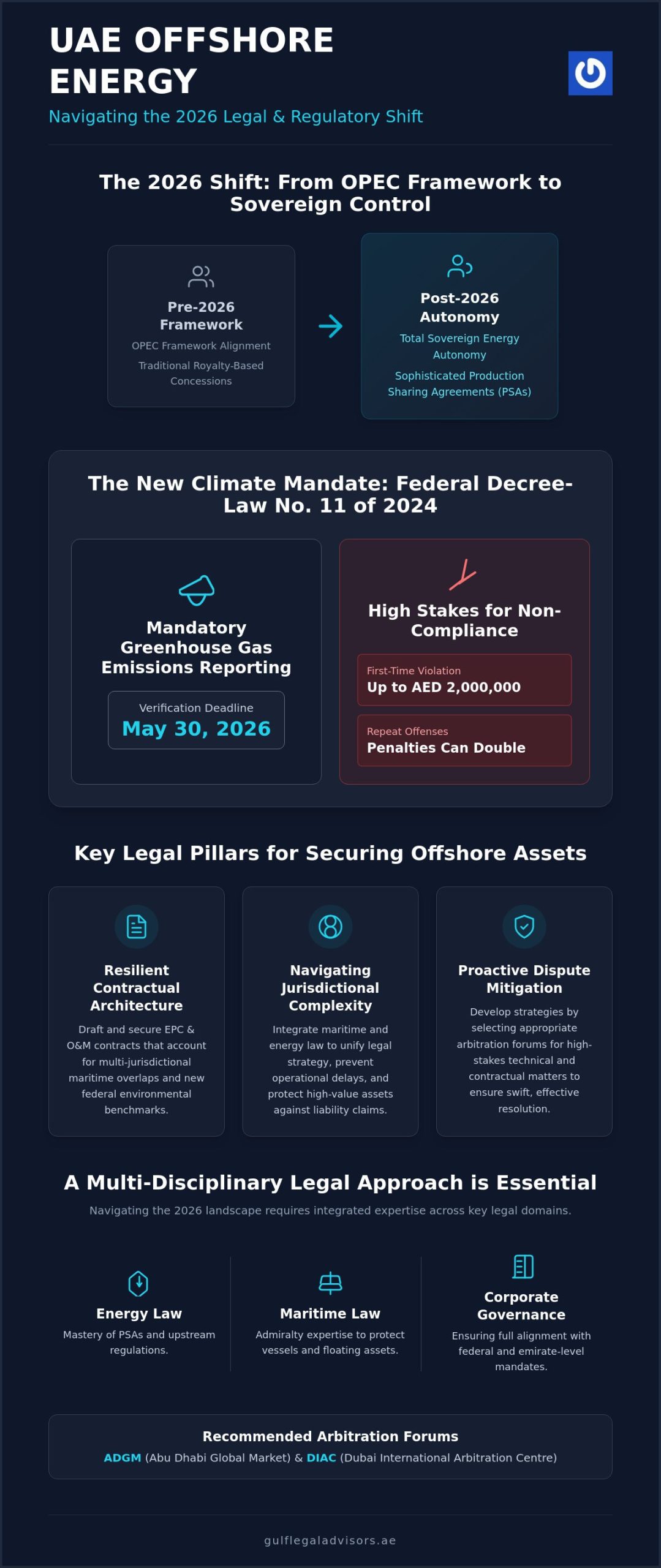
The regulatory landscape for 2026 is anchored by the implementation of Federal Decree-Law No. 11 of 2024. This law requires all private and public entities to verify greenhouse gas emissions by May 30, 2026. For international oil companies (IOCs), adherence to these standards is a non-negotiable operational prerequisite. Penalties for first-time violations are substantial, reaching up to AED 2,000,000, and can double for repeat offenses. Contracts must now include rigorous environmental benchmarks that go beyond traditional production targets. The Ministry of Energy and Infrastructure has expanded its oversight to ensure that offshore concession agreements reflect these new climate mandates. Strategic partners must navigate these federal requirements while respecting the constitutional reality that each Emirate retains ownership of its natural resources.
Regulatory Compliance and Governance for Offshore Infrastructure
Governance of offshore infrastructure in 2026 requires a shift from reactive maintenance to proactive regulatory adherence. Asset integrity is now legally tethered to environmental performance. Federal Decree-Law No. 11 of 2024 mandates that offshore operators verify their greenhouse gas emissions by May 30, 2026. Failure to meet these standards invites significant financial penalties and operational suspension. Effective offshore energy legal counsel UAE must ensure that asset safety protocols reflect both federal mandates and the specific requirements of emirate-level authorities. This integrated approach to governance protects the long-term viability of high-value infrastructure against an increasingly scrutinized environmental landscape.
Access to these strategic zones remains tightly controlled by national security protocols. Infrastructure protection is a matter of federal interest, requiring specific security clearances for personnel and vessels. You must navigate the upstream oil and gas legal advisory UAE framework to align these security mandates with operational timelines. Balancing the need for rapid deployment with the necessity of security compliance is a core function of a strategic legal partner. If your organization requires a detailed review of current compliance standing, a consultation for specialized energy advisory can clarify potential bottlenecks before they impact project delivery.
Licensing and Federal Energy Mandates
Procedural requirements for offshore drilling and production licenses are subject to rigorous In-Country Value (ICV) assessments. These requirements ensure that energy projects contribute to the national economy through local procurement and employment. Managing the reporting cycles for federal energy bodies is no longer a peripheral task; it’s a central pillar of corporate governance. Legal frameworks must account for the 9% corporate income tax, though companies engaged in the extraction of natural resources remain exempt. This distinction requires precise accounting and legal characterization of all offshore activities to ensure tax compliance while maximizing available exemptions.
HSE and AI Governance in Energy Operations
The integration of AI for predictive maintenance creates new liability questions that traditional HSE frameworks don’t fully address. When automated systems manage safety monitoring, the contractual framework must clearly define the allocation of risk between technology providers and asset owners. Federal AI safety standards are evolving to address these specific industrial applications. Proactive offshore energy legal counsel UAE helps bridge the gap between technical innovation and traditional liability structures. This ensures that technological adoption doesn’t create unmitigated legal exposure, particularly in high-stakes environments where automated decisions impact human safety and environmental protection.
Contractual Architectures for Offshore Energy Projects
The architecture of offshore energy contracts in the UAE has evolved beyond simple extraction rights. Strategic offshore energy legal counsel UAE is now required to manage the transition from traditional royalty concessions to sophisticated Production Sharing Agreements (PSAs) and service-based models. These frameworks must account for the UAE’s 2026 production autonomy and the stringent performance benchmarks now expected by federal authorities. Every clause must be calibrated to protect the developer’s interest while satisfying the national mandate for resource optimization. It’s no longer enough to rely on boilerplate language in an environment that demands specific technical and regulatory alignment.
Managing the LNG contract legal advisory UAE value chain presents specific challenges, particularly in Abu Dhabi. Under the Abu Dhabi Gas Ownership Law, ADNOC must retain a minimum 51% interest in any joint agreement involving natural gas. This requirement dictates the structural foundation of every commercial arrangement. It’s not just about the numbers. It’s about defining control, operational influence, and revenue distribution within a mandated majority-ownership framework. Legal structures must be robust enough to handle these ownership requirements while remaining attractive to international investment partners.
EPC and O&M Agreements: Managing Operational Risk
Offshore construction involves environmental variables that standard onshore contracts cannot address. Force majeure clauses must be explicitly tailored to Gulf maritime conditions, including specific weather events or regional maritime restrictions. Payment security and performance guarantees are paramount in these capital-heavy projects. We focus on drafting dispute escalation clauses that prioritize technical expert determination before moving to formal arbitration. This structured approach prevents minor operational disagreements from escalating into project-halting legal battles. Risk allocation in long-term Operations and Maintenance (O&M) agreements must also account for the asset integrity standards mentioned in previous sections.
Offshore Concessions and M&A Activity
The acquisition or transfer of offshore assets requires a high level of regulatory precision. Conducting a joint venture agreement UAE analysis is a critical component of due diligence for any offshore energy consortium. You must ensure that the transfer of concession interests receives the necessary approvals from bodies like the Supreme Council for Financial and Economic Affairs (SCFEA). Strategic counsel in this area focuses on the seamless transition of operational rights and the assumption of environmental liabilities. This is vital given the 2026 mandate for emissions reporting. Corporate restructuring in the energy sector must be handled with a view toward both federal compliance and long-term asset integrity.
Mitigating Risk through Strategic Dispute Resolution
The resolution of high-stakes energy disputes in the UAE requires a sophisticated understanding of both federal mandates and emirate-level specifics. When multi-jurisdictional maritime and energy assets are involved, the choice of a dispute resolution forum is a strategic decision that impacts the enforceability of awards. Specialized offshore energy legal counsel UAE must evaluate whether to utilize onshore courts or offshore financial centers like the Abu Dhabi Global Market (ADGM) or the Dubai International Financial Centre (DIFC). This decision often hinges on the technical nature of the dispute and the required speed of resolution. Effective commercial dispute resolution Dubai frameworks provide a reliable path for enforcing arbitral awards through the UAE federal court system. This ensures that contractual protections are not just theoretical but actionable, particularly in a landscape where the 2026 shift toward production autonomy increases the value of every offshore asset.
Arbitration remains the preferred method for resolving complex upstream and midstream disagreements. The Dubai International Arbitration Centre (DIAC) has established itself as a premier forum for energy-specific matters, offering rules that accommodate the technical depth of offshore projects. Drafting robust arbitration clauses within offshore service agreements is a preventative measure that defines the seat, language, and number of arbitrators before a conflict arises. In technical offshore disputes, the management of expert witnesses is critical. These experts provide the necessary clarity on engineering failures, production shortfalls, or environmental compliance issues that form the core of most energy claims. A well-structured arbitration process ensures that decisions are made by individuals with industry-specific knowledge, rather than generalist judicial bodies.
International Arbitration in Energy Disputes
Utilizing international centers for energy disputes allows for a level of technical oversight that local courts may not always provide. The focus is on ensuring that the arbitral tribunal understands the nuances of the UAE energy sector, including the specific requirements of ADNOC or the Dubai Supreme Council of Energy. We prioritize the selection of arbitrators who possess a deep background in petroleum engineering and maritime operations. This ensures that the resulting awards are grounded in both legal principle and industrial reality, which is essential for maintaining the integrity of long-term offshore concessions.
Maritime Liens and Admiralty Claims
Offshore energy operations frequently intersect with admiralty law, particularly when support vessels or jack-up rigs are involved in a dispute. The arrest of vessels remains a powerful tool for securing claims in maritime-energy insolvencies. Under UAE law, maritime liens can be asserted for unpaid crew wages, salvage, or collision damage, often taking priority over other creditors. This intersection requires a legal strategy that accounts for the physical location of the asset and the flag state of the vessel. Limitation of liability for offshore maritime incidents is another critical area where energy and maritime laws overlap. Strategic recovery of assets in these scenarios requires a deep understanding of the UAE’s specific admiralty procedures and the procedural requirements for filing claims in federal courts. If you are facing a potential conflict or require a review of your current arbitration clauses, our team provides strategic dispute advisory to protect your offshore interests.
Selecting Offshore Energy Legal Counsel: The Strategic Partner Approach
Selecting offshore energy legal counsel UAE is a high-stakes decision that determines an organization’s ability to withstand regulatory volatility. The complexity of the 2026 energy landscape demands a partner who integrates maritime expertise with a deep understanding of federal energy mandates. This multi-disciplinary approach is essential for managing the intersection of Admiralty law and the UAE National Energy Strategy 2050. Executives must prioritize counsel that demonstrates a proven capacity for managing the decentralized regulatory environment while maintaining federal-level compliance. Gulf Legal Advisors serves as a strategic navigator, providing the intellectual depth and practical focus required to protect capital-intensive infrastructure in a period of unprecedented production autonomy.
Federal-level expertise is no longer optional. With the UAE’s shift toward sovereign energy policy, the ability to interpret and apply new federal decrees is the baseline for operational success. Strategic resolution of multi-jurisdictional matters requires a grounded, reassuring presence that only comes from deep-rooted stability in the region. Aligning your offshore operations with the latest federal requirements ensures that your assets remain secure and your production targets stay on track.
Strategic Advisory vs. Conventional Legal Support
The transition from reactive litigation to proactive risk governance is the hallmark of a sophisticated offshore energy legal counsel UAE. Conventional legal support often focuses on resolving disputes after they arise; strategic advisory identifies potential friction points in EPC contracts and concession agreements before they impact the balance sheet. Leveraging technology governance, particularly regarding automated systems and predictive maintenance, provides a definitive competitive advantage in the 2026 market. By engaging a legal consultancy firm Dubai, organizations can achieve a level of corporate excellence that aligns operational goals with national regulatory shifts. This proactive stance ensures that compliance isn’t just a hurdle but a strategic asset.
Future-Proofing Offshore Operations
Future-proofing your offshore assets requires a forward-looking perspective on UAE energy regulation. As the nation moves deeper into its Net Zero 2050 Strategic Initiative, the role of legal counsel expands into sustainable offshore development and carbon capture governance. Preparing for the next phase of environmental mandates is critical for maintaining the “Green Oil” branding that the UAE now prioritizes. Securing strategic legal representation involves evaluating a firm’s ability to handle intricate multi-jurisdictional matters while remaining attuned to the fast-paced business landscape of a global hub. Your next steps should focus on establishing a watertight legal framework that supports both current production targets and long-term sustainability goals.
Securing Your Position in the UAE’s Sovereign Energy Future
The 2026 regulatory shift demands a definitive departure from traditional legal oversight. Success in this new era of production autonomy depends on the seamless integration of environmental compliance, maritime jurisdictional protections, and robust contractual architectures. By prioritizing proactive risk governance over reactive litigation, energy executives can safeguard their capital-intensive offshore assets against multi-jurisdictional volatility. Engaging specialized offshore energy legal counsel UAE ensures your operations remain aligned with the federal mandates that now define the national energy landscape.
Gulf Legal Advisors brings specialized expertise in the Maritime-Energy law nexus to every engagement. As strategic advisors for national energy infrastructure, we provide the stability and intellectual depth required to navigate the complexities of global commercial hubs. Our comprehensive dispute resolution capabilities ensure that your interests are protected in any forum, from federal courts to international arbitration centers. Consult with our offshore energy legal specialists to establish a watertight framework for your upcoming projects. We look forward to supporting your strategic objectives within the Emirates.
Frequently Asked Questions
What are the primary responsibilities of offshore energy legal counsel in the UAE?
The primary responsibilities involve the strategic management of high-stakes contractual frameworks and regulatory adherence. Specialized offshore energy legal counsel UAE must negotiate Engineering, Procurement, and Construction (EPC) contracts, manage the transfer of concession interests, and ensure absolute compliance with federal energy mandates. They act as strategic navigators through the complex multi-jurisdictional overlaps between maritime and energy law, protecting capital-intensive assets from operational and legal friction.
How does UAE maritime law impact offshore energy infrastructure?
Maritime law provides the foundational framework for protecting offshore assets like jack-up rigs, floating storage units, and support vessels. It governs limitation of liability for maritime incidents and provides the mechanism for vessel arrests to secure claims in technical disputes. Understanding the nexus between admiralty law and energy production is essential for preventing project delays caused by multi-jurisdictional claims involving offshore infrastructure.
What are the key regulatory changes for the UAE energy sector in 2026?
The most significant shift is the UAE’s official exit from the OPEC framework in May 2026, granting the nation total production autonomy. Additionally, Federal Decree-Law No. 11 of 2024 requires full compliance with greenhouse gas emissions reporting by May 30, 2026. These changes move the industry toward a decentralized, emirate-led regulatory environment that prioritizes “Green Oil” branding and sovereign control over production levels.
How is arbitration used to resolve offshore energy disputes in the Gulf?
Arbitration is the standard method for resolving complex upstream and midstream disagreements due to its ability to incorporate technical expert determination. Forums like the Dubai International Arbitration Centre (DIAC) or the Abu Dhabi Global Market (ADGM) are frequently selected for their specialized rules and industry-specific oversight. Drafting robust arbitration clauses is a critical function of offshore energy legal counsel UAE to ensure disputes are handled by qualified experts rather than generalist courts.
Can a foreign energy company hold a 100% interest in an offshore concession?
Generally, foreign entities cannot hold a 100% interest in strategic energy concessions. In Abu Dhabi, for example, the Abu Dhabi Gas Ownership Law requires ADNOC to hold a minimum 51% interest in any joint agreement involving natural gas. While the UAE has lifted the 49% cap on foreign ownership in many commercial sectors, the extraction of natural resources remains a protected strategic sector where national oil companies typically retain a majority stake.
What legal protections exist for offshore energy infrastructure against environmental liabilities?
Legal protections are primarily established through watertight contractual indemnities and precisely defined force majeure clauses tailored to Gulf maritime conditions. Proactive compliance with the May 2026 greenhouse gas reporting deadline is the most effective way to mitigate regulatory risk and avoid penalties that can reach AED 2,000,000. Comprehensive legal frameworks ensure that environmental responsibilities are clearly allocated between operators, contractors, and technology providers.
How does AI governance apply to offshore energy projects in the UAE?
AI governance applies to the liability structures surrounding automated safety monitoring and predictive maintenance systems. As offshore platforms integrate AI to optimize production, the legal framework must define who is responsible for automated decisions that impact asset integrity or human safety. Aligning technology governance with evolving federal AI safety standards is now a core requirement for maintaining operational licenses in 2026.
What is the process for enforcing international arbitral awards in UAE energy cases?
The enforcement process relies on the UAE’s adherence to the New York Convention, allowing for the recognition of international awards through the federal court system. Many entities utilize the “judicial gateways” of the DIFC or ADGM courts to streamline the enforcement of energy-related awards. This ensures that a technical victory in arbitration can be converted into an enforceable judgment against assets located within the UAE’s jurisdiction.