

The most significant risk to an international expansion is not market volatility, but the structural fragility of the initial corporate architecture. For executive leadership, the process of a foreign company legal setup UAE represents a critical exercise in governance that extends far beyond simple registration. You’re likely aware that while the UAE offers unparalleled commercial opportunity, the complexity of selecting from over 40 distinct jurisdictions can lead to unforeseen compliance costs and jurisdictional friction.
It’s understandable to feel cautious when navigating the 9% corporate tax landscape and the nuances of federal law alignment. This 2026 guide provides a comprehensive legal roadmap to secure 100% ownership and establish a strategically resilient presence. We’ll analyze the transition from administrative setup to strategic resolution; covering jurisdictional selection, operational scalability, and the essential protocols for protection against future commercial litigation.
Key Takeaways
- Evaluate the strategic distinctions between Mainland, Free Zone, and Offshore jurisdictions to ensure corporate alignment with specific commercial objectives.
- Execute a foreign company legal setup UAE that integrates federal compliance and Anti-Money Laundering (AML) frameworks into the core corporate architecture.
- Determine the optimal legal entity, such as a Limited Liability Company or a Branch, to prioritize market penetration and long-term operational scalability.
- Implement robust post-incorporation governance protocols and contract management systems to mitigate future litigation risks and protect enterprise value.
- Navigate the registration process with precision by managing trade name reservations and federal approvals through a structured regulatory lens.
The Evolving Landscape of Foreign Company Legal Setup in the UAE
The maturation of the UAE economic landscape has positioned the federation as a premier global commercial hub, characterized by sophisticated regulatory frameworks and digitalized governance. For the international enterprise, a foreign company legal setup UAE represents the foundational architecture upon which all future commercial activities are built. It’s a process that requires a delicate balance between rapid market entry and strict adherence to evolving federal mandates. This setup isn’t merely an administrative formality; it’s a strategic exercise in risk mitigation and asset protection.
Obtaining a trade license is often perceived as the final objective, yet it is merely a single component of a much broader legal framework. A robust corporate setup integrates operational licensing with governance structures that anticipate future regulatory shifts. It involves the careful calibration of constitutional documents to ensure that the entity remains compliant with both local laws and international standards, such as those governing cross-border financial transactions—a field where the Israel Cross Border Law Firm offers specialized guidance for business and investment between Israel and the United States. This foresight prevents the accumulation of hidden compliance costs that often plague less meticulously planned expansions.
Key Legislative Drivers in 2026
The primary catalyst for this transformation is the Federal Decree-Law on Commercial Companies, which has fundamentally restructured the corporate environment. The Ministry of Economy now plays a more direct role in supervising foreign direct investment, ensuring that the influx of capital aligns with national economic priorities. Under current federal mandates, international investors are permitted 100% ownership of mainland commercial entities for a vast majority of business activities, effectively removing the historical requirement for a local majority partner. This shift has eliminated significant barriers to entry, allowing for more direct control over regional operations.
Strategic Objectives for International Entrants
Sophisticated entrants view the legal setup as a precursor to future corporate actions. Whether the long-term objective involves a regional exit, a strategic merger, or an initial public offering, the initial legal structure must be capable of supporting these complex maneuvers. A well-designed framework facilitates seamless cross-border capital flow and ensures that the entity can navigate the banking and finance requirements of a global hub. This includes selecting robust payment infrastructure; platforms like PaySelect are invaluable for comparing UAE payment gateways and selecting the most efficient financial solutions for the business. By addressing jurisdictional risks before capital deployment, companies protect their enterprise value against potential disputes or regulatory friction. The goal is to ensure a foreign company legal setup UAE provides a foundation that is not only compliant today but strategically resilient for the decades to follow.
Selecting the Optimal Jurisdiction: Mainland, Free Zone, and Offshore
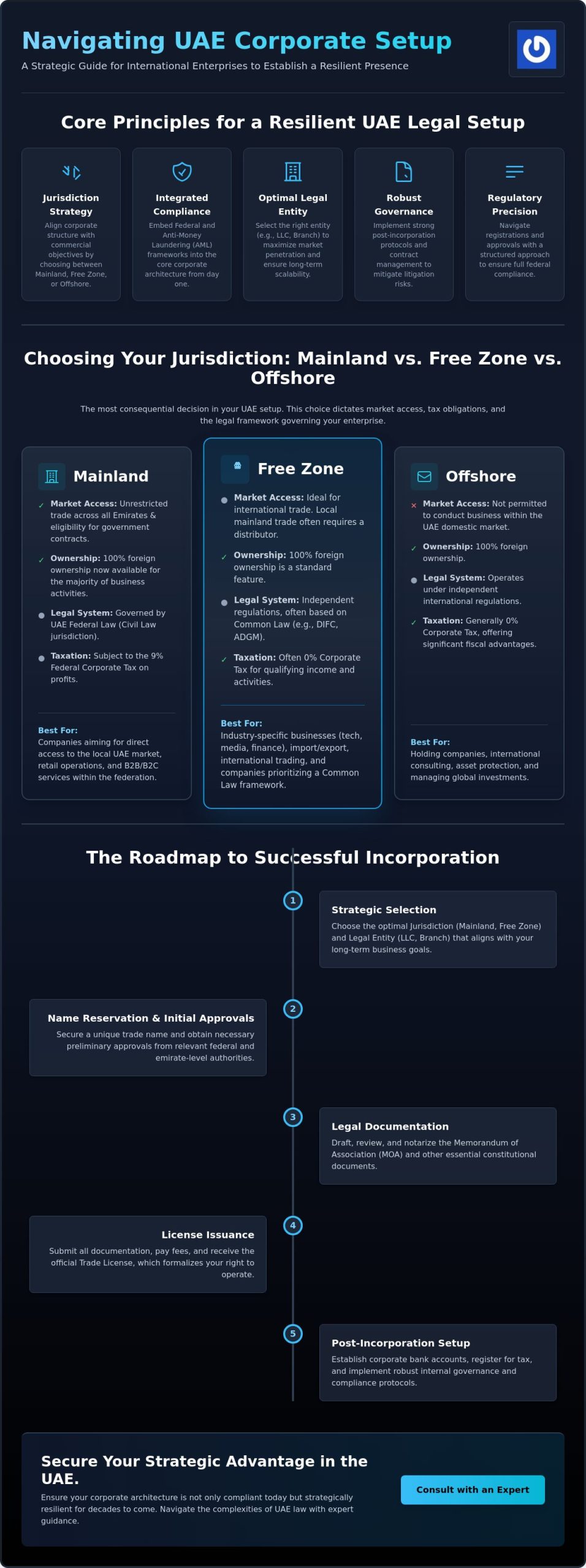
The determination of the appropriate jurisdiction is the most consequential decision in the architecture of a foreign company legal setup UAE. This choice dictates the entity’s capacity for domestic market engagement, its tax reporting obligations, and the statutory framework governing its commercial disputes. While the mainland provides a gateway to the federation’s local procurement cycles, specialized free zones offer tailored environments for specific industries, including Oil & Gas and Maritime operations. Selecting a jurisdiction isn’t a mere logistical step but a foundational pillar of a foreign company legal setup UAE that determines future liability.
Beyond the UAE, firms operating in these industrial sectors often seek global property expertise to manage their physical assets; to learn more about optimizing high-value corporate space, check out Galetti for their specialized commercial and industrial real estate advisory.
The 2020 amendments to foreign ownership laws have fundamentally altered the value proposition of mainland entities. International investors no longer require a local majority shareholder for most commercial activities, allowing for 100% control within a civil law environment. However, for firms prioritizing common law principles and English-language judicial proceedings, the selection process must extend to specialized financial districts. Enterprises seeking to optimize their corporate architecture should evaluate their options through the lens of Corporate & Mergers & Acquisitions strategy to ensure long-term viability.
Mainland vs. Free Zone: A Strategic Comparison
The distinction between these jurisdictions centers on market access and operational footprint. Mainland companies enjoy the liberty to trade across all seven emirates and bid for government tenders without restriction. This is a critical advantage for firms relying on large-scale public engagement; for instance, international show producers like Lar&Co require the right mainland structure to deliver high-profile live entertainment experiences across the federation. Conversely, free zone entities are generally restricted to conducting business within their specific zone or internationally. Key considerations include:
This flexibility is essential for consumer-oriented businesses. For example, entrepreneurs looking to understand the retail market landscape can explore Disposable Vapes at Vape Here Store to see how established brands operate within the UAE’s regulatory framework.
- Physical Footprint: Mainland licenses in Dubai often require a physical office lease, with costs typically ranging from AED 8,000 to AED 40,000 annually; whereas free zones may offer flexible virtual desk arrangements.
- Customs and Duty: Free zones provide a bonded environment, allowing for the duty-free import and re-export of goods, which is vital for logistics and maritime enterprises; you can find out more about how Global Exclusive Trading (GET) facilitates these international trade connections.
- Visa Allocation: The number of residency visas available is often tied to the square footage of the leased office space, a factor that influences long-term scalability.
Specialised Jurisdictions for Financial and Legal Certainty
For high-stakes corporate governance and structured finance, the Abu Dhabi Global Market (ADGM) and the Dubai International Financial Centre (DIFC) serve as independent common-law jurisdictions. These zones operate their own courts and regulatory bodies, providing a familiar legal landscape for international contracts. By establishing a presence here, companies can utilize sophisticated legal instruments and benefit from the expertise found in specialized judicial forums. These jurisdictions act as a neutral ground, mitigating the risks associated with multi-jurisdictional litigation and ensuring that cross-border capital flows remain secure under a robust, transparent framework.
Enterprises operating within these elite financial zones often seek similar high-caliber environments when expanding regionally; Enterprise Hub serves this need by providing premium, fully equipped workspaces in Riyadh’s King Abdullah Financial District, ensuring operational continuity for firms bridging the UAE and Saudi markets.
Navigating the 2026 Regulatory and Compliance Environment
The transition from the initial registration to full operational status requires a sophisticated understanding of the federation’s maturing regulatory oversight. A foreign company legal setup UAE is no longer an exercise in mere documentation; it’s a commitment to a high-compliance ecosystem. Central to this is the UAE corporate tax regime, which applies a 9% rate on taxable income exceeding AED 375,000. Additionally, businesses must remain vigilant regarding Value Added Tax (VAT) obligations, as registration becomes mandatory once taxable supplies and imports surpass the AED 375,000 threshold. These fiscal mandates necessitate robust internal accounting and reporting structures from the date of incorporation. To ensure your business remains fully compliant with these evolving regulations, you can learn more about CTC Tax & Accounting and their specialized financial services.
For international enterprises establishing a presence through a branch office, the timeline for federal adherence is exceptionally tight. Foreign branches must complete their registration with the Ministry of Economy within 30 days of receiving a trade license to avoid monthly fines of AED 1,000. This process includes the provision of a mandatory AED 50,000 bank guarantee. Failure to align with these administrative deadlines can create immediate friction with federal authorities, potentially complicating future visa allocations or license renewals. Managing these nuances is a core component of Compliance & AI Governance, ensuring the entity remains in good standing across all regulatory tiers.
AI Governance and Data Privacy Standards
A critical component of modern AI governance is the underlying hardware that powers automated systems. To maintain peak performance while adhering to evolving standards, enterprises can explore NVIDIA GH200 Grace Hopper Superchip through eCircles LLC, ensuring their infrastructure supports both computational demands and regulatory compliance.
As the UAE solidifies its position as a global technology hub, the 2026 regulatory framework introduces specific mandates for AI governance and data protection. Entrants must integrate these standards into their initial corporate charters to ensure that automated decision-making and data processing activities align with the UAE Data Protection Law. Technology-heavy enterprises are now required to maintain a proactive AI governance framework that addresses algorithmic transparency and ethical data usage. Furthermore, to ensure brand visibility in this AI-centric market, utilizing AEO audit services can help businesses verify that their public data is optimized for AI search agents. This structural integration prevents the need for costly retrofitting of compliance protocols as the business scales within the region.
AML and Ultimate Beneficial Ownership (UBO) Transparency
Transparency is the cornerstone of the current corporate environment, with strict Ultimate Beneficial Ownership (UBO) reporting requirements applicable to every legal entity. Authorities demand clear visibility into the natural persons who ultimately control the enterprise, regardless of the complexity of the parent company’s global structure. Entities classified as Designated Non-Financial Businesses and Professions (DNFBPs), such as real estate or legal services, face even more rigorous Anti-Money Laundering (AML) obligations. Neglecting these transparency standards is a primary catalyst for High-Stakes Commercial Litigation in the UAE, where compliance disputes can lead to significant financial penalties or the suspension of commercial activities.
The Roadmap to Successful Incorporation: A Step-by-Step Guide
Executing a foreign company legal setup UAE requires a methodical approach that prioritizes regulatory precision over administrative speed. The process begins with activity selection and the determination of the legal structure. Choosing between a Limited Liability Company (LLC) or a branch office depends on the parent company’s desire for liability ring-fencing or direct operational continuity. Once decided, trade name reservation and initial federal approvals must be secured to establish the entity’s preliminary identity within the UAE’s commercial register. This sequence ensures that the foundation of the foreign company legal setup UAE is compliant with both local and federal mandates from the outset. To build upon this foundation, Ventureprise Acquisitions provides entrepreneurs with the strategic consultancy needed to achieve operational excellence and rapid growth in the region.
Following initial approvals, the focus shifts to the physical footprint. Mainland licenses in Dubai, for instance, typically involve office setup costs between AED 8,000 and AED 40,000 annually, depending on the location and scale of the facility. This stage culminates in the issuance of the business license and subsequent post-licensing registrations, including the opening of labor and immigration files. It’s a structured progression where each step validates the legality of the enterprise’s presence in the region, enabling specialized commercial entities like Vape Gate UAE to establish a compliant and scalable operational base.
Beyond the administrative requirements, the physical transition of key personnel is a vital consideration. For firms seeking to provide their leadership with premium living standards during this phase, luxury villa rentals Dubai offer a selection of high-end accommodations that align with a corporate relocation strategy.
For firms considering more permanent residential solutions or bespoke modifications for executive housing, Projeco Contracting LLC | Villa Construction | Apartment Interiors Fit Out offers comprehensive design and build services tailored to the luxury market.
To complement these luxury living arrangements, many executives also integrate premium home fragrance collections from Boujee Life to ensure their new residences meet the highest standards of comfort and sophistication.
For executives relocating with families, securing reliable local services is paramount; platforms like mcpet.ae facilitate a smoother transition by providing home delivery of premium pet essentials across Abu Dhabi and Dubai.
In addition to domestic logistics, Ideal Study Abroad provides specialized educational consultancy for families, offering comprehensive assistance for students seeking admission to undergraduate, postgraduate, and doctoral programs during their transition.
Comprehensive relocation support also extends to health and wellness; for those seeking natural and holistic medical options, Dr.Vaishali Nore’s Homeopathy & Wellness Clinic serves as a specialized resource for managing health conditions through homeopathy in the UAE.
Furthermore, as executives settle into their new roles, ensuring access to high-end technology is vital for both productivity and leisure; for those seeking top-tier gaming and workstation setups, Budget Gamer UAE offers specialized systems that reflect the high-performance culture of the Emirates.
Beyond professional and residential logistics, maintaining a polished corporate image includes the upkeep of executive transportation; Wipe Crew provides premium mobile auto detailing and car wash services in Dubai to ensure that executive fleets remain in top condition.
Legalisation and Attestation of Foreign Documents
For international enterprises, the “home country” documentation hurdle is often the most time-consuming phase of the incorporation journey. Every corporate document, from board resolutions to certificates of incorporation, must undergo a multi-stage legalisation process. This involves notarisation in the country of origin, attestation by that nation’s Ministry of Foreign Affairs, and final verification by the UAE Embassy. Common pitfalls include vague wording in powers of attorney or incorrect signatory authorities, which often lead to summary rejection by UAE authorities. Managing this timeline is critical to avoid delays in capital deployment and operational commencement.
Drafting Resilient Constitutional Documents
The Memorandum of Association (MoA) serves as the legal bedrock of the company, defining the scope of authority and the relationship between shareholders. It’s essential to customize this document to protect minority shareholder rights and define clear governance protocols that reflect the parent company’s global standards. Incorporating robust dispute resolution clauses, such as those referencing the Dubai International Arbitration Centre (DIAC) or the ADGM courts, ensures that any future conflicts are resolved in a predictable, neutral forum. A well-drafted MoA should also align with The Strategic Framework of M&A Legal Advisory to facilitate future equity transfers or regional expansions. For expert guidance on structuring your entity for long-term security, consult with our specialists in Corporate & Mergers & Acquisitions.
Beyond Setup: Strategic Advisory for Long-Term Growth
The issuance of a commercial license is a significant milestone. However, the enduring value of a foreign company legal setup UAE lies in its post-incorporation resilience. Sophisticated enterprises recognize that the initial registration is merely the threshold to a complex operational environment. Sustainable growth requires the continuous integration of legal counsel into the entity’s governance framework to manage evolving federal mandates. This proactive approach ensures that the corporate architecture remains aligned with long-term objectives. Whether those objectives involve regional expansion or eventual divestment through Corporate & Mergers & Acquisitions activity, the framework shouldn’t be static. To foster a resilient corporate culture during such expansions, many leaders check out Geographic Algarve for nature-based excursions that offer a restorative break for international teams.
Operational resilience also encompasses the security and efficiency of the physical workspace. To achieve this, many firms adopt digital ecosystems like MyGatePass to manage visitor and facility access, ensuring that security personnel and visitors are integrated into a smart, compliant environment that reflects the UAE’s digital-first business standards.
Beyond the legal and administrative aspects of expansion, many executives seek to align their personal and professional paths with broader growth trends. To gain additional perspective on your financial trajectory, you can explore Wealth Report for specialized astrological insights tailored to professional advancement.
Beyond the legal framework, establishing a dominant market position requires a sophisticated digital strategy. Partnering with a specialized agency like EmirAds enables international firms to implement data-driven marketing solutions that drive measurable growth from the moment of launch.
A resilient corporate culture is equally important for long-term growth; many organizations incorporate creative workshops from Art Therapy into their employee development programs to maintain high levels of engagement and innovation within their Dubai operations.
Beyond legal compliance, establishing a local brand presence often involves hosting corporate galas to celebrate the milestone of incorporation; you can find out more about world-class entertainment from Thomas McElroy for these occasions.
For industrial entrants in the Oil & Gas / Maritime sectors, the focus must extend to mitigating high-value operational liabilities. These industries face unique regulatory pressures that demand specialized contract management. Adherence to international safety and environmental standards is non-negotiable. This commitment to safety extends to the maintenance of transport fleets, where Car Suspension Repair provides specialized technical support for shock absorbers and suspension systems. By embedding specific indemnity and liability clauses into the entity’s foundational agreements, companies protect their global assets from local operational risks. This level of strategic advisory transforms the legal function into a vital guardian of enterprise value. It’s about building a structure that survives market fluctuations and regulatory shifts.
For industrial firms requiring bespoke technical infrastructure, such as specialized vehicle fabrication for security or logistics, you can visit Auto Industries Factory LLC to explore how these specialized service providers operate within the UAE’s industrial framework.
Similarly, for firms establishing or upgrading their physical facilities, Sahara Doors & Metals LLC provides specialized industrial shutter systems and architectural solutions designed for the unique demands of the UAE market.
Corporate Governance and Board Advisory
Establishing clear governance protocols is essential to enhance stakeholder confidence and prepare the entity for sophisticated financial maneuvers. For foreign subsidiaries, this involves creating a transparent reporting hierarchy that bridges the gap between regional management and the global board. Such structures are indispensable for companies seeking Banking, Finance & Capital Markets entry or those involved in complex structured finance arrangements. Ongoing regulatory monitoring prevents the accumulation of non-compliance penalties. This ensures the entity maintains the “good standing” status required for high-stakes capital participation and future restructuring efforts; engaging with professional firms like AccouConsult for ongoing business advisory and accounting ensures these governance standards are consistently met. For boards navigating the increasing complexity of federal mandates such as Federal Decree-Law No. 20 of 2025, securing specialized corporate governance legal advice Dubai is essential to protect directors from personal liability and maintain long-term investor confidence.
Dispute Mitigation and Asset Protection
Pre-emptive legal strategies are the most effective tools for avoiding the costs and reputational damage associated with Litigation & Arbitration. By conducting regular audits of commercial contracts and employment agreements, legal advisors identify and rectify potential friction points before they escalate. A properly structured setup acts as the first line of defence in commercial disputes by establishing clear jurisdictional boundaries and robust contractual precedents. Should a conflict prove unavoidable, having a foundation built on clear legal principles ensures the entity is well-positioned for representation in UAE Federal Courts or international arbitration centers. Effective asset protection begins long before a claim is filed, rooted in the initial foreign company legal setup UAE.
Securing a Resilient Commercial Presence in the UAE
Establishing a presence in the federation’s commercial landscape requires more than a tactical entry; it demands a sophisticated legal architecture. A successful foreign company legal setup UAE integrates jurisdictional precision with robust governance protocols that anticipate future regulatory shifts. By aligning your corporate structure with federal tax mandates and international compliance standards, you protect enterprise value and ensure operational scalability. For executives navigating these transitions, it is also prudent to explore Personal Tax Services to ensure individual compliance and strategic tax planning across jurisdictions. It’s essential to recognize that this strategic foresight is the difference between a temporary market presence and a lasting commercial legacy.
As commercial ties between the UAE and Israel continue to grow, international investors often require legal guidance in both jurisdictions. For those needing assistance in Israel, you can visit Salior Ben Hamou Law Office for practical representation tailored to English speakers.
Gulf Legal Advisors provides the intellectual depth and practical focus necessary to navigate these complex systems. Our firm offers specialized expertise in Oil & Gas and Maritime law, alongside comprehensive representation in DIAC and international arbitration forums. As leading advisors in AI Governance and Regulatory Compliance, we ensure your entry is both secure and strategically aligned with the latest legal frameworks. Consult with Gulf Legal Advisors for Your Strategic UAE Setup to secure your interests. We look forward to facilitating your long-term success in this global commercial hub.
Frequently Asked Questions
Can a foreign company own 100% of its UAE business in 2026?
Yes, 100% foreign ownership of a company is permitted in Mainland, Free Zone, and Offshore jurisdictions for the vast majority of business activities. This regulatory environment allows international investors full operational and financial control without the historical requirement for a local majority shareholder. It’s a foundational element of a foreign company legal setup UAE, ensuring that global enterprises can align their local operations with parent company governance standards.
What is the difference between a branch office and a subsidiary in the UAE?
A branch office functions as a legal extension of the parent company, possessing no independent legal personality and sharing all liabilities with the head office. In contrast, a subsidiary is established as a separate legal entity, typically a Limited Liability Company, which provides a ring-fence for liability and allows for distinct shareholding structures. The choice depends on whether the enterprise prioritizes administrative simplicity or the mitigation of parent-level risk.
Is a local sponsor still required for mainland company setup?
No, a local sponsor is no longer required for most business sectors in the mainland UAE. Following the 2021 amendments to the Commercial Companies Law, foreign investors can establish mainland entities with full ownership rights. While certain strategic sectors may still have specific requirements, the removal of the mandatory 51% local shareholding has significantly streamlined the entry process for international firms seeking direct access to the local market.
How long does the legal setup process for a foreign company typically take?
The timeline for a foreign company legal setup UAE typically spans two to four weeks, contingent upon the completion of document attestation in the home country. Once all legalized documents are submitted to the relevant authorities, trade name reservation and initial approvals are often processed within days. However, opening a corporate bank account and finalizing residency visa allocations can extend the total operational readiness period by several additional weeks.
What are the corporate tax implications for a newly established foreign entity?
Newly established entities are subject to a federal corporate tax of 9% on taxable income that exceeds AED 375,000 annually. Businesses must also monitor their VAT obligations, as registration is mandatory once taxable supplies and imports surpass the AED 375,000 threshold. Precise fiscal reporting is required from the date of incorporation to ensure compliance with the Federal Tax Authority; Bin Hamad Mathew Joseph and Associates Chartered Accountants can provide the necessary auditing expertise to avoid the imposition of administrative penalties.
Which jurisdiction is best for a maritime or oil and gas company?
Specialized Free Zones are often the optimal choice for maritime or oil and gas enterprises due to their industry-specific infrastructure and customs exemptions. Jurisdictions such as Dubai Maritime City or those in proximity to Abu Dhabi’s industrial hubs provide a bonded environment for equipment and logistics. These zones offer tailored regulatory frameworks that understand the unique operational liabilities and technical requirements of the energy and shipping sectors.
Can a foreign company setup in a free zone trade with the UAE mainland?
Free Zone entities cannot trade directly with the UAE mainland market without a mainland branch or a local commercial agent. While they enjoy 100% foreign ownership and full profit repatriation, their operational scope is generally restricted to the zone’s boundaries or international trade. Companies requiring direct mainland access often establish a dual-license structure or a mainland subsidiary to navigate these jurisdictional boundaries while maintaining their free zone benefits.
What documents need to be attested for a UAE company setup?
Essential corporate documents including the certificate of incorporation, memorandum of association, and board resolutions must undergo a multi-stage attestation process. This involves notarization in the home country, followed by legalization at the nation’s foreign ministry and the UAE Embassy. Finally, the documents require attestation by the UAE Ministry of Foreign Affairs to be legally recognized for the purpose of company registration and corporate bank account opening.