



With over 80% of regional firms anticipating a rise in construction litigation, the assumption that a standard international contract offers total protection is a significant commercial risk. In the local market, FIDIC contract disputes UAE are rarely settled by the contractual text alone; they are defined by the complex interplay between these forms and the mandatory provisions of the UAE Federal Civil Transactions Law. As Federal Decree-Law No. 25 of 2025 recently superseded the previous 1985 code as of June 1, 2026, the legal ground for project owners and contractors has shifted fundamentally.
It’s understandable that high-stakes decision-makers feel a sense of uncertainty regarding the enforceability of Clause 20 time-bars or the nuances of decennial liability under this new regime. This analysis offers a strategic framework for the resolution of these matters, providing the technical insights needed to preserve claim rights and mitigate exposure. You’ll gain clarity on the conflict of laws between FIDIC standards and UAE federal law, actionable protocols for dispute avoidance, and an evaluation of the most efficient resolution forums in the current regulatory environment.
Key Takeaways
- Identify the primary drivers of FIDIC contract disputes UAE, focusing on the frequent friction between standardized General Conditions and bespoke Particular Conditions.
- Understand the “Public Order” principle of UAE Federal Law and how mandatory local statutes can override specific FIDIC provisions.
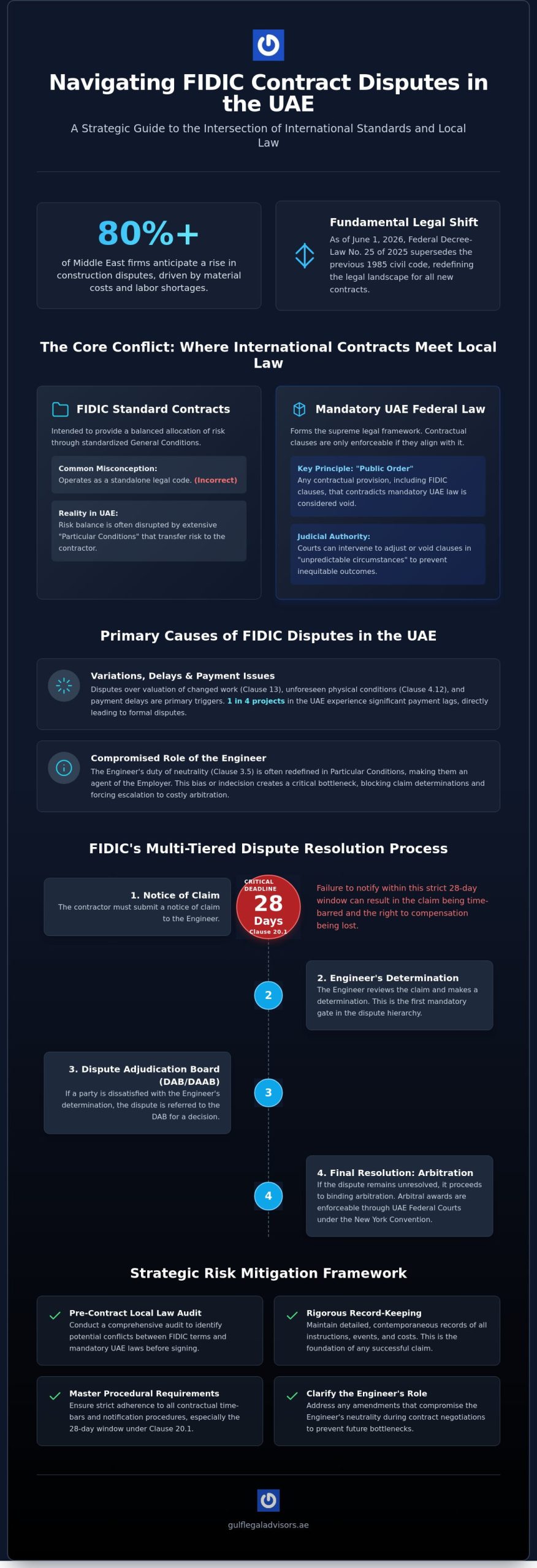
- Master the multi-tiered resolution requirements, including the strict 28-day notification window under Clause 20.1 and the subsequent Engineer determination phase.
- Implement strategic risk mitigation through rigorous contemporaneous record-keeping and a comprehensive local law audit prior to contract execution.
- Evaluate the procedural pathways for Arbitration and the mechanisms for enforcing arbitral awards through the UAE Federal Courts under the New York Convention.
What Are the Primary Causes of FIDIC Contract Disputes in the UAE?
FIDIC contract disputes UAE arise from disagreements regarding the interpretation or execution of the standard forms published by the International Federation of Consulting Engineers (FIDIC). While these forms aim to provide a balanced allocation of risk, the regional preference for extensive “Particular Conditions” often disrupts this equilibrium. In high-value infrastructure and energy projects, these modifications frequently transfer significant risk to the contractor, fostering an adversarial environment from the project’s inception. A significant misconception among international stakeholders is that these contracts operate as a standalone code. In reality, they are deeply integrated with national jurisdiction; contractual clauses are only enforceable to the extent they align with mandatory UAE federal laws.
Disputes are particularly prevalent in the UAE’s large-scale infrastructure and energy sectors, where project complexity is high. Data from 2025 indicates that over 80% of companies in the Middle East expect an increase in construction disputes, driven by rising material costs and labor shortages. When the standard FIDIC risk-sharing model is altered through bespoke amendments, the clarity of the original form is often lost, leading to protracted legal conflicts during the project lifecycle.
Common Triggers: Delays, Variations, and Payment Issues
Variations under Clause 13 are a primary catalyst for conflict, often involving disputes over the valuation of changed work or whether a specific instruction constitutes a change in scope. These disagreements are exacerbated by Clause 4.12, which addresses unforeseen physical conditions. In the UAE’s unique geological and urban landscape, encountering unexpected obstructions is common. When these events occur, the lack of a robust construction contract legal advisory UAE framework can lead to the forfeiture of claim rights. The financial pressure is further intensified by payment delays; statistics show that 1 in 4 construction projects in the UAE experience significant payment lags, directly triggering formal FIDIC contract disputes UAE as contractors struggle with cash flow.
The Role of the Engineer in Dispute Evolution
The Engineer’s duty to act neutrally under Clause 3.5 of the 1999 Red Book is frequently compromised in the local market. Many modified contracts redefine the Engineer as an agent acting solely for the Employer, which creates a perceived or actual conflict of interest. This shift often results in a bottleneck where the Engineer fails to issue timely determinations on claims. Without these decisions, the project cannot move forward through the contractual hierarchy, forcing parties toward formal arbitration. The Engineer’s Determination is the first mandatory gate in the FIDIC dispute hierarchy. When this gate is blocked by indecision or bias, the dispute inevitably escalates into a more costly and time-consuming legal proceeding.
How Does UAE Federal Law Override FIDIC Standard Terms?
The interaction between international standard forms and national legislation is a cornerstone of construction law in the region. While parties enjoy the freedom to negotiate specific terms, this autonomy is strictly bounded by the principle of “Public Order” (Ordre Public). Any contractual provision that contradicts mandatory UAE law is considered void. This legal hierarchy ensures that FIDIC contracts in the UAE remain subservient to the foundational principles of the Civil Code. While Federal Decree-Law No. 25 of 2025 recently replaced the long-standing Federal Law No. 5 of 1985 for contracts entered into after June 1, 2026, the core tenets regarding fairness and liability remain largely consistent across both regimes.
The concept of “unpredictable circumstances” has gained renewed focus in 2026. Under the new Civil Transactions Law, as under the old, the judiciary maintains the authority to intervene when external, exceptional events render a contractual obligation exhaustive or ruinous. This statutory override prevents the literal enforcement of FIDIC clauses that might otherwise lead to inequitable financial collapse for one party. It’s a vital safeguard that balances the strictness of contractual language against unforeseen economic shifts.
Mandatory Provisions: Articles 249, 390, and Decennial Liability
Article 249 provides the court with the power to reduce an exhaustive obligation to a reasonable level during exceptional, public events. This is a critical defense in FIDIC contract disputes UAE where global supply chain disruptions or sudden regulatory changes occur. Similarly, Article 390(2) allows UAE courts or arbitrators to adjust “Liquidated Damages” regardless of the fixed sum agreed upon in the contract. If the actual loss suffered is significantly lower than the pre-agreed penalty, the court can intervene to ensure the compensation is proportionate. Additionally, decennial liability persists as a non-excludable 10-year guarantee. Contractors and engineers remain liable for structural defects or collapse even if the contract purports to limit liability to a shorter period.
Good Faith and the Exercise of Rights
Article 246 mandates that contracts be performed in a manner consistent with the requirements of good faith. This principle is often invoked when one party attempts to use a procedural technicality, such as a strict time-bar, to avoid a legitimate payment. The “Abuse of Right” doctrine (Article 106) further restricts parties from exercising their contractual rights if the primary intent is to harm the other party or if the benefit gained is disproportionate to the harm caused. In practice, UAE law prioritizes the underlying equity of the transaction over rigid adherence to procedural technicalities when those technicalities are abused. For entities managing complex projects, engaging with expert litigation and arbitration counsel is essential to navigating these mandatory statutory overrides.
What Is the Multi-Tiered Dispute Resolution Process Under FIDIC?
The resolution of FIDIC contract disputes UAE follows a rigorous, multi-tiered hierarchy designed to filter out disagreements before they escalate into formal legal proceedings. This sequence begins with the submission of a Notice of Claim, followed by the Engineer’s consultation and determination period. If the matter remains unresolved, it moves to the Dispute Adjudication Board (DAB) or the updated Dispute Avoidance/Adjudication Board (DAAB). The final stages involve a mandatory period for amicable settlement, triggered by a Notice of Dissatisfaction, before the parties may pursue formal arbitration or litigation. Each stage acts as a mandatory procedural gate; failure to navigate one correctly often precludes access to the next.
Clause 20.1: The Critical 28-Day Notice Period
The most significant procedural hurdle in the FIDIC framework is the requirement under Clause 20.1 to submit a Notice of Claim within 28 days of the event. Failure to adhere to this strict timeline can result in the total forfeiture of the claim, a consequence that often catches contractors off guard. While the contract suggests an absolute bar, the application of this clause in the UAE is nuanced. Local courts and tribunals often weigh the FIDIC time-bar against the UAE Civil Code’s stance on prescription periods and the overarching duty of good faith. However, relying on judicial discretion is a high-risk strategy. For those managing delay claims construction UAE, strict compliance with the 28-day window remains the primary defense against the loss of legitimate entitlements.
The Reality of DABs and DAABs in the UAE Market
While the standard FIDIC forms envision standing Dispute Adjudication Boards that remain active throughout the project, the reality in the UAE market is often different. Employers frequently delete these provisions in the Particular Conditions, opting instead for “Ad Hoc” adjudication or bypassing the board entirely in favor of direct arbitration. This trend stems from a desire to reduce standing costs, yet it often removes a vital mechanism for dispute avoidance. The 2017 FIDIC suite attempted to address this by rebranding the board as the DAAB, emphasizing “Dispute Avoidance” as a proactive function. In the regional context, the effectiveness of these boards in mitigating FIDIC contract disputes UAE depends heavily on how the Particular Conditions are drafted. Without a standing board, the transition from a Notice of Claim to a formal dispute is often abrupt, leaving little room for the structured mediation the FIDIC authors intended. Understanding how these procedural gaps play out in practice is essential; a detailed examination of construction dispute arbitration UAE case studies illustrates how parties navigate these gaps under the 2026 regulatory framework.
How Can Contractors and Employers Mitigate FIDIC Dispute Risks?
Mitigating FIDIC contract disputes UAE requires a shift from reactive litigation toward proactive contract governance. Success in the regional construction sector depends on a party’s ability to anticipate friction points before they crystallize into formal claims. Establishing a rigorous culture of contemporaneous record-keeping serves as the primary line of defense. Under Clause 20.1, the evidentiary value of site diaries, progress reports, and formal correspondence often determines the outcome of a determination. Without granular, time-stamped data, even a legitimate claim will likely fail during the Engineer’s evaluation or subsequent arbitration. It’s a matter of technical discipline that must be maintained throughout the project lifecycle.
A comprehensive local law audit of the Particular Conditions is equally vital during the pre-execution phase. Given the enforcement of Federal Decree-Law No. 25 of 2025, stakeholders must ensure that bespoke amendments don’t inadvertently conflict with mandatory statutory protections. Establishing direct communication protocols between the Project Manager and the Legal Department ensures that technical delays are evaluated for their legal implications in real-time. Utilizing “Early Warning” mechanisms, regardless of whether the specific FIDIC edition mandates them, allows parties to address scope creep or unforeseen conditions through structured negotiation rather than adversarial confrontation.
Strategic Drafting of Particular Conditions
Strategic risk mitigation begins during the procurement phase. Identifying “Red Flag” clauses is a priority for high-stakes decision-makers; these often include broad indemnity provisions or unconditional performance bonds that can be called without proof of default. Aligning the contract’s dispute clause with the latest procedural rules of the preferred arbitration center ensures that the resolution process remains efficient and enforceable. Including “Quantum Meruit” protections provides a critical safety net in the event of contract termination, ensuring that the contractor is compensated for the actual value of work performed even if the contract is set aside under local law.
Operational Compliance and Claim Substantiation
Claims must be substantiated with technical precision to survive scrutiny. Every submission should explicitly link a specific “Event” to a corresponding “Contractual Clause” to provide a clear legal basis for the requested relief. In complex infrastructure projects, the role of forensic delay analysts is indispensable for mapping the critical path and quantifying the impact of disruptions. A claim is only as strong as the data supporting it; in the UAE, the burden of proof rests heavily on the claimant. For organizations seeking to strengthen their project governance, the specialized litigation and arbitration team at Gulf Legal Advisors provides the strategic oversight necessary for effective commercial dispute resolution.
What Legal Remedies Are Available When FIDIC Disputes Escalate?
Formal arbitration remains the default mechanism for resolving FIDIC contract disputes UAE in large-scale infrastructure and energy projects. This preference is driven by the requirement for technical expertise and the procedural finality that international and regional arbitration centers provide. Once an award is rendered, the UAE’s adherence to the New York Convention facilitates the enforcement of these awards through the national courts. It’s a structured process that ensures cross-border commercial security. The enforcement phase is a critical juncture where the precision of the initial contract drafting and the conduct of the arbitration proceedings are tested against local judicial standards.
Termination of the contract is the most severe remedy available to parties. The distinction between “Termination for Convenience” and “Termination for Default” carries significant financial implications. Under Article 836 of the 2026 Civil Transactions Law, an employer’s right to withdraw from a contract is now expressly regulated, including the specific compensation payable to the contractor for work performed and lost profits. This statutory clarity reduces the ambiguity often found in bespoke FIDIC modifications. Additionally, the recovery of legal costs and interest varies significantly between forums; while arbitral tribunals generally have the discretion to award substantial legal costs, UAE federal courts typically award only nominal legal fees alongside court-mandated interest rates.
Arbitration Forums: DIAC and International Centers
The Dubai International Arbitration Centre (DIAC) is the primary forum for regional construction matters. In 2026, the implementation of “DANA,” a cloud-based case management system, has further streamlined the arbitration process, reflecting the UAE’s move toward digital judicial efficiency. Choosing the correct seat and forum is a strategic decision that impacts the ease of award enforcement. A seat in the DIFC or ADGM offers a common law procedural framework that many international stakeholders prefer for its predictability. It’s essential to recognize that the choice of seat determines the supervisory court, which can influence the finality of the resolution.
Litigation in UAE Federal Courts
Disputes fall to the national courts if the arbitration clause is found to be invalid or if the parties haven’t explicitly agreed to an alternative forum. In these instances, the UAE federal court system utilizes a sophisticated court-appointed expert system to evaluate the technical merits of construction claims. These experts provide the judicial bench with the specialized knowledge required to interpret complex FIDIC-based evidence and forensic delay reports. For entities requiring comprehensive representation in these high-stakes environments, a legal consultancy firm Dubai like Gulf Legal Advisors offers the necessary depth to navigate both the technical and procedural requirements of the national court system. This ensures that the underlying equity of the transaction is protected even when the contractual framework is challenged.
Strategic Governance in a Shifting Legal Landscape
Navigating the complexities of FIDIC contract disputes UAE requires a sophisticated understanding of how international standard forms intersect with the mandatory provisions of the UAE Federal Civil Transactions Law. Success is no longer defined by the contractual text alone but by the proactive reconciliation of these terms with the evolving statutory requirements of Federal Decree-Law No. 25 of 2025. Stakeholders must prioritize rigorous record-keeping and strict adherence to Clause 20.1 notification windows to ensure that legitimate claims are preserved and enforceable within the regional judicial framework.
Effective resolution depends on the strategic selection of arbitration forums and the meticulous substantiation of technical data. Gulf Legal Advisors offers specialized expertise in the UAE Federal Civil Code and extensive experience in DIAC and international arbitration. Our team provides strategic advisory for the Oil, Gas, and infrastructure sectors, ensuring that high-stakes projects remain resilient against contractual friction. To protect your commercial interests and secure your project’s trajectory, it’s essential to Secure Strategic Counsel for Your FIDIC Dispute. Modern infrastructure demands a partner who possesses both the intellectual depth to handle complex litigation and the practical focus to deliver results.
Frequently Asked Questions
Is the 28-day notice period in FIDIC Clause 20.1 strictly enforceable in the UAE?
While Clause 20.1 is a condition precedent, its absolute enforceability is balanced against Article 246 (Good Faith) and Article 106 (Abuse of Right) of the UAE Civil Transactions Law. Courts may allow a claim if the employer suffered no actual prejudice or if enforcing the bar would be inequitable. However, strict adherence remains the most secure legal position to avoid unnecessary FIDIC contract disputes UAE.
Can a UAE court override a FIDIC contract’s liquidated damages clause?
Yes, Article 390(2) of the Civil Transactions Law grants UAE courts and arbitrators the mandatory power to adjust liquidated damages to reflect actual loss. If the actual damage suffered is significantly lower than the pre-agreed sum, the court can reduce the penalty. Conversely, the court can increase the amount if the loss is higher, regardless of the fixed sum stated in the contract.
What happens if a FIDIC contract does not specify a dispute resolution forum?
If a contract lacks a valid arbitration agreement, the default jurisdiction rests with the UAE national courts. This typically involves litigation in the Federal Courts, where a court-appointed expert will be assigned to assess the technical and financial merits of the construction dispute. This process follows the standard Civil Procedure Law and requires specialized legal representation to navigate the expert’s review.
How does ‘Good Faith’ affect the termination of a FIDIC contract under UAE law?
The requirement for good faith under Article 246 means that termination must not be exercised in an arbitrary or malicious manner. Even if a party possesses a contractual right to terminate for convenience or default, the exercise of that right is subject to judicial review. Termination conducted in bad faith can lead to significant damage awards against the terminating party, overriding the literal contractual text.
Are Dispute Adjudication Boards (DAB) mandatory for UAE construction projects?
DABs are not legally mandatory under UAE law, although they are a standard feature of the FIDIC General Conditions. In the local market, employers often delete these clauses in the Particular Conditions to reduce costs. If the clause remains in the signed agreement, it’s a mandatory contractual requirement that must be exhausted before a party can proceed to formal arbitration or litigation.
Can I claim for ‘unforeseen ground conditions’ if the contract says the Contractor takes all risks?
You may still have a claim under Article 249 of the Civil Transactions Law if the conditions constitute an “exceptional event” that makes performance exhaustive. While FIDIC Clause 4.12 addresses unforeseen physical conditions, mandatory UAE law allows for the adjustment of obligations that become ruinous due to unpredictable circumstances. This statutory protection provides a critical safety net that overrides broad, bespoke risk-transfer clauses.
What is ‘Decennial Liability’ and can it be excluded from a FIDIC contract?
Decennial Liability is a mandatory 10-year guarantee against structural collapse or stability defects as defined in the Civil Code. It’s a matter of public policy and cannot be excluded or limited by any contractual provision. This liability applies jointly to both the contractor and the supervising engineer, beginning from the date of project delivery, regardless of any shorter liability periods mentioned in the FIDIC form.
How long does it take to enforce an arbitration award for a FIDIC dispute in the UAE?
Enforcement of a domestic arbitral award through the UAE courts generally takes between six and twelve months, depending on the complexity of any challenges. The process has become more efficient with the 2026 digital initiatives, such as the DIAC “DANA” system. This ensures that FIDIC contract disputes UAE reach a final, enforceable conclusion within a timeframe that respects the commercial requirements of the infrastructure sector.