

The UAE Cabinet decision on June 1, 2026, to declare an official “Emergency Financial Crisis” period has fundamentally shifted the legal responsibilities of every major enterprise in the region. Operating under a legacy framework during such a transition is no longer a matter of administrative preference; it’s a direct threat to corporate longevity. Many leadership teams recognize that the interplay between the 9% federal corporate tax and the June 30, 2026, deadline for updating constitutional documents creates a high stakes environment where errors are costly. Engaging specialized corporate restructuring legal services UAE is the most reliable method to mitigate these risks while maintaining operational continuity.
This guide provides a definitive roadmap for navigating the complexities of multi-jurisdictional realignment and the evolving AI governance landscape. You’ll find a clear path toward establishing a legally robust structure that prioritizes asset protection and regulatory excellence. We will examine the specific advantages of the insolvency regimes in the DIFC and ADGM, the strategic implications of the current financial crisis declaration, and the technical requirements for achieving a seamless transition with minimal litigation exposure.
Key Takeaways
- Identify the strategic drivers for realignment in 2026, including the impact of the federal corporate tax and the recent “Emergency Financial Crisis” declaration.
- Compare the distinct legal advantages of UAE Mainland, Free Zones, and Financial Centres like the DIFC and ADGM to select the optimal jurisdiction for holding structures.
- Learn to utilize sophisticated legal mechanisms, including mergers and demergers, through expert corporate restructuring legal services UAE to ensure long-term operational resilience.
- Integrate robust compliance and AI governance frameworks into your corporate structure to mitigate emerging regulatory risks and enhance asset protection.
- Execute complex multi-jurisdictional transitions using a phased advisory approach designed to minimize litigation risk and maintain business continuity.
The Strategic Imperative of Corporate Restructuring in the UAE
Corporate restructuring constitutes the strategic realignment of an entity’s legal, ownership, and operational frameworks. It’s a deliberate process designed to enhance organizational efficiency and ensure long-term viability in a fluctuating market. For a foundational Corporate Restructuring Definition, one must examine how these modifications impact debt, equity, and asset management to meet specific commercial objectives. In the current regional climate, high-stakes decision-makers view these transformations as essential for maintaining a competitive edge and ensuring institutional stability.
The landscape in 2026 is marked by a definitive shift away from legacy “Mainland-only” models. Modern enterprises are increasingly adopting sophisticated multi-jurisdictional holding structures to optimize their regional and global footprint. This evolution isn’t merely about administrative convenience. It represents a calculated effort to enhance shareholder value and institutionalize rigorous corporate governance. Professional corporate restructuring legal services UAE provide the necessary oversight to manage these transitions without disrupting core operations or compromising asset security.
Drivers of Structural Evolution in 2026
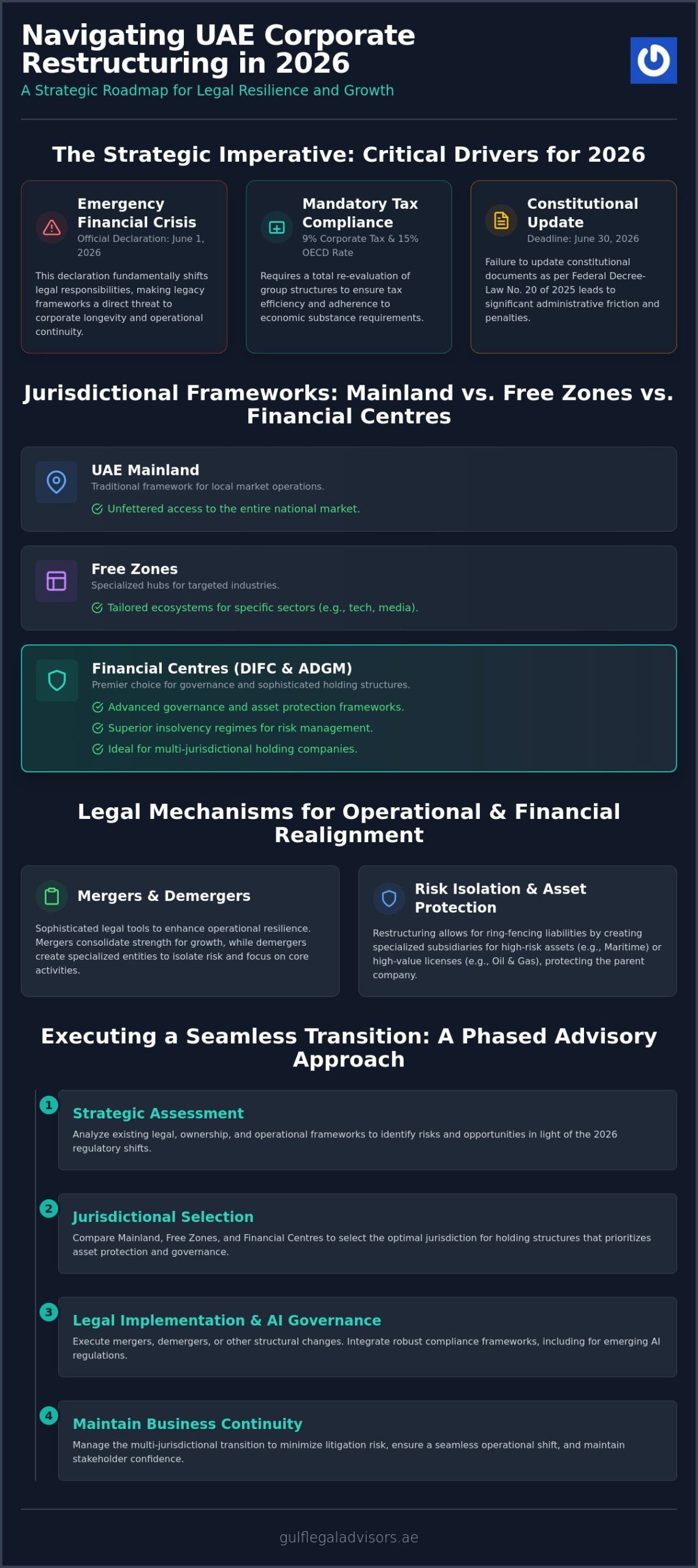
Regulatory shifts serve as the primary catalyst for change this year. Companies must prioritize compliance with Federal Decree-Law No. 20 of 2025, which mandates that constitutional documents be updated by the June 30, 2026, deadline. Failure to align with these amendments can lead to significant administrative friction. Additionally, the full implementation of the 9% federal corporate tax and the 15% rate for large multinationals under the OECD Pillar Two framework necessitates a total re-evaluation of group structures to ensure tax efficiency and adherence to economic substance requirements.
Strategic growth also demands structural agility. For many organizations, restructuring is a prerequisite for engaging with M&A legal advisors UAE. A clean, transparent legal hierarchy makes an entity significantly more attractive for acquisitions or public listings. It ensures that the business is positioned to capitalize on the UAE’s projected 4.8% non-hydrocarbon economy expansion while providing a clear audit trail for international investors.
Restructuring as a Risk Mitigation Tool
Risk isolation is a critical objective for diversified conglomerates. By utilizing expert corporate restructuring legal services UAE, firms can effectively ring-fence liabilities across different business units. This is particularly vital in capital-intensive sectors where operational risks are high. For instance, separating Maritime assets from broader corporate holdings protects the parent company from the specific liabilities inherent in shipping and logistics operations.
In the Oil & Gas sector, a robust legal shield is indispensable. Restructuring allows for the creation of specialized subsidiaries that hold specific licenses or high-value assets, insulating the group from high-stakes litigation. This methodical approach prepares the entity for potential international investment or entry into capital markets, ensuring that governance standards meet the expectations of global judicial and financial bodies. It’s about building a structure that doesn’t just survive today’s regulations but is built for the complexities of the next decade.
Jurisdictional Frameworks: Mainland vs. Free Zones vs. Financial Centres
The selection of a legal jurisdiction is the cornerstone of any structural realignment. In the context of the UAE’s Economic Transformation, the traditional distinctions between Mainland and Free Zone entities have matured. While Mainland registrations grant unfettered access to the national market, Free Zones continue to offer specialized ecosystems tailored to specific industries. However, the introduction of the federal corporate tax and subsequent refinements in 2026 have harmonized many regulatory requirements. This shift makes the choice of jurisdiction more about governance and asset protection than simple tax avoidance.
Expert corporate restructuring legal services UAE often recommend a hybrid ‘Onshore-Offshore’ model for diversified groups. This involves establishing a holding company within a financial centre like the ADGM or DIFC while maintaining operating subsidiaries on the Mainland. This structure effectively isolates high-value assets from operational liabilities. It provides a sophisticated layer of security that appeals to international investors and financial institutions alike. For complex groups, this dual-layered approach is the most robust method to ensure multi-jurisdictional compliance.
The Role of Financial Centres (ADGM and DIFC)
The Abu Dhabi Global Market (ADGM) and the Dubai International Financial Centre (DIFC) operate under Common Law frameworks, distinct from the civil law system of the wider UAE. This provides a predictable environment for corporate governance and dispute resolution. ADGM has emerged as a primary hub for technology and AI-focused enterprises. It benefits from a regulatory environment that anticipates the growth of the UAE’s fintech market, which is projected to reach USD 52.07 billion in 2026. Conversely, the DIFC remains the strategic choice for banking and finance restructuring, offering a mature judicial system and deep liquidity pools. Both jurisdictions provide a familiar legal landscape for global partners, facilitating easier capital market entry.
Mainland Realignment for National Market Access
Restructuring a Mainland entity requires a precise understanding of the 100% foreign ownership provisions. While many activities no longer require a local partner, the transition from a traditional partnership to a fully owned subsidiary must be handled with care. This involves ensuring strict compliance with the Ministry of Economy’s latest directives and the June 30, 2026, deadline for constitutional document updates. For businesses seeking to optimize their national footprint, a strategic review of corporate structures is essential to determine whether a branch or a subsidiary offers the most efficient path for expansion. This decision impacts everything from licensing costs to future divestment strategies.
Legal Mechanisms for Operational and Financial Realignment
Executing a structural transformation requires more than a strategic outline; it demands the precise application of statutory instruments. In the UAE, the legal process of mergers, demergers, and carve-outs involves a methodical transfer of assets and liabilities that must adhere to both federal laws and specific jurisdictional mandates. A demerger, for instance, is often the preferred mechanism for isolating high-risk operational units from the parent company’s core capital. Professional corporate restructuring legal services UAE ensure that these transfers are documented with the granularity required to withstand judicial scrutiny and maintain the integrity of the corporate veil.
The preservation of commercial licenses and intellectual property (IP) remains a primary concern during any realignment. Licenses are frequently tied to specific activities and jurisdictional approvals; therefore, a change in corporate structure may necessitate a formal novation of contracts or the re-issuance of permits. Intellectual property assets require separate assignment protocols to ensure that trademarks and patents remain protected throughout the transition. Managing these technicalities prevents the disruption of operations and secures the entity’s intangible value during the shift.
M&A as a Restructuring Catalyst
Mergers and acquisitions frequently serve as the initial trigger for broader organizational change. Integrating a newly acquired entity into a unified governance framework is essential for achieving the synergies identified during the due diligence phase. This process is particularly complex in the context of cross-border M&A UAE, where differences in jurisdictional regulations can create friction. Legal realignment post-acquisition focuses on harmonizing internal policies, streamlining reporting lines, and consolidating legal entities to reduce administrative redundancy and enhance overall institutional clarity.
Financial Restructuring and Debt Management
The UAE Cabinet’s declaration of an “Emergency Financial Crisis” period, effective from February 28, 2026, has introduced significant modifications to the debt management landscape. Under Cabinet Decision No. 94/2026, debtors affected by the crisis gain access to a more flexible restructuring framework, including a mandatory 40-day period for creditor negotiations. During this window, creditor-initiated bankruptcy applications are postponed, providing companies with the necessary breathing room to pursue debt workouts or secure prioritized new financing.
Utilizing corporate restructuring legal services UAE during such periods is vital for protecting director liability. When an enterprise faces financial distress, the legal responsibilities of the board of directors intensify. A structured, transparent realignment process demonstrates a commitment to creditor interests and helps mitigate the risk of personal liability for “wrongful trading” or insolvency-related negligence. By leveraging the formal procedures outlined in the UAE Bankruptcy Law, leadership teams can navigate financial realignments with a focus on long-term solvency and institutional recovery.
Mitigating Risk: Compliance, Governance, and AI Integration
Risk management in 2026 requires a proactive stance on digital and regulatory integrity. A common failure in realignment is treating compliance as a post-transaction checklist rather than a foundational requirement. Before initiating any structural shift, engaging comprehensive due diligence legal services Dubai is essential. This process identifies hidden liabilities, assesses the validity of existing contracts, and ensures that the proposed transition doesn’t inadvertently trigger regulatory breaches. High-stakes decision-makers rely on corporate restructuring legal services UAE to build a structure that’s defensible against both current and future audits.
The legal nuances of Ultimate Beneficial Ownership (UBO) reporting have become increasingly complex following recent amendments. Restructured entities must ensure that their UBO registers are updated and filed with the relevant licensing authorities immediately following any change in shareholding or control. Accurate reporting isn’t just a matter of transparency; it’s a legal safeguard against administrative penalties and reputational damage. Maintaining a clear audit trail of ownership is a prerequisite for any business seeking to maintain its standing within the global financial system.
AI Governance and Technology Compliance
With artificial intelligence projected to contribute nearly 14% to the UAE’s GDP by 2030, the strategic placement of technology assets is a priority for modern enterprises. Restructuring now involves creating dedicated frameworks for AI governance and data privacy. This means establishing board-level oversight to manage the legal risks associated with algorithmic decision-making and automated processes. For enterprises in the fintech sector, which is forecasted to grow to USD 90.06 billion by 2031, aligning the corporate structure with emerging UAE AI regulations ensures that technology remains a competitive asset rather than a liability.
Corporate Governance and AML Integrity
The UAE’s continued tightening of the anti-money laundering (AML) framework necessitates a total recalibration of risk profiles for restructured entities. Implementing a robust AML framework is no longer optional; it’s a core component of institutional stability. A transparent governance structure enhances stakeholder confidence and protects the entity’s reputation in an environment of increased scrutiny. Professional corporate restructuring legal services UAE help organizations navigate these evolving mandates, ensuring that every subsidiary and branch remains in full compliance with federal and jurisdictional directives. To secure your organization’s regulatory standing, engaging a legal consultancy firm Dubai is the most effective way to ensure multi-jurisdictional alignment.
Executing the Restructuring: A Strategic Advisory Approach
The successful execution of a structural realignment is the point where strategic intent meets operational reality. A fragmented or poorly timed implementation can result in administrative delays, unforeseen tax liabilities, or the disruption of core business activities. By securing professional corporate restructuring legal services UAE, leadership teams ensure that the transition is managed with the methodical precision required for high-stakes environments. This advisory approach prioritizes clarity and efficiency, allowing the enterprise to emerge from the process with a more resilient and compliant framework.
Navigating the interaction between Mainland authorities, Free Zone regulators, and Financial Centre judicial bodies requires a deep understanding of regional administrative nuances. Engaging a legal consultancy firm Dubai provides the necessary institutional depth to manage these multi-jurisdictional complexities. This partnership ensures that every document, from shareholder resolutions to updated Articles of Association, is executed in strict accordance with the latest federal mandates and jurisdictional requirements.
The Phased Execution Framework
A professional restructuring engagement follows a logical, top-down hierarchy designed to eliminate ambiguity. The process is typically divided into three distinct phases:
- Phase 1: Diagnostic Legal Audit and Jurisdictional Analysis. This initial stage involves a comprehensive review of the existing corporate structure, license validity, and contractual obligations. We analyze the strategic suitability of different jurisdictions based on the group’s specific commercial objectives.
- Phase 2: Structural Design and Regulatory Pre-approval. In this phase, the new legal architecture is finalized. We engage with relevant authorities to secure pre-approvals for mergers, demergers, or redomiciliations, ensuring that the proposed changes are viable before formal execution.
- Phase 3: Implementation, Document Execution, and License Migration. The final phase involves the formal signing of legal instruments, the transfer of assets, and the migration of commercial licenses. This is handled with a focus on maintaining operational continuity throughout the transition.
Ensuring Long-Term Structural Stability
The conclusion of the implementation phase doesn’t mark the end of the legal journey. Post-restructuring legal audits are essential to verify that all registrations are active and that the new structure is functioning as intended within the 2026 regulatory environment. Continuous monitoring is required to adapt to any further shifts in AML or AI governance laws. It’s also the ideal time to strengthen the group’s internal governance by incorporating robust commercial dispute resolution Dubai clauses into new shareholder agreements. These provisions provide a predictable path for conflict resolution, further protecting the entity’s long-term stability.
Gulf Legal Advisors remains a sophisticated navigator for UAE enterprises seeking to optimize their corporate footprint. Our commitment to unwavering professionalism and strategic resolution ensures that your organization is not only compliant with today’s standards but is built to thrive in the complex commercial landscape of tomorrow. Through expert corporate restructuring legal services UAE, we deliver the clarity and security that modern business leaders require.
Securing Your Corporate Future in an Evolving Market
The transition toward a more structured and transparent commercial landscape in the UAE presents both challenges and significant strategic opportunities. Navigating the interaction between Mainland regulations, Free Zone mandates, and the specialized common law frameworks of the DIFC and ADGM requires a methodical approach. By aligning your organizational structure with the 2026 regulatory deadlines and integrating robust AI governance, you protect your enterprise from administrative friction and emerging liabilities. A commitment to structural excellence remains the definitive method for ensuring institutional stability and sustainable growth.
Utilizing professional corporate restructuring legal services UAE ensures that every facet of your realignment, from asset isolation to licensing migration, is handled with meticulous precision. Gulf Legal Advisors serves as a sophisticated navigator for complex regulatory shifts, offering specialized advisory for high-stakes sectors and proven expertise in multi-jurisdictional UAE law. We invite you to consult with our strategic advisors on corporate restructuring legal services in the UAE to determine the most resilient path for your organization. Establishing a legally robust framework today is the most effective way to secure your commercial legacy for the years ahead.
Frequently Asked Questions
What are the primary legal benefits of corporate restructuring in the UAE?
The primary legal benefits include enhanced asset protection through the isolation of liabilities and the optimization of tax positions under the 9% federal corporate tax regime. Restructuring also strengthens corporate governance frameworks and prepares entities for international investment or public listings. By utilizing professional corporate restructuring legal services UAE, businesses can establish a more resilient legal hierarchy that aligns with global compliance standards.
How long does the corporate restructuring process typically take in the UAE?
A comprehensive restructuring engagement typically spans between three and six months. This timeline is influenced by the complexity of the corporate group and the specific requirements of the chosen jurisdictions. Delays are often mitigated through proactive engagement with regulatory bodies during the diagnostic and pre-approval phases. Maintaining a methodical approach ensures that license migrations and document executions are completed without disrupting daily operations.
Can a Mainland company be restructured into a Free Zone holding company?
Yes, enterprises can establish a Free Zone holding company, particularly in common law jurisdictions like the DIFC or ADGM, to own Mainland operating subsidiaries. This “Onshore-Offshore” hybrid model is a sophisticated strategy for securing asset protection and utilizing common law dispute resolution. It allows the group to maintain national market access while benefiting from the robust governance frameworks offered by the UAE’s premier financial centres.
What is the impact of corporate restructuring on existing commercial licenses?
Restructuring often necessitates the formal amendment or novation of commercial licenses to reflect changes in ownership or legal form. Each jurisdiction, whether Mainland or Free Zone, has specific protocols for license migration that must be strictly followed to ensure continuity. Failure to coordinate these updates with the relevant licensing authorities can lead to administrative friction or the temporary suspension of certain business activities.
Are there specific legal requirements for restructuring in the Oil & Gas sector?
Restructuring within the Oil & Gas sector requires adherence to specialized licensing mandates and regulations from the Supreme Council for Financial and Economic Affairs. Asset isolation is a critical objective in this capital-intensive industry to protect the parent entity from high-stakes operational liabilities. Legal realignments must also account for specific joint venture agreements and local content requirements that are unique to the energy sector.
How does the UAE Bankruptcy Law affect corporate restructuring?
The UAE Bankruptcy Law provides a structured framework for debt realignments and creditor negotiations, especially during the “Emergency Financial Crisis” declared in 2026. Under Cabinet Decision No. 94/2026, debtors have access to a 40-day negotiation window and protections against creditor-initiated insolvency applications. This legal framework facilitates consensual workouts while protecting directors from personal liability during periods of financial distress.
What role does AI governance play in modern UAE corporate restructuring?
AI governance involves integrating compliance frameworks that address algorithmic transparency and data privacy into the new corporate structure. As the UAE moves toward becoming a global AI hub, restructured entities must establish board-level oversight for digital transformation. This ensures that the strategic placement of technology assets within the group complies with emerging federal regulations and protects the organization from tech-related legal risks.
Is it necessary to conduct due diligence before restructuring a corporate group?
Comprehensive due diligence is an indispensable prerequisite for any structural change to identify contingent liabilities and contractual restrictions. This process ensures that the proposed realignment doesn’t inadvertently trigger “change of control” clauses or violate existing banking covenants. It serves as the diagnostic foundation for all corporate restructuring legal services UAE, providing the clarity needed to execute a seamless and legally compliant transition.