



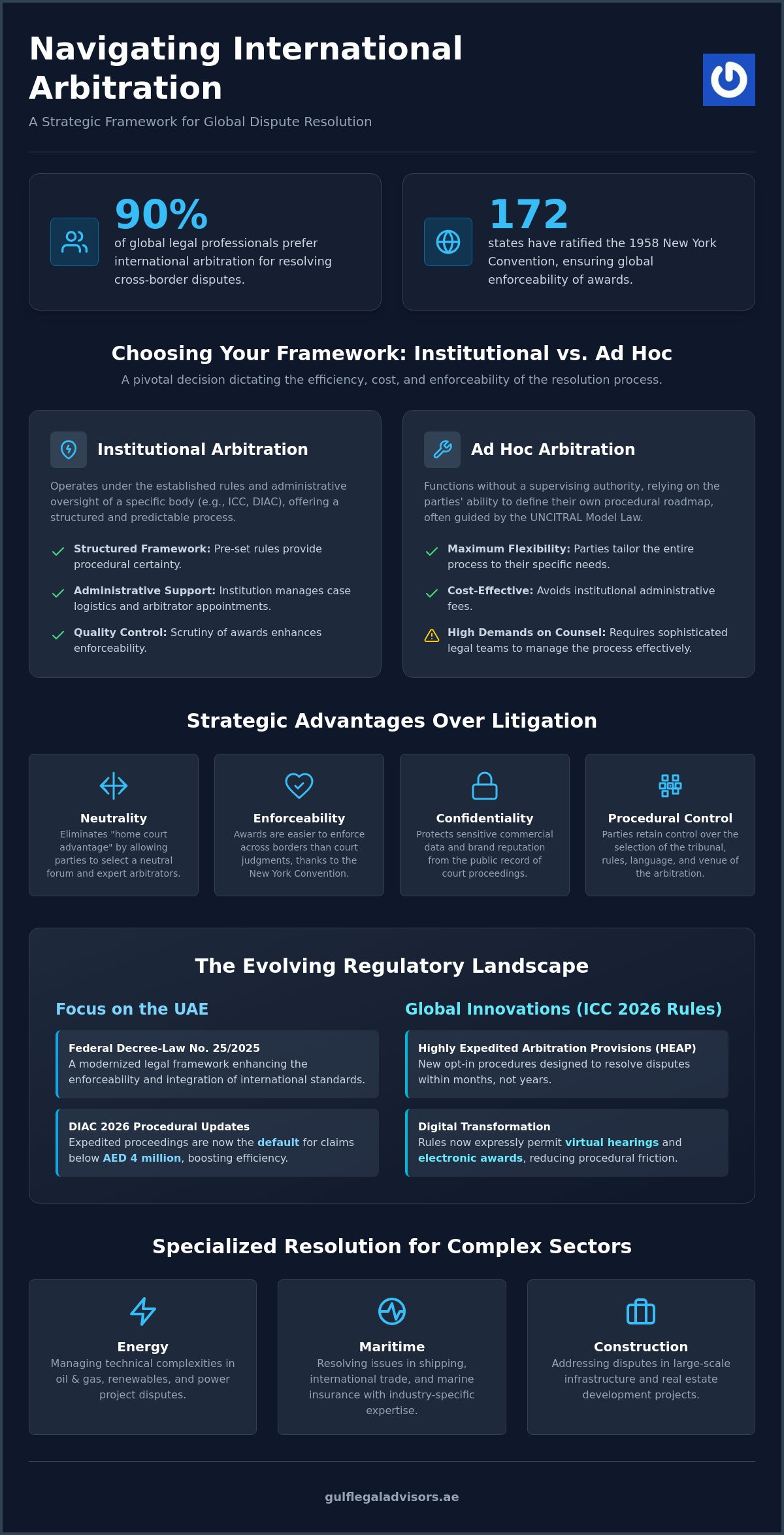
With 90% of global legal professionals now selecting international arbitration as their preferred method for resolving cross-border disputes, the traditional reliance on national judiciary systems has transitioned from a standard practice to a calculated risk. For corporate leaders, the fear of biased local courts and the prohibitive costs of multi-jurisdictional litigation are not merely theoretical concerns; they are tangible barriers to global expansion. The 1958 New York Convention, now ratified by 172 states, provides a level of security in the enforcement of awards that domestic judgments simply cannot match.
It’s understandable that the rapid evolution of regulatory frameworks, including the 2026 ICC Arbitration Rules and the UAE’s Federal Decree-Law No. 25/2025, presents a challenge for even the most sophisticated legal departments. This reference guide provides a comprehensive framework for navigating these complexities, offering the clarity necessary to maintain strategic control in volatile environments. We will examine the criteria for institutional selection, the implementation of expedited procedures for claims below USD 4 million, and the specific mechanisms that ensure the cross-border enforceability of your arbitral awards.
Key Takeaways
- Gain a strategic perspective on how international arbitration functions as a neutral, binding mechanism to protect multi-jurisdictional investments.
- Evaluate the procedural trade-offs between structured institutional frameworks and the flexibility of ad hoc proceedings to optimize cost and efficiency.
- Leverage confidentiality and procedural control to safeguard sensitive commercial data and brand reputation from the public record.
- Identify specialized resolution strategies for the unique technical complexities found in the energy, maritime, and construction sectors.
- Understand the procedural requirements for the successful enforcement of arbitral awards within the UAE’s modernized legal framework.
Understanding the Mechanism of International Arbitration in a Globalized Economy
International arbitration serves as a private, consensual, and binding method for the resolution of commercial disputes between parties in different jurisdictions. Unlike traditional litigation, which relies on the mandatory authority of a state’s judiciary, the mechanism of international arbitration derives its power from the contractual agreement of the parties involved. This framework allows multinational enterprises to bypass the inherent uncertainties of foreign court systems, replacing them with a predictable, neutral process. It’s a system designed for clarity, ensuring that legal outcomes are determined by chosen experts rather than jurisdictional circumstance. In a globalized economy, this autonomy over the dispute resolution process is not merely a preference but a strategic necessity for risk management.
The Core Principles of Arbitral Neutrality
Neutrality remains the cornerstone of the arbitral process. By selecting a neutral forum, parties effectively eliminate the “home court advantage” that often complicates cross-border transactions. This extends to the selection of the tribunal; parties often appoint arbitrators based on specific technical expertise rather than general legal experience. The distinction between the “seat” and the “venue” provides corporate leaders with the flexibility to choose legal frameworks that offer the highest levels of stability and judicial non-interference.
The Legal Foundation: The New York Convention
The global enforceability of arbitral awards is anchored by the 1958 New York Convention, which has been ratified by 172 states as of 2026. This treaty requires national courts to recognize and enforce foreign arbitral awards, subject to very limited exceptions. Consequently, an award is often significantly easier to enforce across borders than a national court judgment. The New York Convention functions as the essential architecture that ensures commercial stability and the reliable execution of legal obligations across the global marketplace.
The current year has seen a significant shift toward the integration of advanced technologies within the international arbitration framework. The 2026 revisions to institutional rules, such as those from the International Chamber of Commerce (ICC) effective June 1, 2026, now expressly permit electronic awards and virtual hearings. These rules have also introduced the Highly Expedited Arbitration Provisions (HEAP), an opt-in procedure designed to resolve disputes within a few months. These advancements reduce the procedural friction of multi-jurisdictional disputes, allowing for a more efficient allocation of corporate resources and faster resolution of high-stakes matters.
Institutional vs. Ad Hoc Arbitration: Navigating Procedural Frameworks
The selection between institutional and ad hoc frameworks represents a pivotal decision in realizing the strategic advantages of arbitration. Institutional arbitration operates under the established rules and administrative oversight of a specific body, such as the International Chamber of Commerce (ICC) or the Dubai International Arbitration Centre (DIAC). In contrast, ad hoc proceedings function without a supervising authority, relying instead on the parties’ ability to define their own procedural roadmap. While the UNCITRAL Model Law provides a standardized benchmark for these ad hoc arrangements, the complexity of managing a dispute without institutional support requires a high level of sophistication from legal counsel. This choice often dictates the efficiency, cost, and ultimate enforceability of the resolution.
Selecting an appropriate forum requires a rigorous analysis of reputation, cost, and regional expertise. We’ve seen a notable rise in specialized regional centers across the Middle East and Asia, which offer localized knowledge and cultural alignment for global entities. For instance, DIAC’s 2026 procedural updates have made expedited proceedings the default for claims below AED 4 million, significantly enhancing its appeal for regional commercial hubs. Global firms must evaluate whether an institution’s rules align with their specific sector requirements and jurisdictional needs. Expert guidance in Litigation & Arbitration ensures that the chosen framework supports the broader commercial objectives of the enterprise.
The Benefits of Institutional Oversight
Institutional bodies provide a structured environment that mitigates procedural risks through comprehensive administrative support. They manage the critical stages of arbitrator appointments and handle challenge procedures with established protocols. One of the most significant benefits is the institutional scrutiny of awards, which ensures that the final decision meets the necessary legal standards for enforcement. Additionally, established fee schedules allow for greater predictability in corporate budgets, preventing the unforeseen administrative costs often associated with unstructured international arbitration.
When to Consider Ad Hoc Arbitration
Ad hoc arbitration is generally reserved for disputes where party autonomy is the primary objective. It allows for the total customization of timelines and evidence rules to fit the specific nuances of a high-value, highly specialized matter. While this can lead to potential cost savings by avoiding institutional administrative fees, it places a heavier burden on the parties to maintain the momentum of the case. Without the safety net of an institution, the procedural integrity of the case rests entirely on the expertise and cooperation of the legal teams involved.
Strategic Advantages: Why Global Entities Prioritize Arbitration Over Litigation
For global entities, the decision to opt for international arbitration is a calculated effort to preserve asset value during periods of conflict. While litigation is often reactive and public, the mechanism of international arbitration allows for a proactive approach to dispute management. This is particularly relevant for entities operating in high-stakes sectors where the preservation of commercial relationships and brand integrity is paramount. By prioritizing arbitration, corporations gain the ability to tailor every aspect of the proceedings, from the selection of the seat to the specific evidence rules, ensuring the process aligns with their operational realities. It’s a system that prioritizes commercial logic over procedural rigidity.
Value Preservation Through Confidentiality
Public litigation carries the inherent risk of “reputational contagion,” where a single legal dispute can negatively impact shareholder confidence or broader market perception. Private proceedings ensure that sensitive commercial data and internal governance matters remain off the public record. This is a critical advantage for joint ventures or partnerships where proprietary technology and trade secrets are at the center of the conflict. The strategic use of confidentiality clauses within international agreements ensures that discovery processes don’t expose competitive advantages to the market or rival entities. Maintaining this veil of privacy allows businesses to resolve disputes without compromising their long-term market position.
The Role of Technical Expertise in Adjudication
The complexity of modern commerce, particularly in Banking, Finance & Capital Markets, requires adjudicators who possess deep-rooted industry knowledge. National judges are often generalists who may lack the specific technical background needed to interpret intricate financial instruments or construction engineering standards. By selecting arbitrators with backgrounds in maritime law or energy infrastructure, parties ensure the tribunal understands the commercial context of the dispute. Expert-led panels significantly reduce the risk of erratic judicial decisions that can stem from a lack of specialized sector understanding.
Beyond technical expertise, the finality of an arbitral award is a significant driver for its adoption among high-stakes decision-makers. In traditional litigation, cases can languish in appellate courts for years, causing prolonged financial uncertainty and resource drain. International arbitration limits the scope for appeals, providing a definitive resolution that allows management to redirect their focus toward growth. This procedural efficiency, combined with the 90% preference rate for arbitration reported in the Queen Mary University of London survey, underscores why it’s now the global standard for international contract disputes. It provides the security and clarity that modern business environments demand.
Sector-Specific Arbitration: Managing Complexity in Energy, Maritime, and Construction
The efficacy of international arbitration as a strategic tool is most evident within sectors characterized by high capital expenditure and technical intricacy. While the foundational principles of the process remain constant, the application of these rules must be calibrated to the specific operational realities of the industry in question. Recent data from the International Chamber of Commerce (ICC) confirms this trend; in 2025, Construction and Engineering accounted for 28% of all new filings, followed closely by the Energy sector at 15%. These figures reflect a global recognition that specialized tribunals are better equipped to handle the multi-billion dollar stakes inherent in these fields than generalist national judiciaries.
The resolution of post-acquisition disputes also requires a sophisticated blend of transactional knowledge and procedural expertise. We often see the integration of M&A legal advisors UAE during post-closing arbitration to address complex warranty claims and earn-out disagreements. This collaborative approach ensures that the strategic intent of the original transaction is preserved throughout the dispute resolution process. For entities engaged in these high-stakes environments, securing counsel with deep-rooted expertise in Litigation & Arbitration is essential for maintaining commercial stability.
Energy and Oil & Gas Arbitration
Upstream disputes frequently involve sovereign states and multi-billion dollar concession agreements, necessitating a deep understanding of sovereign immunity and investor-state dispute settlement (ISDS) mechanisms. Stabilization clauses play a critical role here, protecting long-term investments against unilateral legislative changes by the host state. The complexity of these matters requires a framework that aligns with the specific upstream oil and gas legal advisory UAE context, where regulatory adherence is as vital as the technical merits of the case. These proceedings often center on the interpretation of complex technical data and long-term economic projections.
Construction and Infrastructure Disputes
International construction projects are notoriously prone to delay claims and technical disagreements, often governed by FIDIC-based contracts. The prevalence of multi-party arbitration is a defining characteristic of this sector, as disputes rarely involve only two entities but rather a web of owners, contractors, and subcontractors. Effective resolution depends on the tribunal’s ability to manage consolidated proceedings without sacrificing procedural integrity. Utilizing construction contract legal advisory Dubai during the drafting phase can mitigate these risks by establishing clear arbitration protocols from the outset. This foresight prevents the procedural bottlenecks that often plague large-scale infrastructure projects.
In the maritime and admiralty sector, international arbitration remains the standard for resolving liabilities in global shipping and offshore infrastructure development. These cases often involve urgent applications for interim relief, such as the arrest of vessels or the security of assets across multiple jurisdictions. The ability of arbitral institutions to appoint emergency arbitrators within days, as seen in the 2026 updates to the DIAC rules, provides the immediate security required in the fast-paced maritime environment. This speed, combined with the technical proficiency of the arbitrators, ensures that global supply chains face minimal disruption during legal conflict.
The UAE Regulatory Landscape: Enforceability and Integration with International Standards
The UAE has established itself as a premier jurisdiction for international arbitration by aligning its legislative framework with global best practices. The Federal Arbitration Law serves as the foundation, reflecting the UNCITRAL Model Law to ensure procedural consistency for multinational enterprises. In 2026, the landscape has been further refined by the enactment of the Civil Transactions Law (Federal Decree-Law No. 25/2025), which modernizes contract-law frameworks and impacts how disputes are adjudicated. These developments reinforce the UAE’s reputation as a stable and predictable environment for high-stakes commercial matters, providing the intellectual depth and practical focus required by global commercial hubs.
The Dubai International Arbitration Centre remains the central pillar of this ecosystem. With the 2026 procedural updates making expedited proceedings the default for claims below AED 4 million, the institution has significantly increased its efficiency for mid-market and large-scale disputes alike. Navigating these local procedural nuances requires specialized DIAC arbitration legal representation to ensure that every stage of the process, from the initial request to the final award, adheres to the strict standards required by the tribunal. This strategic representation is essential for maintaining the integrity of the proceedings and securing a favorable outcome.
The Framework for Commercial Dispute Resolution
The UAE offers a sophisticated dual-track system for commercial dispute resolution Dubai, allowing parties to choose between onshore courts and offshore seats such as the DIFC or ADGM. This flexibility is a strategic asset for global entities that require a specific legal environment tailored to their corporate governance needs. Judicial trends in 2026 indicate a continued pro-arbitration stance, with courts increasingly limiting the grounds for setting aside awards to narrow procedural failures. This shift ensures that the finality of the process remains intact, protecting the integrity of the contractual agreement against unnecessary judicial interference.
Securing Award Enforceability
The enforcement of arbitral awards UAE involves a streamlined process of ratification and execution via the federal courts. While challenges based on public policy or procedural due process remain possible, the threshold for such objections has been significantly raised to align with international standards. Successful execution requires a methodical approach to the local requirements for service and documentation. As of July 2026, the typical timeline for award recognition in UAE courts has been compressed to approximately 60 to 90 days for uncontested applications. This efficiency provides award creditors with the security necessary to pursue their claims with confidence, knowing that the legal system supports the swift recovery of assets.
Securing Future Commercial Interests through Strategic Dispute Resolution
The evolution of international arbitration in 2026 demands a sophisticated approach that balances procedural efficiency with deep-rooted industry knowledge. By leveraging the robust enforcement mechanisms of the New York Convention and the UAE’s modernized federal framework, global entities can effectively mitigate the risks inherent in cross-border commerce. The transition toward digitalized proceedings and expedited institutional rules provides a level of clarity and speed that was previously unattainable in traditional litigation. It’s no longer enough to simply participate in the process; success requires a proactive strategy aligned with current regulatory shifts.
Maintaining a competitive advantage in volatile markets requires a partnership with advisors who possess the technical depth to handle complex Oil & Gas and Maritime matters. Gulf Legal Advisors offers a strategic focus on high-stakes corporate dispute resolution, supported by deep integration with the UAE’s regulatory and federal court systems. This expertise ensures that your arbitral awards aren’t just favorable decisions but enforceable assets that protect your long-term commercial value. Consult with Gulf Legal Advisors for Strategic Arbitration Counsel to secure your global interests with confidence and precision.
Frequently Asked Questions
What is the primary difference between international arbitration and litigation?
International arbitration is a consensual and private process derived from contractual agreement, while litigation is a mandatory state-governed judicial function. Unlike the public nature of national courts, arbitration offers confidentiality and allows parties to select adjudicators with specific technical expertise. This procedural autonomy ensures a neutral forum, effectively removing the jurisdictional risks and local biases often encountered in foreign litigation environments.
How much does international arbitration typically cost for a commercial dispute?
Total costs for international arbitration vary based on the complexity of the dispute, the number of arbitrators, and institutional administrative fees. While the specific legal fees depend on the complexity of the case, the administrative costs of institutions like the ICC or DIAC are governed by transparent, claim-value-based schedules. Corporate leaders should account for tribunal fees and expert testimony when budgeting for multi-jurisdictional dispute resolution.
Is an international arbitral award truly final and binding?
Arbitral awards are final and binding, offering limited scope for judicial appeal or review. National courts in 172 signatory states generally respect the merits of the award, intervening only in cases of severe procedural failure or public policy conflicts. This lack of a lengthy appellate process provides the definitive resolution and commercial finality that global enterprises require to manage their long-term financial liabilities.
How do I choose the best seat for my international arbitration?
Selecting the optimal seat requires an assessment of the local judiciary’s support for the arbitral process and the jurisdiction’s regulatory stability. Established hubs like London, Singapore, or Dubai provide sophisticated legal frameworks that minimize the risk of judicial interference. The choice of seat is a strategic decision that establishes the procedural law of the arbitration and impacts the eventual enforceability of the final award.
What happens if the other party refuses to participate in the arbitration?
The arbitration process continues even if a respondent refuses to participate, provided there is a valid arbitration agreement and proper notification. Tribunals have the authority to conduct ex parte proceedings and issue a binding award based on the evidence presented by the claimant. This ensures that one party’s non-cooperation cannot indefinitely obstruct the legal resolution of a commercial conflict or the recovery of assets.
Can I enforce an international arbitral award in the UAE if the seat was abroad?
Foreign arbitral awards are recognized and enforced in the UAE federal courts under the 1958 New York Convention. The enforcement process is streamlined, requiring a ratification application that avoids a re-examination of the dispute’s technical merits. This framework ensures that awards issued in any of the 172 signatory nations are treated with the same legal authority as those rendered within the UAE’s own borders.
How long does the average international arbitration process take from filing to award?
The average timeline for an international arbitration process ranges from twelve to eighteen months, though this is significantly influenced by the chosen procedural rules. Under the 2026 updates from the ICC and DIAC, expedited procedures now allow for the resolution of specific claims in under six months. These structured timelines offer greater predictability for corporate planning compared to the often uncertain schedules of national judiciary systems.
What is the role of the New York Convention in international arbitration?
The New York Convention functions as the primary global framework for the recognition and enforcement of arbitral awards across international borders. By obligating 172 signatory states to honor foreign awards, it provides a level of security that domestic court judgments rarely achieve. This treaty is the fundamental reason international arbitration remains the preferred mechanism for resolving disputes in the global business and finance sectors.